Results by title
9 books match the query 'Eucharist'
A Gift of Presence
The Theology and Poetry of the Eucharist in Thomas AquinasJan Heiner Tück
Catholic University of America Press, 2018
Jan-Heiner Tück presents a work that explores the sacramental theology, lived spirituality, and Eucharistic poetry of the Church’s doctor communis, St. Thomas Aquinas. Although Aquinas’ Eucharistic poetry has long occupied an important place in the Church’s liturgical prayer and her repertoire of sacred music, the depth of these poems remains hidden until one grasps the rich sacramental theology underlying it. Consequently, Tück first offers a detailed but approachable primer of Aquinas’ theology of the sacraments, before diving deeply into the Angelic Doctor’s theology and poetry of the Eucharist. The Scriptural accounts stand at the heart of the systematic framework developed by Aquinas, and thus significant attention is devoted to showing the harmony between the accounts of Christ’s passion and the detailed exposition of the Summa theologiae. Moreover, the Eucharistic controversies of the ninth and eleventh centuries provide the contrapuntal context in which Aquinas did his thinking, praying, and writing. Not surprisingly, therefore, the response he crafts to these controversies draws upon both speculative powers and contemplative prayer, brought together in the unity of Aquinas’ theology and spirituality. The net result is a twofold treasure for the Church: a careful systematic presentation of Eucharistic theology and the lived devotional expression of the same in the carefully constructed—and now much beloved—stanzas of Pange lingua gloriosi, Lauda Sion, Adoro te devote, etc. By revealing the lively interplay of the saint’s powerful speculative intellect and a heart steeped in love for the Eucharistic Lord, Tück offers a sophisticated exposition of Aquinas’ Eucharistic poetry and the roots it sinks into a wider theological framework. Finally, the contemporary significance and power of Aquinas’ work is drawn out, not only in the rarefied realm of intellectual inquiry but also in the everyday expanse of ordinary life.
[more]
Bread from Heaven
An Introduction to the Theology of the EucharistBernhard Blankenhorn
Catholic University of America Press, 2021
Bread from Heaven offers a contemporary theological synthesis on the Eucharist that brings together classical and critical biblical exegesis, debates on the early history of the Christian liturgy, patristic doctrine, the teachings offered by the Councils of Florence, Trent and Vatican II, and the Church’s lex orandi, all within a framework provided by the Eucharistic theology of Thomas Aquinas.
The volume begins with Christ’s Bread of Life discourse in John 6, in light of the Old Testament theme of the manna, and the Synoptic accounts of the Last Supper. These biblical texts offer solid foundation for a theology of Eucharistic sacrifice, presence and Communion. It then continues with a historical and systematic study of the institution of the Eucharist by Christ, with special attention given to the emergence of the first Eucharistic prayers. Then follows a survey of key Christological and ecclesiological themes which undergird Eucharistic theology. The chapters on Eucharistic sacrifice and presence form the heart of the work. Here, the focus moves to key conciliar, patristic and Thomistic insights on these themes. Bread from Heaven clarifies misunderstandings of Eucharistic sacrifice and renders transubstantiation accessible to beginners.
Blankenhorn concludes with a study of the consecration, the minister of the Eucharist and the fruits of communion. The chapter on the debate over the words of institution and the epiclesis gives a fresh perspective that integrates both eastern and western tradition. The study of the Eucharistic celebrant strikes a balance between a spirituality of the priest as acting in persona Christi and of the priest as praying in persona ecclesiae. The concluding chapter centers on the Eucharist’s unitive, mystical fruits in the Church.
This textbook is ideal for an advanced undergraduate or graduate course on Eucharistic theology. It also seeks to advance the debate on several controversial historical and speculative issues in sacramental theology.
[more]
Challenging Communion
The Eucharist and Middle English LiteratureJennifer Garrison
The Ohio State University Press, 2017
In this book, Jennifer Garrison examines literary representations of the central symbol of later medieval religious culture: the Eucharist. In contrast to scholarship that depicts mainstream believers as enthusiastically and simplistically embracing the Eucharist, Challenging Communion: The Eucharist and Middle English Literature identifies a pervasive Middle English literary tradition that rejects simplistic notions of eucharistic promise.
Through new readings of texts such as Piers Plowman, A Revelation of Love, The Book of Margery Kempe, and John Lydgate’s religious poetry, Garrison shows how writers of Middle English often take advantage of the ways in which eucharistic theology itself contests the boundaries between the material and the spiritual, and how these writers challenge the eucharistic ideal of union between Christ and the community of believers. By troubling the definitions of literal and figurative, Middle English writers respond to and reformulate eucharistic theology in politically challenging and poetically complex ways. Garrison argues that Middle English texts often reject simple eucharistic promises in order to offer what they regard as a better version of the Eucharist, one that is intellectually and spiritually demanding and that invites readers to transform themselves and their communities.
Through new readings of texts such as Piers Plowman, A Revelation of Love, The Book of Margery Kempe, and John Lydgate’s religious poetry, Garrison shows how writers of Middle English often take advantage of the ways in which eucharistic theology itself contests the boundaries between the material and the spiritual, and how these writers challenge the eucharistic ideal of union between Christ and the community of believers. By troubling the definitions of literal and figurative, Middle English writers respond to and reformulate eucharistic theology in politically challenging and poetically complex ways. Garrison argues that Middle English texts often reject simple eucharistic promises in order to offer what they regard as a better version of the Eucharist, one that is intellectually and spiritually demanding and that invites readers to transform themselves and their communities.
[more]
Christian faith & human understanding
studies on the Eucharist, Trinity, and the human personRobert Sokolowski
Catholic University of America Press, 2006
In this collection of essays, renowned philosopher Robert Sokolowski illustrates how Christian faith is not an alternative to reason, but rather an enhancement of it.
[more]
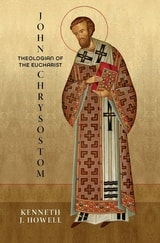
John Chrysostom, Theologian of the Eucharist
Kenneth J. Howell
Catholic University of America Press, 2024
Despite the fact that John Chrysostom wrote more on the Eucharist than any other Greek Church Father, there has never been a full treatment of his doctrine in English. In this book, Kenneth Howell brings together a wide array of sources from which he develops a many-sided portrait of Chrysostom’s eucharistic thought. While the Antiochene preacher assumed the real presence and the sacrificial nature of the Eucharist, he focused more on the moral and spiritual implications of communion. At the root of his theology lies the conviction that the Eucharist with its home in the liturgy is the extension of Christ’s incarnate life through space and time. All
that Christ accomplished in his life, death, and resurrection is present and available to the communing Christian who stands in union with the angelic hosts in the liturgy of the church. John’s preaching at times reaches encomiastic proportions as he never tires of praising the benefits and power of the Eucharist and he deftly applies the sacrament to the struggle of virtue and vice as he explores both the invitation and the obstacles to communion. Among the moral implications of the Eucharist, John seems to distinguish well between sins arising from human weakness versus malicious dispositions freely chosen. He is especially keen to exhort his hearers to lay aside
the remembrance of evil (mnesikakia) done to them in their past lives. Humility and forbearance are two essential virtues in arriving at forgiveness of past injuries. And lack of forgiveness is like greed in that both constitute a turn in on oneself. The Eucharist demands love of neighbor and active ministry to the less fortunate of the world. For John, God is interested in golden souls more than golden chalices.
[more]
On the Body and Blood of the Lord; On the Truth of the Body and Blood of Christ in the Eucharist
Catholic University of America Press, 2009
In this first English translation of Lanfranc's De corpore et sanguine Domini adversus Berengarium, the reader learns firsthand both the history of the crisis and the doctrinal issues in question
[more]
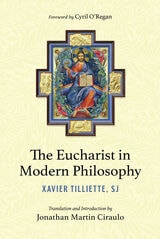
The Eucharist in Modern Philosophy
Xavier Tilliette
Catholic University of America Press, 2022
The Eucharist in Modern Philosophy is one of the last books written by the renowned Jesuit philosopher Xavier Tilliette (1921-2018), and the first to be translated into English. Jonathan Martin Ciraulo, the translator, also provides an introduction to the thought of Tilliette and the content of this book, while Cyril O’Regan provides the foreword, noting the particular intellectual characteristics of Tilliette and his analysis of eucharistic philosophies.
In addition to being known as one of the foremost experts on the German Idealist Friedrich Schelling, Tilliette wrote voluminously on the relationship between modern philosophy and theology, particularly concerning the way in which Christology is central to the development of modern philosophy. In this volume, he extends that project to look at how various philosophers, such as Descartes, Leibniz, Hegel, Blondel, and Marion, as well as poets and mystics, such as de Chardin, Simone Weil, and Paul Claudel, thought extensively about the question of the Eucharist. The result is an enormous diversity of Eucharistic thought, from Descartes’ attempt to justify transubstantiation in light of his philosophical revolution, to Feuerbach’s supposed exposure of the contradiction inherent to sacramentality, to Antonio Rosmini’s eucharistic piety and speculation, to Maurice Blondel’s recovery and expansion of Leibniz’s notion of the substantial bond. Tilliette shows that this philosophical conversation about the Eucharist is a living tradition, as the aporias and failures of one generation provide stimulus for all that follows. Much of the work is largely historical, showing in great detail the context of each particular eucharistic philosophy, but Tilliette also evaluates the relative fruitfulness of the various eucharistic theories for philosophy, theology, and the life of the Church. This book demonstrates that the Eucharist has been, and will likely continue to be, a major impetus for philosophical reflection.
[more]
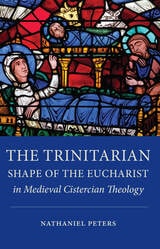
The Trinitarian Shape of the Eucharist in Medieval Cistercian Theology
Nathaniel Peters
Catholic University of America Press, 2026
William of Saint-Thierry, Isaac of Stella, and Baldwin of Forde created a distinctly Cistercian body of Eucharistic theology in the twelfth century. In this book, Nathaniel Peters offers a scholarly account of that theology and examines the connection between medieval Trinitarian and Eucharistic theology.
These Cistercian authors thought that the character of God as a Trinity of persons united in essence provides the structure of the economy of salvation—especially its turning point, the Eucharist. They saw the Eucharist as the place where the ontological union of the Incarnation becomes intimate, personal, and communal. In the Eucharist, God the Father draws those who receive to himself by uniting them to the body and blood of the Son. This unity brings an increase of unity with the Holy Spirit. Once united to the Son and Spirit, the faithful are united to the Father. The Eucharist also connects the meditation, sacrifices, and offering of their own lives to the life of Christ, with which they are offered to the Father.
Chapter 1 examines the thought of William of Saint-Thierry, who has the most developed understanding of Eucharistic presence, conversion, and reception. It also treats the connections William draws between Eucharistic reception and meditation on scripture and the passion of Christ. Chapter 2 treats Isaac of Stella, who uses more intellectualist imagery and imagery of the mystical body of Christ. Chapter 3 studies Baldwin of Forde, who argues that the term transubstantiation best describes Eucharistic conversion and emphasizes reception by faith in the truth about Christ. Chapter 5 offers a brief conclusion, with reference to later thinkers who explore the Trinitarian shape of the Eucharist in similar ways.
[more]
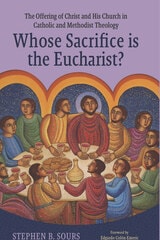
Whose Sacrifice is the Eucharist? The Offering of Christ and His Church in Catholic and Methodist Theology
Stephen B. Sours
Catholic University of America Press, 2024
This book explores what Catholics and Methodists believe about eucharistic sacrifice. Eucharistic sacrifice refers to the offering that Christ and his church make in the celebration of the Lord’s Supper. It is, therefore, both a Christian doctrine and a church practice. The sacrificial dimension of the sacrament comes both from Christ’s sacrifice on the cross and from his self-offering at the Last Supper in which Christ gives himself to the Father on behalf of his people. “This is my body, which is given for you” (Luke 22:19). The eucharist is a sacrificial meal because in the bread and cup Christians are united to the body and blood of Christ that was sacrificed for them on the cross. Moreover, the resurrected Lord is really present with his people in the eucharist, and while his historic crucifixion is an event in the past, Jesus’ salvation continues and his grace is given to his people in the sacrament, “for this is my blood of the covenant, which is poured out for many for the forgiveness of sins” (Matthew 26:28). Catholics and Methodists believe that Jesus instructs his followers to repeat his words and actions from the Last Supper in their celebration of the eucharist, but a long running assumption is that Catholics and Methodists—following the historic Reformation schism—are deeply divided over eucharistic sacrifice. This book challenges that assumption by analyzing what these churches teach on eucharistic sacrifice from historical, sacramental, liturgical, and ecumenical perspectives. Key figures like Thomas Aquinas and John Wesley help define eucharistic sacrifice in each tradition. Subsequently, authoritative texts such as ecclesial statements, eucharistic prayers, and hymns further specify what Catholics and Methodists believe they are doing when they offer the eucharist to God. Sours argues that far from being divided, Catholics and Methodists have much in common regarding this controversial doctrine.
[more]