Results by title
4 books match the query 'Eurasia'
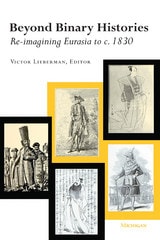
Beyond Binary Histories
Re-imagining Eurasia to c. 1830Victor Lieberman, Editor
University of Michigan Press, 1999
The collaborators of this project show, in varying degrees, that political centralization in these areas reflected and inspired the creation of vernacular literatures at the expense of more universal languages. They illustrate that societies in widely separated areas, with no obvious links, became more literate, mobile, specialized, and commercial at roughly the same time. And they point out that administrative development in many of these same areas showed curiously synchronized cycles. Finally, having defined Eurasian parallels and sketched their limits, they push on to explore the underlying dynamics of these discoveries, scrutinizing the role of guns, global climate, markets, new information networks, institutional pressures, and sixteenth-century messianism.
Insofar as similarities between some European and Asian areas exceeded those between different sectors of Asia, this collection invites historians to reject continental perspectives in favor of more thematic, contextually-specific categories. But at the same time, it raises the possibility of a broad "early modern" period for Eurasia at large.
The contributors are Mary Elizabeth Berry (University of California, Berkeley), Peter Carey (University of Oxford), James B. Collins (Georgetown University), Valerie Kivelson (University of Michigan), R. I. Moore (University of Newcastle upon Tyne), Sanjay Subrahmanyam (Ecole des Hautes Etudes en Sciences Sociales, Paris), John K. Whitemore (University of Michigan), and David K. Wyatt (Cornell University).

Bribes, People, and Politics
How Everyday Corruption Shapes Governance in EurasiaWilliam M. Reisinger & Marina Zaloznaya
University of Michigan Press, 2027
Everyday bureaucratic corruption is not the domain of oligarchs or powerful elites, but of informal exchanges between bureaucrats and ordinary citizens seeking to move paperwork, secure benefits, or avoid penalties. Despite extensive research on the economic, legal, and social consequences of corruption, this mundane form has rarely been treated as a political phenomenon.
Drawing on original, nationally representative surveys conducted in Russia, Ukraine, Georgia, and China, Bribes, People, and Politics analyzes how citizens’ encounters with corrupt bureaucratic practices influence popular political trust, perceptions of elite corruption, legal attitudes, voting behavior, and political activism. After each interaction with public bureaucracy, citizens subtly revise their views about what role people like themselves play within the political system. As a result, corrupt bureaucratic encounters can significantly shape popular attitudes and behavior toward the political order. By linking the microdynamics of bureaucratic encounters to macro-level questions of political legitimacy and regime durability, this book bridges the literature on corruption, political sociology, and comparative politics, offering a new framework for understanding the persistent phenomenon of public sector corruption in Eurasia.
Intellectuals and the Articulation of the Nation
Ronald Grigor Suny and Michael D. Kennedy, Editors
University of Michigan Press, 1999
What kinds of intellectual practices are influential in the making and remaking of nations? How do literary texts shape nation-making? When are intellectuals most and least relevant to developing the nation? How do liberal, socialist, and nationalist intellectuals shape national ideologies? One of the principal debates in the study of nations concerns the relative significance of elites, specifically intellectuals, in inventing the nation. Intellectuals and the Articulation of the Nation delimits the capacities of intellectuals for shaping nations, as well as the ways in which the development of nations shapes intellectual practices. The introductory chapter presents the principal debates around nation-making and the identity and practices of intellectuals. Contributors from anthropology, history, literature, political science and sociology then explore the capacities and limits of intellectuals in the formation and restructuring of national identities in general, and in Eastern Europe and the former Soviet Union in particular. Each essay is followed by a brief intellectual autobiography in which the author's own relationship to nations is explored. The editors conclude the volume by developing a general theory of national intellectual practice. The principal focus of this book—the mutual articulation of intellectuals and nations—is a key subject for students and scholars of history, cultural studies, political science, anthropology, and sociology.
Learning to Unlearn
Decolonial Reflections from Eurasia and the AmericasMadina V. Tlostanova and Walter D. Mignolo
The Ohio State University Press, 2012
Learning to Unlearn: Decolonial Reflections from Eurasia and the Americas is a complex, multisided rethinking of the epistemic matrix of Western modernity and coloniality from the position of border epistemology. Colonial and imperial differences are the two key concepts to understanding how the logic of coloniality creates ontological and epistemic exteriorities. Being at once an enactment of decolonial thinking and an attempt to define its main grounds, mechanisms, and concepts, the book shifts the politics of knowledge from “studying the other” (culture, society, economy, politics) toward “the thinking other” (the authors).
Addressing areas as diverse as the philosophy of higher education, gender, citizenship, human rights, and indigenous agency, and providing fascinating and little-known examples of decolonial thinking, education, and art, Madina V. Tlostanova and Walter D. Mignolo deconstruct the modern architecture of knowledge—its production and distribution as manifested in the corporate university. In addition, the authors dwell on and define the echoing global decolonial sensibilities as expressed in the Americas and in peripheral Eurasia. The book is an important addition to the emerging transoceanic inquiries that introduce decolonial thought and non-Western border epistemologies not only to update or transform disciplines but also to act and think decolonially in the global futures to come.