Results by title
3 books match the query 'Euro'
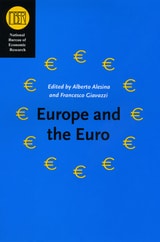
Europe and the Euro
Edited by Alberto Alesina and Francesco Giavazzi
University of Chicago Press, 2010
It is rare for countries to give up their currencies and thus their ability to influence such critical aspects of their economies as interest and exchange rates. Yet ten years ago a number of European countries did exactly that when they adopted the euro. Despite some dissent, there were a number of arguments in favor of this policy change: it would facilitate exchange of goods, money, and people by decreasing costs; it would increase trade; and it would enhance efficiency and competitiveness at the international level.
A decade is an ideal time frame over which to evaluate the success of the euro and whether it has lived up to expectations. To that aim, Europe and the Euro looks at a number of important issues, including the effects of the euro on reform of goods and labor markets; its influence on business cycles and trade among members; and whether the single currency has induced convergence or divergence in the economic performance of member countries. While adoption of the euro may not have met the expectations of its most optimistic proponents, the benefits have been many, and there is reason to believe that the euro is robust enough to survive recent economic shocks. This volume is an essential reference on the first ten years of the euro and the workings of a monetary union.
[more]
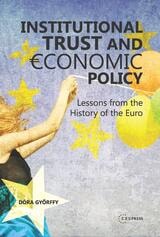
Institutional trust and economic policy Lessons from the history of the Euro
Lessons from the history of the EuroDóra Gyorffy
Central European University Press, 2013
The book seeks to link theoretical debates on the relevance of trust in economic outcomes with the current arguments about the origins and lessons of the subprime crisis. By what mechanisms does trust influence economic outcomes? Under what conditions do these mechanisms prevail? How do debates about trust help our understanding of the subprime crisis in the European Union? By integrating insights from Post-Keynesian, Austrian and new institutional economics, the central proposition of the analysis is that the presence or absence of institutional trust creates virtuous and vicious cycles in law-abiding, which critically influence the possibility for economic agents to have realistic long-term plans.
[more]
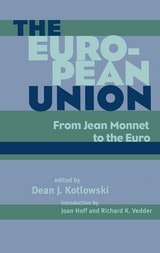
The European Union
From Jean Monnet to the EuroDean Kotlowski
Ohio University Press, 2000
The transformation of Europe since the end of World War II has been astounding. In 1945, a battle–scarred continent lay in ruins. Today, it has achieved a level of integration, prosperity, and stability that few people could have anticipated. The life and career of the French statesman Jean Monnet and the recent adoption of the “euro” as Europe's common currency represent the bookends of this half–century–long metamorphosis.
This collection of essays, drawn from the lectures of the 1999 Baker Conference at Ohio University, explores Monnet's vision of an integrated Europe, its gradual implementation, and the social, economic, and international consequences. The scholarship focuses upon Monnet's life, personality, and legacy, the development of social policy within the European Union (EU), the economic and national security implications of the EU, and the continuation of an American presence in Europe through the North Atlantic Treaty Organization.
This significant collection fuses biography with comparative political economy and policy studies to help political scientists, sociologists, economists, international lawyers, and historians on both sides of the Atlantic understand important aspects of Europe's post–1945 development.
[more]