Results by title

8 books match the query 'Eurocentrism'
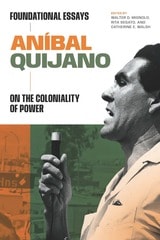
cover of Aníbal Quijano: Foundational Essays on the Coloniality of Power

Aníbal Quijano

Foundational Essays on the Coloniality of Power

Anibal Quijano. Edited by Walter D. Mignolo, Rita Segato, and Catherine E. Walsh

Duke University Press, 2024
The Peruvian sociologist Aníbal Quijano is widely considered to be a foundational figure of the decolonial perspective grounded in three basic concepts: coloniality, coloniality of power, and the colonial matrix of power. His decolonial theorizations of these three concepts have transformed the principles and assumptions of the very idea of knowledge, impacted the social sciences and humanities, and questioned the myth of rationality in natural sciences. The essays in this volume encompass nearly thirty years of Quijano’s work, bringing them to an English-reading audience for the first time. This volume is not simply an introduction to Quijano’s work; it achieves one of his unfulfilled goals: to write a book that contains his main hypotheses, concepts, and arguments. In this regard, the collection encourages a fuller understanding and broader implementation of the analyses and concepts that he developed over the course of his long career. Moreover, it demonstrates that the tools for reading and dismantling coloniality originated outside the academy in Latin America and the former Third World.
[more]
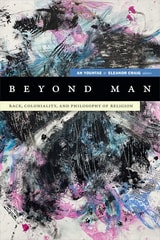
cover of Beyond Man: Race, Coloniality, and Philosophy of Religion

Beyond Man

Race, Coloniality, and Philosophy of Religion

Yountae An and Eleanor Craig, editors

Duke University Press, 2021

Beyond Man reimagines the meaning and potential of a philosophy of religion that better attends to the inextricable links among religion, racism, and colonialism. An Yountae, Eleanor Craig, and the contributors reckon with the colonial and racial implications of the field's history by staging a conversation with Black, Indigenous, and decolonial studies. In their introduction, An and Craig point out that European-descended Christianity has historically defined itself by its relation to the other while paradoxically claiming to represent and speak to humanity in its totality. The topics include secularism, the Eucharist's relation to Blackness, and sixteenth-century Brazilian cannibalism rituals as well as an analysis of how Mircea Eliade's conception of the sacred underwrites settler colonial projects and imaginaries. Throughout, the contributors also highlight the theorizing of Afro-Caribbean thinkers such as Sylvia Wynter, C. L. R. James, Frantz Fanon, and Aimé Césaire whose work disrupts the normative Western categories of religion and philosophy.

Contributors. An Yountae, Ellen Armour, J. Kameron Carter, Eleanor Craig, Amy Hollywood, Vincent Lloyd, Filipe Maia, Mayra Rivera, Devin Singh, Joseph R. Winters
[more]
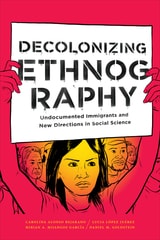
cover of Decolonizing Ethnography: Undocumented Immigrants and New Directions in Social Science

Decolonizing Ethnography

Undocumented Immigrants and New Directions in Social Science

Carolina Alonso-Bejarano, Lucia López Juárez, Mirian A. Mijangos García, and Daniel M. Goldstein

Duke University Press, 2019
In August 2011, ethnographers Carolina Alonso Bejarano and Daniel M. Goldstein began a research project on undocumented immigration in the United States by volunteering at a center for migrant workers in New Jersey. Two years later, Lucia López Juárez and Mirian A. Mijangos García—two local immigrant workers from Latin America—joined Alonso Bejarano and Goldstein as research assistants and quickly became equal partners for whom ethnographic practice was inseparable from activism. In Decolonizing Ethnography the four coauthors offer a methodological and theoretical reassessment of social science research, showing how it can function as a vehicle for activism and as a tool for marginalized people to theorize their lives. Tacking between personal narratives, ethnographic field notes, an original bilingual play about workers' rights, and examinations of anthropology as a discipline, the coauthors show how the participation of Mijangos García and López Juárez transformed the project's activist and academic dimensions. In so doing, they offer a guide for those wishing to expand the potential of ethnography to serve as a means for social transformation and decolonization.
[more]
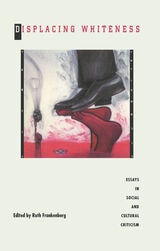
cover of Displacing Whiteness: Essays in Social and Cultural Criticism

Displacing Whiteness

Essays in Social and Cultural Criticism

Ruth Frankenberg, ed.

Duke University Press, 1997

Displacing Whiteness makes a unique contribution to the study of race dominance. Its theoretical innovations in the analysis of whiteness are integrated with careful, substantive explorations of whiteness on an international, multiracial, cross-class, and gendered terrain. Contributors localize whiteness, as well as explore its sociological, anthropological, literary, and political dimensions.
Approaching whiteness as a plural rather than singular concept, the essays describe, for instance, African American, Chicana/o, European American, and British experiences of whiteness. The contributors offer critical readings of theory, literature, film and popular culture; ethnographic analyses; explorations of identity formation; and examinations of racism and political process. Essays examine the alarming epidemic of angry white men on both sides of the Atlantic; far-right electoral politics in the UK; underclass white people in Detroit; whiteness in "brownface" in the film Gandhi; the engendering of whiteness in Chicana/o movement discourses; "whiteface" literature; Roland Barthes as a critic of white consciousness; whiteness in the black imagination; the inclusion and exclusion of suburban "brown-skinned white girls"; and the slippery relationships between culture, race, and nation in the history of whiteness. Displacing Whiteness breaks new ground by specifying how whiteness is lived, engaged, appropriated, and theorized in a range of geographical locations and historical moments, representing a necessary advance in analytical thinking surrounding the burgeoning study of race and culture.

Contributors. Rebecca Aanerud, Angie Chabram-Dernersesian, Phil Cohen, Ruth Frankenberg, John Hartigan Jr., bell hooks, T. Muraleedharan, Chéla Sandoval, France Winddance Twine, Vron Ware, David Wellman
[more]
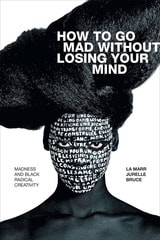
cover of How to Go Mad without Losing Your Mind: Madness and Black Radical Creativity

How to Go Mad without Losing Your Mind

Madness and Black Radical Creativity

La Marr Jurelle Bruce

Duke University Press, 2020
“Hold tight. The way to go mad without losing your mind is sometimes unruly.” So begins La Marr Jurelle Bruce's urgent provocation and poignant meditation on madness in black radical art. Bruce theorizes four overlapping meanings of madness: the lived experience of an unruly mind, the psychiatric category of serious mental illness, the emotional state also known as “rage,” and any drastic deviation from psychosocial norms. With care and verve, he explores the mad in the literature of Amiri Baraka, Gayl Jones, and Ntozake Shange; in the jazz repertoires of Buddy Bolden, Sun Ra, and Charles Mingus; in the comedic performances of Richard Pryor and Dave Chappelle; in the protest music of Nina Simone, Lauryn Hill, and Kendrick Lamar, and beyond. These artists activate madness as content, form, aesthetic, strategy, philosophy, and energy in an enduring black radical tradition. Joining this tradition, Bruce mobilizes a set of interpretive practices, affective dispositions, political principles, and existential orientations that he calls “mad methodology.” Ultimately, How to Go Mad without Losing Your Mind is both a study and an act of critical, ethical, radical madness.
[more]
cover of More Than Black: Multiracial Identity & New Racial Order

More Than Black

Multiracial Identity & New Racial Order

G. Reginald Daniel

Temple University Press, 2001

In the United States, anyone with even a trace of African American ancestry has been considered black. Even as the twenty-first century opens, a racial hierarchy still prevents people of color, including individuals of mixed race, from enjoying the same privileges as Euro-Americans. In this book, G. Reginald Daniel argues that we are at a cross-roads, with members of a new multiracial movement pointing the way toward equality.

Tracing the centuries-long evolution of Eurocentrism, a concept geared to protecting white racial purity and social privilege, Daniel shows how race has been constructed and regulated in the United States. The so-called one-drop rule (i.e., hypodescent) obligated individuals to identify as black or white, in effect erasing mixed-race individuals from the social landscape. For most of our history, many mixed-race individuals of African American descent have attempted to acquire the socioeconomic benefits of being white by forming separate enclaves or "passing." By the 1990s, however, interracial marriages became increasingly common, and multiracial individuals became increasingly political, demanding institutional changes that would recognize the reality of multiple racial backgrounds and challenging white racial privilege.

More Than Black? regards the crumbling of the old racial order as an opportunity for substantially more than an improvement in U.S. race relations; it offers no less than a radical transformation of the nation's racial consciousness and the practice of democracy.

[more]
cover of The Difference Aesthetics Makes: On the Humanities “After Man”

The Difference Aesthetics Makes

On the Humanities “After Man”

Kandice Chuh

Duke University Press, 2019
In The Difference Aesthetics Makes cultural critic Kandice Chuh asks what the humanities might be and do if organized around what she calls “illiberal humanism” instead of around the Western European tradition of liberal humanism that undergirds the humanities in their received form. Recognizing that the liberal humanities contribute to the reproduction of the subjugation that accompanies liberalism's definition of the human, Chuh argues that instead of defending the humanities, as has been widely called for in recent years, we should radically remake them. Chuh proposes that the work of artists and writers like Lan Samantha Chang, Carrie Mae Weems, Langston Hughes, Leslie Marmon Silko, Allan deSouza, Monique Truong, and others brings to bear ways of being and knowing that delegitimize liberal humanism in favor of more robust, capacious, and worldly senses of the human and the humanities. Chuh presents the aesthetics of illiberal humanism as vital to the creation of sensibilities and worlds capable of making life and lives flourish.
[more]
cover of ¡Presente!: The Politics of Presence

¡Presente!

The Politics of Presence

Diana Taylor

Duke University Press, 2020

In ¡Presente! Diana Taylor asks what it means to be physically and politically present in situations where it seems that nothing can be done. As much an act, a word, an attitude, a theoretical intervention, and a performance pedagogy, Taylor maps ¡presente! at work in scenarios ranging from conquest, through colonial enactments and resistance movements, to present moments of capitalist extractivism and forced migration in the Americas. ¡Presente!—present among, with, and to; a walking and talking with others; an ontological and epistemic reflection on presence and subjectivity as participatory and relational, founded on mutual recognition—requires rethinking and unlearning in ways that challenge colonial epistemologies. Showing how knowledge is not something to be harvested but a process of being, knowing, and acting with others, Taylor models a way for scholarship to be present in political struggles.
[more]