Results by title
4 books match the query 'Europe, Southern'
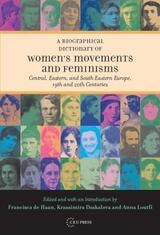
A Biographical Dictionary of Women's Movements and Feminisms
Central, Eastern, and South Eastern Europe, 19th and 20th CenturiesAnna Loutfi
Central European University Press, 2006
This Biographical Dictionary describes the lives, works and aspirations of more than 150 women and men who were active in, or part of, women’s movements and feminisms in Central, Eastern and South Eastern Europe. Thus, it challenges the widely held belief that there was no historical feminism in this part of Europe. These innovative and often moving biographical portraits not only show that feminists existed here, but also that they were widespread and diverse, and included Romanian princesses, Serbian philosophers and peasants, Latvian and Slovakian novelists, Albanian teachers, Hungarian Christian social workers and activists of the Catholic women’s movement, Austrian factory workers, Bulgarian feminist scientists and socialist feminists, Russian radicals, philanthropists, militant suffragists and Bolshevik activists, prominent writers and philosophers of the Ottoman era, as well as Turkish republican leftist political activists and nationalists, internationally recognized Greek feminist leaders, Estonian pharmacologists and science historians, Slovenian ‘literary feminists,’ Czech avant-garde painters, Ukrainian feminist scholars, Polish and Czech Senate Members, and many more. Their stories together constitute a rich tapestry of feminist activity and redress a serious imbalance in the historiography of women’s movements and feminisms.
[more]
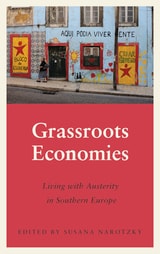
Grassroots Economies
Living with Austerity in Southern EuropeSusana Narotzky
Pluto Press, 2020
The austerity crisis has radically altered the economic landscape of Southern Europe. But alongside the decimation of public services and infrastructure lies the wreckage of a generation's visions for the future. In Greece, Italy, Spain and Portugal, there is a new, difficult reality of downward mobility.
Grassroots Economies interrogates the effects of the economic crisis on the livelihood of working people, providing insight into their anxieties. Drawing on a rich seam of ethnographic material, it is a distinctive comparative analysis that explores the contradictions of their coping mechanisms and support structures.
With a focus on gender, the book explores values and ideologies, including dispossession and accumulation. Ultimately it demonstrates that everyday interactions on the local scale provide a significant sense of the global.
[more]

One Day for Democracy
Independence Day and the Americanization of Iron Range ImmigrantsMary Lou Nemanic
Ohio University Press, 2007
Just before the turn of the twentieth century, immigrants from eastern and southern Europe who had settled in mining regions of Minnesota formed a subculture that combined elements of Old World traditions and American culture. Their unique pluralistic version of Americanism was expressed in Fourth of July celebrations rooted in European carnival traditions that included rough games, cross-dressing, and rowdiness.In One Day for Democracy, Mary Lou Nemanic traces the festive history of Independence Day from 1776 to the twentieth century. The author shows howthese diverse immigrant groups on the Minnesota Iron Range created their own version of the celebration, the Iron Range Fourth of July.As mass-mediated popular culture emerged in the twentieth century, Fourth of July celebrations in the Iron Range began to include such popular cultureelements as beauty queens and marching bands. Nemanic documents the enormous influence of these changes on this isolated region and highlights the complex interplay between popular culture and identity construction.But this is not a typical story of assimilation or ethnic separation. Instead, One Day for Democracy reveals how more than thirty different ethnic groupswho shared identities as both workers and new Americans came together in a remote mining region to create their own subculture.
[more]

The Dawn of Belief
Religion in the Upper Paleolithic of Southwestern EuropeD. Bruce Dickson
University of Arizona Press, 1990
Hunter-gatherers of the Upper Paleolithic period of the late Pleistocene epoch in western Europe left a legacy of cave paintings and material remains that have long fascinated modern man. This book draws on theories derived from cultural anthropology and cognitive archaeology to propose a reconstruction of the religious life of those people based on the patterning and provenience of their artifacts.
Based on the premises that all members of Homo sapiens sapiens share basically similar psychological processes and capabilities and that human culture is patterned, the author uses ethnographic analogy, inference from material patterns, and formal analysis to find in prehistoric imagery clues to the cosmology that lay behind them. The resulting book is an intriguing speculation on the nature of paleolithic religion, offering scholars a valuable synthesis of anthropological, archaeological, and sociological research, and general readers an accessible account of how our forebears may have regarded the unknown.
Based on the premises that all members of Homo sapiens sapiens share basically similar psychological processes and capabilities and that human culture is patterned, the author uses ethnographic analogy, inference from material patterns, and formal analysis to find in prehistoric imagery clues to the cosmology that lay behind them. The resulting book is an intriguing speculation on the nature of paleolithic religion, offering scholars a valuable synthesis of anthropological, archaeological, and sociological research, and general readers an accessible account of how our forebears may have regarded the unknown.
[more]