Results by title
2 books match the query 'European Integration'
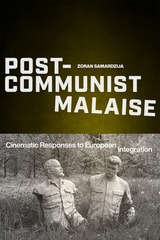
Post-Communist Malaise
Cinematic Responses to European IntegrationZoran Samardzija
Rutgers University Press, 2020
The collapse of communism in the Soviet Union and Eastern Europe was supposed to bring about the “end of history” with capitalism and liberal democracy achieving decisive victories. Europe would now integrate and reconcile with its past. However, the aftershocks of the financial crisis of 2008—the rise in right-wing populism, austerity politics, and mass migration—have shown that the ideological divisions which haunted Europe in the twentieth century still remain. It is within this context that Post-Communist Malaise revives discourses of political modernism and revisits debates from Marxism and seventies film theory. Analyzing work of Theo Angelopoulos, Věra Chytilová, Srdjan Dragojević, Jean-Luc Godard, Miklós Jancsó, Emir Kusturica, Dušan Makavejev, Cristi Puiu, Jan Švankmajer, Andrei Tarkovsky, and Béla Tarr, the book focuses on how select cinemas from Eastern Europe and the Balkans critique the neoliberal integration of Europe whose failures fuel the rise of nationalism and right-wing politics. By politicizing art cinema from the regions, Post-Communist Malaise asks fundamental questions about film, aesthetics, and ideology. It argues for the utopian potential of the materiality of cinematic time to imagine a new political and cultural organization for Europe.
[more]
The Dynamics of European Integration
Causes and Consequences of Institutional ChoicesThomas König
University of Michigan Press, 2024
In Europe’s recent history, there have been several challenges to the strength of the European Union—Brexit, COVID, financial crises, and global tensions—bringing an increased need to understand the ways that the European Union (EU) could successfully stay together or fall apart. In examining how the European Union has changed since 1993, important puzzles have emerged, including how national government functions are transferred to the EU without reforming the EU, how increased transparency is announced while decisions are approved in informal meetings, and how the effects of the polarizing rise of Euroscepticism can be managed to still promote the formation of solidarity and trust among Europeans. To understand these puzzles, Thomas König introduces a new theory of (supra)national partyism to help explain the causes and consequences of choices made by political leaders for Europe. He uses a game-theoretical perspective to look at how conditions for leaders change through accessions of new members, shocks, and crises, and separates institutional choices into two different games played by office- and policy-seeking political leaders—the interstate summit game and the national game of party competition. The Dynamics of European Integration reveals how the reorganization of electoral systems can harness dissensus and polarization among diverse national constituencies to enable the promotion of solidarity and trust in the EU.
[more]