Results by title
3 books match the query 'European Perspective'

Debating Women's Equality
Toward a Feminist Theory of Law from a European PerspectiveGerhard, Ute
Rutgers University Press, 2001
Ute Gerhard places women's rights at the center of legal philosophy and sees the struggle for equality as a driving force in the history of law. Focusing on Europe and taking the course of German feminism and law as primary examples, she incorporates the various social contexts in which questions of equality and gender difference have been raised into an analysis that challenges misconceptions about the principle of equality itself.
Gerhard reviews the history of women's movements in the nineteenth and twentieth centuries and traces the historical development of claims to gender equality as well as obstacles to these claims. Critically exploring the influence of philosophers such as Rousseau, Fichte, and Kant, Gerhard concludes that women need to be recognized as both equal and different-that claims to equality do not simply eliminate difference, but also articulate it. Mindful of the social and political contexts surrounding equality arguments, Gerhard probes three legal issues: women's rights in the public sphere, especially the right to vote; women's legal capacities in private law, or the legal doctrine of so-called gender tutelage; and women's human rights, a prominent concern in the current international women's movement.
Show & The Gaze Of Theatre
A European PerspectiveErika Fischer-Lichte
University of Iowa Press, 1997
Theatre, in some respects, resembles a market. Stories, rituals, ideas, perceptive modes, conversations, rules, techniques, behavior patterns, actions, language, and objects constantly circulate back and forth between theatre and the other cultural institutions that make up everyday life in the twentieth century. These exchanges, which challenge the established concept of theatre in a way that demands to be understood, form the core of Erika Fischer-Lichte's dynamic book.
Each eclectic essay investigates the boundaries that separate theatre from other cultural domains. Every encounter between theatre and other art forms and institutions renegotiates and redefines these boundaries as part of an ongoing process. Drawing on a wealth of fascinating examples, both historical and contemporary, Fischer-Lichte reveals new perspectives in theatre research from quite a number of different approaches. Energetically and excitingly, she theorizes history, theorizes and historicizes performance analysis, and historicizes theory.
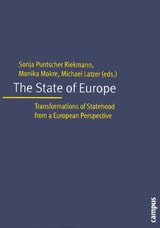
The State of Europe
Transformation of Statehood from a European PerspectiveEdited by Sonja Puntscher Riekmann, Monika Mokre, and Michael Latzer
Campus Verlag, 2004