Results by title
7 books match the query 'European fiction'
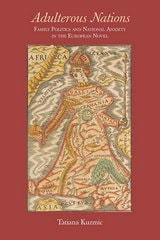
Adulterous Nations
Family Politics and National Anxiety in the European NovelTatiana Kuzmic
Northwestern University Press, 2016
In Adulterous Nations, Tatiana Kuzmic enlarges our perspective on the nineteenth-century novel of adultery, showing how it often served as a metaphor for relationships between the imperialistic and the colonized. In the context of the long-standing practice of gendering nations as female, the novels under discussion here—George Eliot’s Middlemarch, Theodor Fontane’s Effi Briest, and Leo Tolstoy’s Anna Karenina, along with August Šenoa’s The Goldsmith’s Gold and Henryk Sienkiewicz’s Quo Vadis—can be understood as depicting international crises on the scale of the nuclear family. In each example, an outsider figure is responsible for the disruption experienced by the family. Kuzmic deftly argues that the hopes, anxieties, and interests of European nations during this period can be discerned in the destabilizing force of adultery. Reading the work of Šenoa and Sienkiewicz, from Croatia and Poland, respectively, Kuzmic illuminates the relationship between the literature of dominant nations and that of the semicolonized territories that posed a threat to them. Ultimately, Kuzmic’s study enhances our understanding of not only these five novels but nineteenth-century European literature more generally.
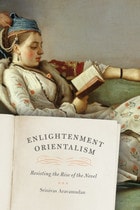
Enlightenment Orientalism
Resisting the Rise of the NovelSrinivas Aravamudan
University of Chicago Press, 2011
Srinivas Aravamudan here reveals how Oriental tales, pseudo-ethnographies, sexual fantasies, and political satires took Europe by storm during the eighteenth century. Naming this body of fiction Enlightenment Orientalism, he poses a range of urgent questions that uncovers the interdependence of Oriental tales and domestic fiction, thereby challenging standard scholarly narratives about the rise of the novel.
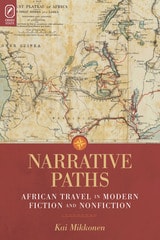
Narrative Paths
African Travel in Modern Fiction and NonfictionKai Mikkonen
The Ohio State University Press, 2015
Narrative Paths contributes to debates in narratology and rhetorical narrative theory about the fiction–nonfiction distinction. With chapters on a wide range of modernist authors—from Pierre Loti, André Gide, Michel Leiris, and Georges Simenon to Blaise Cendrars, Louis-Ferdinand Céline, Joseph Conrad, Graham Greene, Evelyn Waugh, and Isak Dinesen (Karen Blixen)—Mikkonen’s study also contributes to postcolonial approaches to these authors, examining issues of representation, narrative voice, and authority in narratives about colonial Africa.
Proust, Mann, Joyce in the Modernist Context, Second Edition
Gerald Gillespie
Catholic University of America Press, 2010
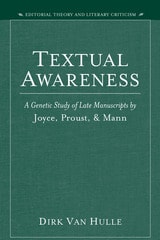
Textual Awareness
A Genetic Study of Late Manuscripts by Joyce, Proust, and MannDirk Van Hulle
University of Michigan Press, 2004
A key issue in both textual criticism and the so-called crisis of the novel is the tension between the finished and the unfinished. After a theoretical examination of the relationship between genetic and textual criticism, Dirk Van Hulle uses the three case studies to show how?at each stage in the writing process?the text still had the potential of becoming something entirely different; how and why these geneses proceeded the way they did; how Joyce, Proust, and Mann allowed contingencies to shape their work; how these authors recycled the words of their critics in order to inoculate their works against them; how they shaped an intertextual dimension through the processing of source texts and reading notes; and how text continually generated more text.
Van Hulle's exploration of process sheds new light on the remarkable fact that so many modernist authors protected their manuscripts, implying both the authors' urge to grasp everything and their awareness of the dangers of their encyclopedic projects. Textual Awareness offers new insights into the artificiality of the artifact?the novel?that are relevant to the study of literary modernism in general and the study of James Joyce, Marcel Proust, and Thomas Mann in particular.
Dirk Van Hulle is Assistant Professor of English and German Literature, University of Antwerp.
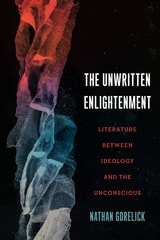
The Unwritten Enlightenment
Literature between Ideology and the UnconsciousNathan Gorelick
Northwestern University Press, 2024
Nathan Gorelick’s The Unwritten Enlightenment: Literature between Ideology and the Unconscious traces the relations between literary criticism and psychoanalysis to their shared origins in the Enlightenment era’s novels and novelistic discourse, where the period’s efforts to invent new notions of subjectivity and individualism are most apparent. Gorelick shows how modern concepts of literature and the unconscious were generated in response to these efforts and by an ethical concern for what the language of the Enlightenment excludes, represses, or struggles to erase. Troubling the idea of the Enlightenment on its own terms, subverting its supposed authority from within, Gorelick thus reveals the workings of unconscious fantasy at the foundations of our contemporary political realities. The Unwritten Enlightenment makes clear that to criticize the Enlightenment’s deficiencies, ambiguities, and legacies of violence without regard for the unconscious fantasies that drive them risks reproducing the very patterns of thought, action, and imagination that the Enlightenment novel already unsettles.
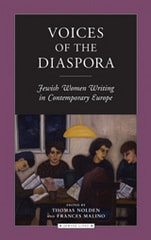
Voices of the Diaspora
Jewish Women Writing in Contemporary EuropeThomas Nolden
Northwestern University Press, 2005
At the same time, these writers address themes specific to their national contexts. Berlin-born Barbara Honigmann questions the possibility of Jewish life in the country responsible for the "final solution." Maghreb-born Marlène Amar and Reina Roffé address the experiences of displacement and emancipation as Sephardic women in Western, post-colonial societies. Clara Sereni describes how Jews in post-Fascist Italy reemerged with a self-assertiveness that troubled a society that had found comfort in amnesia. Ludmila Ulitskaya portrays a Jewish girlhood on the eve of Stalin's death empowered by the religious traditions of Jewish resistance.
From the unique perspective of women's literary voices, this volume reveals to English-speaking readers the extraordinary vivacity and diversity of European Jewry, and introduces them to a new generation of women writers.