Results by title
5 books match the query 'Evangelists'
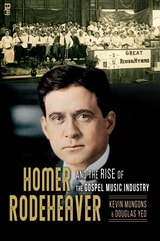
Homer Rodeheaver and the Rise of the Gospel Music Industry
Kevin Mungons and Douglas Yeo
University of Illinois Press, 2021
Homer Rodeheaver merged evangelical hymns and African American spirituals with popular music to create a potent gospel style. Kevin Mungons and Douglas Yeo examine his enormous influence on gospel music against the backdrop of Christian music history and Rodeheaver's impact as a cultural and business figure. Rodeheaver rose to fame as the trombone-playing song leader for evangelist Billy Sunday. As revivalism declined after World War I, Rodeheaver leveraged his place in America's newborn celebrity culture to start the first gospel record label and launch a nationwide radio program. His groundbreaking combination of hymnal publishing and recording technology helped define the early Christian music industry. In his later years, he influenced figures like Billy Graham and witnessed the music's split into southern gospel and black gospel.
Clear-eyed and revealing, Homer Rodeheaver and the Rise of the Gospel Music Industry is an overdue consideration of a pioneering figure in American music.
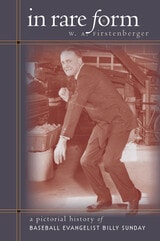
In Rare Form
A Pictorial History of Baseball Evangelist Billy SundayW. A. Firstenberger
University of Iowa Press, 2005
Through an organizational scheme that incorporates memorabilia from childhood (samplers, Civil War badges), baseball (Billy’s 1891 Philadelphia contract, scorecards), evangelism (cartoons, books such as Monkeys and Missing Links), social issues (KKK ads endorsing Sunday, his Women's Christian Temperance life membership certificate), life style (Arts and Crafts decorative pieces, extensive photos of the family's Mount Hood bungalow), and family relations (his personal possessions and those of his wife, Nell, and their children), In Rare Form brings together the inconsistencies between Sunday’s material world and his spiritual world.
Since Sunday might have objected to a materialistic analysis of his life, Firstenberger has allowed him a say: each section of the book begins with an apt quote from Sunday’s sermons and writings. Firstenberger also includes appendixes providing detailed information on Sunday’s revivals and speaking appearances, his 870,075 documented converts, the members of his evangelistic team, the overall structure of his family, and an extensive bibliography. Acknowledging Sunday’s faults and contradictions alongside his heroic accomplishments, the author presents a wryly insightful and innovative perspective on this larger-than-life figure.
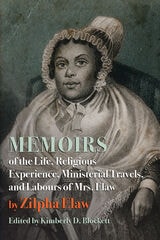
Memoirs of the Life, Religious Experience, Ministerial Travels, and Labours of Mrs. Elaw
Zilpha Elaw
West Virginia University Press, 2021
As a young Black orphan indentured to a Quaker family in Bristol, Pennsylvania, Zilpha Elaw (c. 1793–1873) decided to join the upstart Methodists in 1808. She preached her first sermon a decade later, ignoring her husband and the many church leaders, clergy, and laity who tried to silence her. Elaw’s memoir chronicles the first twenty years of her forty-year itinerant ministry during massive Protestant revivalism in the United States and England.
Elaw preached from Maine to Virginia, attracting multiracial and multidenominational audiences that included powerful men, wealthy White women, poor families, and enslaved communities. She moved from Bristol to Burlington, New Jersey, then to Nantucket, Massachusetts, and finally, in 1840, to London’s East End. In England, Elaw’s celebrity expanded, and at least twice she drew crowds so large they caused human stampedes and multiple injuries.
Blockett’s introduction and extensive annotations draw on newly unearthed information about the entirety of Elaw’s evangelism to provide context for this remarkable story of an antebellum Black woman’s personal and professional mobility.

The God Pumpers
Religion in the Electronic AgeMarshall W. Fishwick
University of Wisconsin Press, 1987
The rituals of religion these days as practiced in the United States on television, have become big theatre, a big show. Televangelism is big business, amounting to billions of dollars each year. Televangelists discussed are Billy Graham, Jimmy Swaggert, Jerry Falwell, Jim and Tammy Bakker, Terry Cole-Whittaker, Marilyn Hickey, Danuto Rylko Soderman, and Beverly LaHaye.
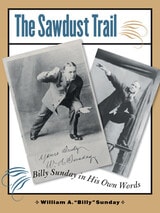
The Sawdust Trail
Billy Sunday in His Own WordsWilliam A. Sunday
University of Iowa Press, 2005
Published serially in the Ladies’ Home Journal in 1932 and 1933 and now in book form for the first time, The Sawdust Trail is the only autobiography that this hugely popular and hugely controversial preacher ever wrote. From his childhood days in Iowa to the early days of his conversion in Illinois, from his baseball career with the National League teams in Chicago, Pittsburgh, and Philadelphia to the challenges of preaching in New York City during his heyday, the sections of Sunday’s autobiography roll out like so many exuberant sermons, yet the sympathetic reader can hear echoes of the loneliness and misery of his early years.
In The Sawdust Trail the sometimes appalling but always appealing Billy Sunday creates a usable past for himself, notable for what he omits as well as for what he includes, which gives us insight not just into his own life and career but also into the peculiar history of evangelism in America.