Results by title
7 books match the query 'Everyday'
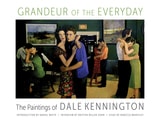
Grandeur of the Everyday
The Paintings of Dale KenningtonDale Kennington, Introduction by Daniel White, Conversation with Kristen Miller Zohn, Essay by Rebecca Brantley
University of Alabama Press, 2017
A lavishly illustrated overview of the life and work of realist painter Dale Kennington, featuring more than eighty-five of her most renowned works.
Grandeur of the Everyday is the first full-length volume dedicated to the life and work of Dale Kennington—an accomplished master of contemporary American realism. Kennington’s works often hold a strange familiarity, even for those coming to her work for the first time. Her paintings are at once familiar and yet defy specificity of place, clear and lucid while also dense in content. These effects derive from her unique ability to capture the essence of everyday living, the ordinary “in between” moments we often overlook in our day-to-day habits and transactions.
Kennington referred to her paintings as “merged memories.” Combining elements of photography, memory, and imagination, Kennington’s art is an entrancing blend of contemporary and magical realism, with themes ranging from loneliness to community and culture, from class and race relations to the juxtaposition of private and public life. Rather than study the spectacular, she concentrated on commonplace moments of human interaction, inviting observers of her paintings to ponder their significance and to complete their implicit narratives. Often relying on local subjects for her paintings—barbershops, bars, restaurants, gospel concerts, motel rooms, nursing homes—she presented a diversity of local experience.
Grandeur of the Everyday is a treasure trove of her most accomplished creations and includes more than eighty-five examples of both Kennington’s easel paintings on canvas and her freestanding wooden folding screens. The volume also offers an original interview with the artist conducted by Kristen Miller Zohn, an introduction by art historian Daniel White, and a critical essay by the director of the Wiregrass Museum of Art, Rebecca Brantley.
[more]
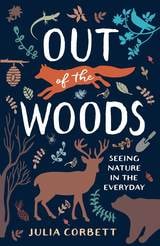
Out of the Woods
Seeing Nature in the EverydayJulia Corbett
University of Nevada Press, 2018
2018 Reading the West Book Awards Nonfiction Winner
Have you ever wondered about society’s desire to cultivate the perfect lawn, why we view some animals as “good” and some as “bad,” or even thought about the bits of nature inside everyday items–toothbrushes, cell phones, and coffee mugs? In this fresh and introspective collection of essays, Julia Corbett examines nature in our lives with all of its ironies and contradictions by seamlessly integrating personal narratives with morsels of highly digestible science and research. Each story delves into an overlooked aspect of our relationship with nature—insects, garbage, backyards, noise, open doors, animals, and language—and how we cover our tracks.
With a keen sense of irony and humor and an awareness of the miraculous in the mundane, Julia recognizes the contradictions of contemporary life. She confronts the owner of a high-end market who insists on keeping his doors open in all temperatures. Takes us on a trip to a new mall with a replica of a trout stream that once flowed nearby. The phrase “out of the woods” guides us through layers of meaning to a contemplation of grief, remembrance, and resilience.
Out of the Woods leads to surprising insights into the products, practices, and phrases we take for granted in our everyday encounters with nature and encourages us all to consider how we might re-value or reimagine our relationships with nature in our everyday lives.
[more]

Philosophizing the Everyday
Revolutionary Praxis and the Fate of Cultural TheoryJohn Roberts
Pluto Press, 2006
After modernism and postmodernism, it is argued, the everyday supposedly is where a democracy of taste is brought into being - the place where art goes to recover its customary and collective pleasures, and where the shared pleasures of popular culture are indulged, from celebrity magazines to shopping malls.
John Roberts argues that this understanding of the everyday downgrades its revolutionary meaning and philosophical implications. Bringing radical political theory back to the centre of the discussion, he shows how notions of cultural democratization have been oversimplified. Asserting that the everyday should not be narrowly identified with the popular, Roberts critiques the way in which the concept is now overly associated with consumption and 'ordinariness'.
Engaging with the work of key thinkers including, Lukács, Arvatov, Benjamin, Lefebvre, Gramsci, Barthes, Vaneigem, and de Certeau, Roberts shows how the concept of the everyday continues to be central to debates on ideology, revolution and praxis. He offers a lucid account of different approaches that developed over the course of the twentieth century, making this an ideal book for anyone looking for a politicised approach to cultural theory.
John Roberts is a Senior Research Fellow in Fine Art at the University of Wolverhampton. He is the author of The Art of Interruption: Realism, Photography and the Everyday (Manchester University Press, 1997) and The Philistine Controversy (Verso, with Dave Beech, 2002), plus other books and numerous articles, in Radical Philosophy and elsewhere.
[more]
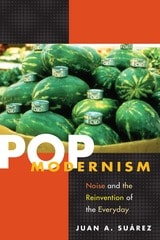
Pop Modernism
Noise and the Reinvention of the EverydayJuan A. Suarez
University of Illinois Press, 2007
Pop Modernism examines the popular roots of modernism in the United States. Drawing on a wide range of materials, including experimental movies, pop songs, photographs, and well-known poems and paintings, Juan A. Suárez reveals that experimental art in the early twentieth century was centrally concerned with the reinvention of everyday life. Suárez demonstrates how modernist writers and artists reworked pop images and sounds, old-fashioned and factory-made objects, city spaces, and the languages and styles of queer and ethnic “others.” Along the way, he reinterprets many of modernism’s major figures and argues for the centrality of relatively marginal ones, such as Vachel Lindsay, Charles Henri Ford, Helen Levitt, and James Agee. As Suárez shows, what’s at stake is not just an antiquarian impulse to rescue forgotten past moments and works, but a desire to establish an archaeology of our present art, culture, and activism.
[more]

The Otherness of the Everyday
Twelve Conversations from the Chinese Art World during the Covid-19 PandemicEdited by JIANG Jiehong
Intellect Books, 2021
Jiang Jiehong seeks to understand the Covid-19 pandemic through interviews with leading figures of the Chinese art world during the summer of 2020.
In late 2019, as a deadly pandemic began to take hold, China’s Wuhan province was the first to feel the effects. As the virus spread, the streets and squares of the world emptied, and the structures of our social world were redefined.
In response to the pandemic, Jiang Jiehong convened in-conversation talks with twelve figures—such as Chen Danqing, Pi Li, Xiang Biao, and Zhang Peili, among others—from different disciplines in the Chinese-speaking world, including anthropology, architecture, art, curation, fashion, film, literature, media, museum, music, and photography. Presented here, the conversations foster new understandings of the ongoing crisis. The discussions explore the threat of the invisible; notions of distance and spatialization, separation and isolation, communication and mobility, discipline and surveillance, and community and collectiveness; and China’s changing relationship with the rest of the world. These illuminating reflections on the global crisis allow us to re-examine past norms and begin to form visions of a post-Covid world.
[more]
Theaters of the Everyday
Aesthetic Democracy on the American StageJacob Gallagher-Ross
Northwestern University Press, 2018
Theaters of the Everyday: Aesthetic Democracy on the American Stage reveals a vital but little-recognized current in American theatrical history: the dramatic representation of the quotidian and mundane. Jacob Gallagher-Ross shows how twentieth-century American theater became a space for negotiating the demands of innovative form and democratic availability.
Offering both fresh reappraisals of canonical figures and movements and new examinations of theatrical innovators, Theaters of the Everyday reveals surprising affinities between artists often considered poles apart, such as John Cage and Lee Strasberg, and Thornton Wilder and the New York experimentalist Nature Theater of Oklahoma. Gallagher-Ross persuasively shows how these creators eschew conventional definitions of dramatic action and focus attention on smaller but no less profound dramas of perception, consciousness, and day-to-day life.
Gallagher-Ross traces some of the intellectual roots of the theater of the everyday to American transcendentalism, with its pragmatic process philosophy as well as its sense of ordinary experience as the wellspring of aesthetic awareness.
[more]
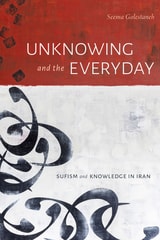
Unknowing and the Everyday
Sufism and Knowledge in IranSeema Golestaneh
Duke University Press, 2023
In Unknowing and the Everyday Seema Golestaneh examines how Sufi mystical experience in Iran shapes contemporary life. Central to this process is ma’rifat, or “unknowing”—the idea that, as it is ultimately impossible to fully understand the divine, humanity must operate from an engaged awareness that it knows nothing. Golestaneh shows that rather than considering ma’rifat an obstacle to intellectual engagement, Sufis embrace that there will always be that which they do not know. From this position, they affirm both the limits of human knowledge and the mysteries of the profane world. Through ethnographic case studies, Golestaneh traces the affective and sensory dimensions of ma’rifat in contexts such as the creation of collective Sufi spaces, the interpretation of Persian poetry, formulations of selfhood and non-selfhood, and the navigation of the socio-material realm. By outlining the relationship between ma’rifat and religious, aesthetic, and social life in Iran, Golestaneh demonstrates that for Sufis the outer bounds of human thought are the beginning rather than the limit.
[more]