Results by title
5 books match the query 'Evidence (Law)'
Evidence and Inference in History and Law
Interdisciplinary DialoguesWilliam Twining and Ian Hampsher-Monk
Northwestern University Press, 2003
Northwestern University Press co-published William Twining's Rethinking Evidence in 1994 and Analysis of Evidence in 1998. This new volume, Evidence and Inference, is an interdisciplinary volume exploring the application of techniques of evidence and inference across a variety of fields.
Coedited by Twining, one of the world's outstanding evidence scholars, and Iain Hampsher-Monk, a leading political theorist, the volume considers intriguing questions from Assyriology, theater iconography, musicology, criminology, the history of ideas, and colonial history as it reveals how particular concepts, lines of questioning, and techniques of reasoning and analysis developed in one context can be fruitfully applied in others. Did cuneiform languages really die out in the second or third century B.C.? Was Schubert responsible for any of the guitar arrangements for some of his lieder? In these cases and others, the authors' work demonstrates that, regardless of the field or the problem, all such projects involve drawing inferences from evidence, and that the logic of this kind of inquiry is always governed by the same principles.
Coedited by Twining, one of the world's outstanding evidence scholars, and Iain Hampsher-Monk, a leading political theorist, the volume considers intriguing questions from Assyriology, theater iconography, musicology, criminology, the history of ideas, and colonial history as it reveals how particular concepts, lines of questioning, and techniques of reasoning and analysis developed in one context can be fruitfully applied in others. Did cuneiform languages really die out in the second or third century B.C.? Was Schubert responsible for any of the guitar arrangements for some of his lieder? In these cases and others, the authors' work demonstrates that, regardless of the field or the problem, all such projects involve drawing inferences from evidence, and that the logic of this kind of inquiry is always governed by the same principles.
[more]
Evidence of the Law
Proving Legal ClaimsGary Lawson
University of Chicago Press, 2017
How does one prove the law? If your neighbor breaks your window, the law regulates how you can show your claim to be true or false; but how do you prove that in breaking your window your neighbor has broken the law? American jurisprudence devotes an elaborate body of doctrine—and an equally elaborate body of accompanying scholarly commentary—to worrying about how to prove facts. It establishes rules for the admissibility of evidence, creates varying standards of proof, and assigns burdens of proof that determine who wins or loses when the facts are unclear. But the law is shockingly inexplicit when addressing these issues with respect to the proof of legal claims. Indeed, the entire language of evidentiary proof, so sophisticated when it comes to questions of fact, is largely absent from the American legal system with respect to questions of law.
As Gary Lawson shows, legal claims are inherently objects of proof, and whether or not the law acknowledges the point openly, proof of legal claims is just a special case of the more general norms governing proof of any claim. As a result, similar principles of evidentiary admissibility, standards of proof, and burdens of proof operate, and must operate, in the background of claims about the law. This book brings these evidentiary principles for proving law out of the shadows so that they can be analyzed, clarified, and discussed. Viewing legal problems through this lens of proof illuminates debates about everything from constitutional interpretation to the role of stipulations in litigation. Rather than prescribe resolutions to any of those debates, Evidence of the Law instead provides a set of tools that can be used to make those debates more fruitful, whatever one’s substantive views may be. As lawyers, judges, and legal subjects confront uncertainty about what the law is, they can, should, and must, Lawson argues, be guided by the same kinds of abstract considerations, structures, and doctrines long used to make determinations about questions of fact.
As Gary Lawson shows, legal claims are inherently objects of proof, and whether or not the law acknowledges the point openly, proof of legal claims is just a special case of the more general norms governing proof of any claim. As a result, similar principles of evidentiary admissibility, standards of proof, and burdens of proof operate, and must operate, in the background of claims about the law. This book brings these evidentiary principles for proving law out of the shadows so that they can be analyzed, clarified, and discussed. Viewing legal problems through this lens of proof illuminates debates about everything from constitutional interpretation to the role of stipulations in litigation. Rather than prescribe resolutions to any of those debates, Evidence of the Law instead provides a set of tools that can be used to make those debates more fruitful, whatever one’s substantive views may be. As lawyers, judges, and legal subjects confront uncertainty about what the law is, they can, should, and must, Lawson argues, be guided by the same kinds of abstract considerations, structures, and doctrines long used to make determinations about questions of fact.
[more]
Experiencing Other Minds in the Courtroom
Neal Feigenson
University of Chicago Press, 2016
Sometimes the outcome of a lawsuit depends upon sensations known only to the person who experiences them, such as the buzzing sound heard by a plaintiff who suffers from tinnitus after an accident. Lawyers, litigants, and expert witnesses are now seeking to re-create these sensations in the courtroom, using digital technologies to simulate litigants’ subjective experiences and thus to help jurors know—not merely know about—what it is like to be inside a litigant’s mind. But with this novel type of evidence comes a host of questions: Can anyone really know what it is like to have another person’s sensory experiences? Why should courts allow jurors to see or hear these simulations? And how might this evidence alter the ways in which judges and jurors do justice?
In Experiencing Other Minds in the Courtroom, Neal Feigenson turns the courtroom into a forum for exploring the profound philosophical, psychological, and legal ramifications of our efforts to know what other people’s conscious experiences are truly like. Drawing on disciplines ranging from cognitive psychology to psychophysics to media studies, Feigenson harnesses real examples of digitally simulated subjective perceptions to explain how the epistemological value of this evidence is affected by who creates it, how it is made, and how it is presented. Through his close scrutiny of the different kinds of simulations and the different knowledge claims they make, Feigenson is able to suggest best practices for how we might responsibly incorporate such evidence into the courtroom.
In Experiencing Other Minds in the Courtroom, Neal Feigenson turns the courtroom into a forum for exploring the profound philosophical, psychological, and legal ramifications of our efforts to know what other people’s conscious experiences are truly like. Drawing on disciplines ranging from cognitive psychology to psychophysics to media studies, Feigenson harnesses real examples of digitally simulated subjective perceptions to explain how the epistemological value of this evidence is affected by who creates it, how it is made, and how it is presented. Through his close scrutiny of the different kinds of simulations and the different knowledge claims they make, Feigenson is able to suggest best practices for how we might responsibly incorporate such evidence into the courtroom.
[more]
Rethinking Evidence
Exploratory EssaysWilliam Twining
Northwestern University Press, 1994
Evidence, proof and probabilities, rationality, skepticism and narrative in legal discourse, and the reform of criminal evidence have all been the subject of lively debates in recent years. This book brings together seminal and new essays from a leading contributor to this new evidence scholarship. Rethinking Evidence contains a series of linked essays which consider historical, theoretical, and applied themes from a broad interdisciplinary perspective. It brings together well-known papers and also includes substantial new essays on the nature and scope of the law of evidence, lawyers' stories, and the case of Edith Thompson. These readable and provocative essays represent a major contribution not only to legal theory but also to the general study of discourse about evidence in many disciplines.
[more]
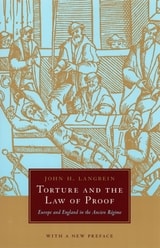
Torture and the Law of Proof
Europe and England in the Ancien RégimeJohn H. Langbein
University of Chicago Press, 2006
In Torture and the Law of Proof John H. Langbein explores the world of the thumbscrew and the rack, engines of torture authorized for investigating crime in European legal systems from medieval times until well into the eighteenth century. Drawing on juristic literature and legal records, Langbein's book, first published in 1977, remains the definitive account of how European legal systems became dependent on the use of torture in their routine criminal procedures, and how they eventually worked themselves free of it.
The book has recently taken on an eerie relevance as a consequence of controversial American and British interrogation practices in the Iraq and Afghanistan wars. In a new introduction, Langbein contrasts the "new" law of torture with the older European law and offers some pointed lessons about the difficulty of reconciling coercion with accurate investigation. Embellished with fascinating illustrations of torture devices taken from an eighteenth-century criminal code, this crisply written account will engage all those interested in torture's remarkable grip on European legal history.
The book has recently taken on an eerie relevance as a consequence of controversial American and British interrogation practices in the Iraq and Afghanistan wars. In a new introduction, Langbein contrasts the "new" law of torture with the older European law and offers some pointed lessons about the difficulty of reconciling coercion with accurate investigation. Embellished with fascinating illustrations of torture devices taken from an eighteenth-century criminal code, this crisply written account will engage all those interested in torture's remarkable grip on European legal history.
[more]