Results by title
4 books match the query 'Evolution (Biology) and the social sciences'
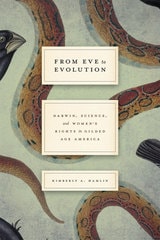
From Eve to Evolution
Darwin, Science, and Women's Rights in Gilded Age AmericaKimberly A. Hamlin
University of Chicago Press, 2014
Hamlin chronicles the lives and writings of the women who combined their enthusiasm for evolutionary science with their commitment to women’s rights, including Antoinette Brown Blackwell, Eliza Burt Gamble, Helen Hamilton Gardener, Charlotte Perkins Gilman, and Elizabeth Cady Stanton. These Darwinian feminists believed evolutionary science proved that women were not inferior to men, that it was natural for mothers to work outside the home, and that women should control reproduction. The practical applications of this evolutionary feminism came to fruition, Hamlin shows, in the early thinking and writing of the American birth control pioneer Margaret Sanger.
Much scholarship has been dedicated to analyzing what Darwin and other male evolutionists had to say about women, but very little has been written regarding what women themselves had to say about evolution. From Eve to Evolution adds much-needed female voices to the vast literature on Darwin in America.
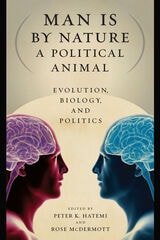
Man Is by Nature a Political Animal
Evolution, Biology, and PoliticsEdited by Peter K. Hatemi and Rose McDermott
University of Chicago Press, 2011
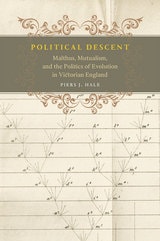
Political Descent
Malthus, Mutualism, and the Politics of Evolution in Victorian EnglandPiers J. Hale
University of Chicago Press, 2014
These two traditions, Hale shows, developed in a context of mutual hostility, debate, and refutation. Participants disagreed not only about evolutionary processes but also on broader questions regarding the kind of creature our evolution had made us and in what kind of society we ought therefore to live. Significantly, and in spite of Darwin’s acknowledgement that natural selection was “the doctrine of Malthus, applied to the whole animal and vegetable kingdoms,” both sides of the debate claimed to be the more correctly “Darwinian.” By exploring the full spectrum of scientific and political issues at stake, Political Descent offers a novel approach to the relationship between evolution and political thought in the Victorian and Edwardian eras.
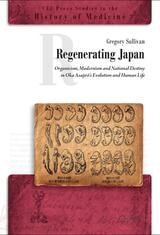
Regenerating Japan
Organicism, Modernism and National Destiny in Oka Asajiro's Evolution and Human LifeGregory Sullivan
Central European University Press, 2018
As the first step toward a comprehensive reinterpretation of the role of evolutionary science and biomedicine in pre-1945 Japan, this book addresses the early writings of that era’s most influential exponent of shinkaron (evolutionism), the German-educated research zoologist and popularizer of biomedicine, Oka Asajirō (1868–1944). Concentrating on essays that Oka published in the years during and after the Russo-Japanese War (1904–5), the author describes the process by which Oka came to articulate a programmatic modernist vision of national regeneration that would prove integral to the ideological climate in Japan during the first half of the twentieth century. In contrast to other scholars who insist that Oka was merely a rationalist enlightener bent on undermining state Shinto orthodoxy, Gregory Sullivan maintains that Oka used notions from evolutionary biology of organic individuality—especially that of the nation as a super-organism—to underwrite the social and geopolitical aims of the Meiji state.
The author suggests that this generative scientism gained wide currency among early twentieth-century political and intellectual elites, including Emperor Hirohito himself, who had personal connections to Oka. The wartime ideology may represent an unfinished attempt to synthesize Shinto fundamentalism and the eugenically-oriented modernism that Oka was among the first to articulate.