Results by title
5 books match the query 'Evolutionary Biology'
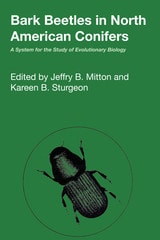
Bark Beetles in North American Conifers
A System for the Study of Evolutionary BiologyEdited by Jeffry B. Mitton and Kareen B. Sturgeon
University of Texas Press, 1982
Because they prey upon a wide variety of conifers, bark beetles have a major impact upon western forests. In most of the western states, for example, we have witnessed bark beetles in epidemic outbreaks, attacking and damaging ponderosa pine, limber pine, and other hosts.
The ecosystem of bark beetle and host tree is a highly coevolved community of organisms in which the evolution of one member of the community significantly influences the evolution of the other. Largely because of the enormous economic impact these insects exert on the management of our forests, few other such communities have been studied so extensively. Bark Beetles in North American Conifers brings together in one volume both theory and a wealth of empirical data gathered by researchers from all the fields in which bark beetles are studied: ecology, evolutionary biology, population genetics, entomology, and forestry.
Topics covered include the life cycle of bark beetles and their population dynamics, their genetic variation and evolutionary mechanisms, the evolution and systematics of the major groups of bark beetles, pheromone production and its implications for coevolution among these organisms, the interaction between bark beetles and their predators, host resistance and susceptibility, the relationship of parasites and symbiotic micro-organisms in general, and management and control of bark beetles based on sound ecological and evolutionary concepts. The concluding section of the book summarizes the dynamics of the coevolved system of bark beetle and host tree and discusses controversial issues for which this system may provide important answers.
Can Microbial Communities Regenerate?
Uniting Ecology and Evolutionary BiologyAndrew Inkpen and Ford Doolittle
University of Chicago Press, 2022
Microorganisms, such as bacteria, are important determinants of health at the individual, ecosystem, and global levels. And yet many aspects of modern life, from the overuse of antibiotics to chemical spills and climate change, can have devastating, lasting impacts on the communities formed by microorganisms. Drawing on the latest scientific research and real-life examples such as attempts to reengineer these communities through microbial transplantation, the construction of synthetic communities of microorganisms, and the use of probiotics, this book explores how and why communities of microorganisms respond to disturbance, and what might lead to failure. It also unpacks related and interwoven philosophical questions: What is an organism? Can a community evolve by natural selection? How can we make sense of function and purpose in the natural world? How should we think about regeneration as a phenomenon that occurs at multiple biological scales? Provocative and nuanced, this primer offers an accessible conceptual and theoretical understanding of regeneration and evolution at the community level that will be essential across disciplines including philosophy of biology, conservation biology, microbiomics, medicine, evolutionary biology, and ecology.
Life's Splendid Drama
Evolutionary Biology and the Reconstruction of Life's Ancestry, 1860-1940Peter J. Bowler
University of Chicago Press, 1996
"Intriguing and insightful."—William Kimler, American Scientist
"[A] volume of impressive scholarship and extensive references."—Library Journal
"One of Bowler's best."—Kevin Padian, Nature
"[Bowler's] comprehensive review of the various debates and ideas in taxonomy, morphology, and vertebrate evolution . . . deserves the attention of biologists and other scholars interested in the history of ideas."—Choice
"The persistence of pre-Darwinian modes of thought in contemporary biology underlines the importance of Bowler's book. Its value is not only in the history it provides, but also in the way it illumines the present."—Peter J. Causton, Boston Book Review
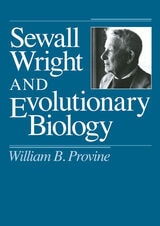
Sewall Wright and Evolutionary Biology
William B. Provine
University of Chicago Press, 1986
"In Sewall Wright and Evolutionary Biology . . . Provine has produced an intellectual biography which serves to chart in considerable detail both the life and work of one man and the history of evolutionary theory in the middle half of this century. Provine is admirably suited to his task. . . . The resulting book is clearly a labour of love which will be of great interest to those who have a mature interest in the history of evolutionary theory."-John Durant, ;ITimes Higher Education Supplement;X
The Evolutionary Biology of Plants
Karl J. Niklas
University of Chicago Press, 1997
After presenting key evolutionary principles, Niklas recounts the saga of plant life from its origins to the radiation of the flowering plants. To investigate how living plants might have evolved, Niklas conducts a series of computer-generated "walks" on fitness "landscapes," arriving at hypothetical forms of plant life strikingly similar to those of today and the distant past. He concludes with an extended consideration of molecular biology and paleontology. An excellent overview for undergraduates, this book will also challenge graduate students and researchers.