Results by title
2 books match the query 'Evolutionary Ecology'
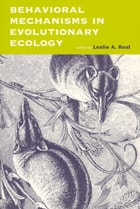
Behavioral Mechanisms in Evolutionary Ecology
Leslie A. Real
University of Chicago Press, 1994
The first book-length exploration of behavioral mechanisms in evolutionary ecology, this ambitious volume illuminates long-standing questions about cause-and-effect relations between an animal's behavior and its environment. By focusing on biological mechanisms—the sum of an animal's cognitive, neural, developmental, and hormonal processes—leading researchers demonstrate how the integrated study of animal physiology, cognitive processes, and social interaction can yield an enriched understanding of behavior.
With studies of species ranging from insects to primates, the contributors examine how various animals identify and use environmental resources and deal with ecological constraints, as well as the roles of learning, communication, and cognitive aspects of social interaction in behavioral evolution. Taken together, the chapters demonstrate how the study of internal mechanistic foundations of behavior in relation to their ecological and evolutionary contexts and outcomes provides valuable insight into such behaviors as predation, mating, and dispersal.
Behavioral Mechanisms in Evolutionary Ecology shows how a mechanistic approach unites various levels of biological organization to provide a broader understanding of the biological bases of behavioral evolution.
[more]
Evolutionary Ecology and Archaeology
Applications to Problems in Human Evolution and PrehistoryJack M Broughton
University of Utah Press, 2009
The field of evolutionary ecology, which applies Darwinian natural selection theory to the study of adaptive design in behavior, morphology, and life history, has produced substantial advances in understanding human evolution and prehistory. Editors Jack Broughton and Michael Cannon have compiled archaeological and paleoanthro- pological studies that provide a foundation for sustained development of the study of the human past.
Each of the twenty-four contributions represents a key benchmark in the field. Chapters are grouped by substantive topic and/or time period. Each of the following sections includes an introduction by the editors:
• Early Hominid Evolution and Behavior
• Pleistocene Foragers and Colonists
• Post-Glacial Adaptations
• Food Production Strategies
• Cooperation and Competition in Complex Societies
This volume’s broad range of research will foster sustained development of evolutionary ecology, and like Darwin’s work nearly 150 years ago will open wide fields of understanding of human prehistory.
[more]