Results by title
5 books match the query 'Evolutionary genetics'
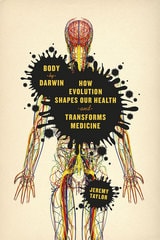
Body by Darwin
How Evolution Shapes Our Health and Transforms MedicineJeremy Taylor
University of Chicago Press, 2015
We think of medical science and doctors as focused on treating conditions—whether it’s a cough or an aching back. But the sicknesses and complaints that cause us to seek medical attention actually have deeper origins than the superficial germs and behaviors we regularly fault. In fact, as Jeremy Taylor shows in Body by Darwin, we can trace the roots of many medical conditions through our evolutionary history, revealing what has made us susceptible to certain illnesses and ailments over time and how we can use that knowledge to help us treat or prevent problems in the future.
In Body by Darwin, Taylor examines the evolutionary origins of some of our most common and serious health issues. To begin, he looks at the hygiene hypothesis, which argues that our obsession with anti-bacterial cleanliness, particularly at a young age, may be making us more vulnerable to autoimmune and allergic diseases. He also discusses diseases of the eye, the medical consequences of bipedalism as they relate to all those aches and pains in our backs and knees, the rise of Alzheimer’s disease, and how cancers become so malignant that they kill us despite the toxic chemotherapy we throw at them. Taylor explains why it helps to think about heart disease in relation to the demands of an ever-growing, dense, muscular pump that requires increasing amounts of nutrients, and he discusses how walking upright and giving birth to ever larger babies led to a problematic compromise in the design of the female spine and pelvis. Throughout, he not only explores the impact of evolution on human form and function, but he integrates science with stories from actual patients and doctors, closely examining the implications for our health.
As Taylor shows, evolutionary medicine allows us think about the human body and its adaptations in a completely new and productive way. By exploring how our body’s performance is shaped by its past, Body by Darwin draws powerful connections between our ancient human history and the future of potential medical advances that can harness this knowledge.
[more]
History Within
The Science, Culture, and Politics of Bones, Organisms, and MoleculesMarianne Sommer
University of Chicago Press, 2016
Personal genomics services such as 23andMe and Ancestry.com now offer what once was science fiction: the ability to sequence and analyze an individual’s entire genetic code—promising, in some cases, facts about that individual’s ancestry that may have remained otherwise lost. Such services draw on and contribute to the science of human population genetics that attempts to reconstruct the history of humankind, including the origin and movement of specific populations. Is it true, though, that who we are and where we come from is written into the sequence of our genomes? Are genes better documents for determining our histories and identities than fossils or other historical sources?
Our interpretation of gene sequences, like our interpretation of other historical evidence, inevitably tells a story laden with political and moral values. Focusing on the work of Henry Fairfield Osborn, Julian Sorell Huxley, and Luigi Luca Cavalli-Sforza in paleoanthropology, evolutionary biology, and human population genetics, History Within asks how the sciences of human origins, whether through the museum, the zoo, or the genetics lab, have shaped our idea of what it means to be human. How have these biologically based histories influenced our ideas about nature, society, and culture? As Marianne Sommer shows, the stories we tell about bones, organisms, and molecules often change the world.
Our interpretation of gene sequences, like our interpretation of other historical evidence, inevitably tells a story laden with political and moral values. Focusing on the work of Henry Fairfield Osborn, Julian Sorell Huxley, and Luigi Luca Cavalli-Sforza in paleoanthropology, evolutionary biology, and human population genetics, History Within asks how the sciences of human origins, whether through the museum, the zoo, or the genetics lab, have shaped our idea of what it means to be human. How have these biologically based histories influenced our ideas about nature, society, and culture? As Marianne Sommer shows, the stories we tell about bones, organisms, and molecules often change the world.
[more]
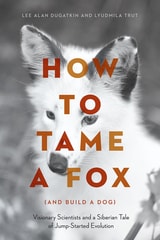
How to Tame a Fox (and Build a Dog)
Visionary Scientists and a Siberian Tale of Jump-Started EvolutionLee Alan Dugatkin and Lyudmila Trut
University of Chicago Press, 2017
Tucked away in Siberia, there are furry, four-legged creatures with wagging tails and floppy ears that are as docile and friendly as any lapdog. But, despite appearances, these are not dogs—they are foxes. They are the result of the most astonishing experiment in breeding ever undertaken—imagine speeding up thousands of years of evolution into a few decades. In 1959, biologists Dmitri Belyaev and Lyudmila Trut set out to do just that, by starting with a few dozen silver foxes from fox farms in the USSR and attempting to recreate the evolution of wolves into dogs in real time in order to witness the process of domestication. This is the extraordinary, untold story of this remarkable undertaking.
Most accounts of the natural evolution of wolves place it over a span of about 15,000 years, but within a decade, Belyaev and Trut’s fox breeding experiments had resulted in puppy-like foxes with floppy ears, piebald spots, and curly tails. Along with these physical changes came genetic and behavioral changes, as well. The foxes were bred using selection criteria for tameness, and with each generation, they became increasingly interested in human companionship. Trut has been there the whole time, and has been the lead scientist on this work since Belyaev’s death in 1985, and with Lee Dugatkin, biologist and science writer, she tells the story of the adventure, science, politics, and love behind it all. In How to Tame a Fox, Dugatkin and Trut take us inside this path-breaking experiment in the midst of the brutal winters of Siberia to reveal how scientific history is made and continues to be made today.
To date, fifty-six generations of foxes have been domesticated, and we continue to learn significant lessons from them about the genetic and behavioral evolution of domesticated animals. How to Tame a Fox offers an incredible tale of scientists at work, while also celebrating the deep attachments that have brought humans and animals together throughout time.
[more]

Plasticity in the Life Sciences
Antonine Nicoglou
University of Chicago Press, 2024
Analyzes the reasons why biologists have referred to and continue to refer to plasticity.
Plasticity has become an important topic in biology, with some even wondering if it has now acquired the theoretical importance in biology that the concept of the gene enjoyed at the beginning of the last century. In this historical and epistemological study, philosopher Antonine Nicoglou shows how the recurrence of the general idea of plasticity—throughout the history of the life sciences—indicates its essential role in the way we think about life processes. Although plasticity has become a key element in new evolutionary thinking, she argues, its role in contemporary biology is also not insignificant. Rather, as mobilized in contemporary biology, plasticity most often seeks to account for the specific nature of living systems.
The book is divided into two parts. The first takes up the history of plasticity from Aristotle to contemporary biology; the second part offers an original way of distinguishing between different phenomena described by “plasticity.” In the process, the author explores what has led some biologists to speak of plasticity as a way of overcoming genetic determinism.
[more]
The Shape of Life
Genes, Development, and the Evolution of Animal FormRudolf A. Raff
University of Chicago Press, 1996
Rudolf Raff is recognized as a pioneer in evolutionary developmental biology. In their 1983 book, Embryos, Genes, and Evolution, Raff and co-author Thomas Kaufman proposed a synthesis of developmental and evolutionary biology. In The Shape of Life, Raff analyzes the rise of this new experimental discipline and lays out new research questions, hypotheses, and approaches to guide its development.
Raff uses the evolution of animal body plans to exemplify the interplay between developmental mechanisms and evolutionary patterns. Animal body plans emerged half a billion years ago. Evolution within these body plans during this span of time has resulted in the tremendous diversity of living animal forms.
Raff argues for an integrated approach to the study of the intertwined roles of development and evolution involving phylogenetic, comparative, and functional biology. This new synthesis will interest not only scientists working in these areas, but also paleontologists, zoologists, morphologists, molecular biologists, and geneticists.
[more]