Results by title
6 books match the query 'Evolutionary psychology'
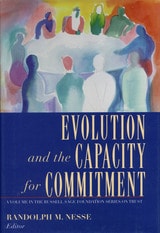
Evolution and the Capacity for Commitment
Randolph Nesse
Russell Sage Foundation, 2001
Commitment is at the core of social life. The social fabric is woven from promises and threats that are not always immediately advantageous to the parties involved. Many commitments, such as signing a contract, are fairly straightforward deals, in which both parties agree to give up certain options. Other commitments, such as the promise of life-long love or a threat of murder, are based on more intangible factors such as human emotions. In Evolution and the Capacity for Commitment, distinguished researchers from the fields of economics, psychology, ethology, anthropology, philosophy, medicine, and law offer a rich variety of perspectives on the nature of commitment and question whether the capacity for making, assessing, and keeping commitments has been shaped by natural selection. Game theorists have shown that players who use commitment strategies—by learning to convey subjective offers and to gauge commitments others are willing to make—achieve greater success than those who rationally calculate every move for immediate reward. Evolution and the Capacity for Commitment includes contributions from some of the pioneering students of commitment. Their elegant analyses highlight the critical role of reputation-building, and show the importance of investigating how people can believe that others would carry out promises or threats that go against their own self-interest. Other contributors provide real-world examples of commitment across cultures and suggest the evolutionary origins of the capacity for commitment. Perhaps nowhere is the importance of commitment and reputation more evident than in the institutions of law, medicine, and religion. Essays by professionals in each field explore why many practitioners remain largely ethical in spite of manifest opportunities for client exploitation. Finally, Evolution and the Capacity for Commitment turns to leading animal behavior experts to explore whether non-humans also use commitment strategies, most notably through the transmission of threats or signs of non-aggression. Such examples illustrate how such tendencies in humans may have evolved. Viewed as an adaptive evolutionary strategy, commitment offers enormous potential for explaining complex and irrational emotional behaviors within a biological framework. Evolution and the Capacity for Commitment presents compelling evidence for this view, and offers a potential bridge across the current rift between biology and the social sciences. A Volume in the Russell Sage Foundation Series on Trust
[more]

Hommes, encore un effort…
Anthropogenèse, christianisme, sexuationThierry de Duve
Diaphanes, 2023
Dans ce petit livre intempestif arc-bouté à la conviction selon laquelle « le christianisme est la religion de la sortie de la religion » (Marcel Gauchet), Thierry de Duve sort des disciplines qui sont les siennes, l’esthétique et histoire de l’art, pour aborder deux questions anthropologiques que la mutation de l’ordre symbolique en cours rend pressantes : la différence des sexes, qu’il envisage par le biais de l’incertitude de la paternité, et l’avenir de la politique d’émancipation, qu’il ancre à la naissance prématurée des enfants humains. Le ton de ce livre est une certaine effronterie respectueuse par laquelle de Duve engage un dialogue imaginaire avec quelques grandes figures intellectuelles, parmi lesquelles Françoise Héritier, Alain Badiou, Georges Duby, Marcel Gauchet et, last but not least, Jacques Lacan.
[more]
Neo-liberal Genetics
The Myths and Moral Tales of Evolutionary PsychologySusan McKinnon
Prickly Paradigm Press, 2005
Evolutionary psychology claims to be the authoritative science of "human nature." Its chief architects, including Stephen Pinker and David Buss, have managed to reach well beyond the ivory tower to win large audiences and influence public discourse. But do the answers that evolutionary psychologists provide about language, sex, and social relations add up? Susan McKinnon thinks not.
Far from being an account of evolution and social relations that has historical and cross-cultural validity, evolutionary psychology is a stunning example of a "science" that twists evolutionary genetics into a myth of human origins. As McKinnon shows, that myth is shaped by neo-liberal economic values and relies on ethnocentric understandings of sex, gender, kinship, and social relations. She also explores the implications for public policy of the moral tales that are told by evolutionary psychologists in the guise of "scientific" inquiry.
Drawing widely from the anthropological record, Neo-liberal Genetics offers a sustained and accessible critique of the myths of human nature fabricated by evolutionary psychologists.
[more]
Social Practices as Biological Niche Construction
Joseph Rouse
University of Chicago Press, 2023
A broad, synthetic philosophy of nature focused on human sociality.
In this book, Joseph Rouse takes his innovative work to the next level by articulating an integrated philosophy of society as part of nature. He shows how and why we ought to unite our biological conception of human beings as animals with our sociocultural and psychological conceptions of human beings as persons and acculturated agents. Rouse’s philosophy engages with biological understandings of human bodies and their environments as well as the diverse practices and institutions through which people live and engage with one another. Familiar conceptual separations of natural, social, and mental “worlds” did not arise by happenstance, he argues, but often for principled reasons that have left those divisions deeply entrenched in contemporary intellectual life. Those reasons are eroding in light of new developments across the disciplines, but that erosion has not been sufficient to produce more adequately integrated conceptual alternatives until now.
Social Practices and Biological Niche Construction shows how the characteristic plasticity, plurality, and critical contestation of human ways of life can best be understood as evolved and evolving relations among human organisms and their distinctive biological environments. It also highlights the constitutive interdependence of those ways of life with many other organisms, from microbial populations to certain plants and animals, and explores the consequences of this in-depth, noting, for instance, how the integration of the natural and social also provides new insights on central issues in social theory, such as the body, language, normativity, and power.
[more]
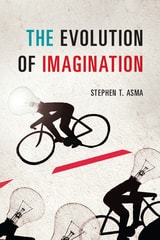
The Evolution of Imagination
Stephen T. Asma
University of Chicago Press, 2017
Consider Miles Davis, horn held high, sculpting a powerful musical statement full of tonal patterns, inside jokes, and thrilling climactic phrases—all on the fly. Or think of a comedy troupe riffing on a couple of cues from the audience until the whole room is erupting with laughter. Or maybe it’s a team of software engineers brainstorming their way to the next Google, or the Einsteins of the world code-cracking the mysteries of nature. Maybe it’s simply a child playing with her toys. What do all of these activities share? With wisdom, humor, and joy, philosopher Stephen T. Asma answers that question in this book: imagination. And from there he takes us on an extraordinary tour of the human creative spirit.
Guided by neuroscience, animal behavior, evolution, philosophy, and psychology, Asma burrows deep into the human psyche to look right at the enigmatic but powerful engine that is our improvisational creativity—the source, he argues, of our remarkable imaginational capacity. How is it, he asks, that a story can evoke a whole world inside of us? How are we able to rehearse a skill, a speech, or even an entire scenario simply by thinking about it? How does creativity go beyond experience and help us make something completely new? And how does our moral imagination help us sculpt a better society? As he shows, we live in a world that is only partly happening in reality. Huge swaths of our cognitive experiences are made up by “what-ifs,” “almosts,” and “maybes,” an imagined terrain that churns out one of the most overlooked but necessary resources for our flourishing: possibilities. Considering everything from how imagination works in our physical bodies to the ways we make images, from the mechanics of language and our ability to tell stories to the creative composition of self-consciousness, Asma expands our personal and day-to-day forms of imagination into a grand scale: as one of the decisive evolutionary forces that has guided human development from the Paleolithic era to today. The result is an inspiring look at the rich relationships among improvisation, imagination, and culture, and a privileged glimpse into the unique nature of our evolved minds.
Guided by neuroscience, animal behavior, evolution, philosophy, and psychology, Asma burrows deep into the human psyche to look right at the enigmatic but powerful engine that is our improvisational creativity—the source, he argues, of our remarkable imaginational capacity. How is it, he asks, that a story can evoke a whole world inside of us? How are we able to rehearse a skill, a speech, or even an entire scenario simply by thinking about it? How does creativity go beyond experience and help us make something completely new? And how does our moral imagination help us sculpt a better society? As he shows, we live in a world that is only partly happening in reality. Huge swaths of our cognitive experiences are made up by “what-ifs,” “almosts,” and “maybes,” an imagined terrain that churns out one of the most overlooked but necessary resources for our flourishing: possibilities. Considering everything from how imagination works in our physical bodies to the ways we make images, from the mechanics of language and our ability to tell stories to the creative composition of self-consciousness, Asma expands our personal and day-to-day forms of imagination into a grand scale: as one of the decisive evolutionary forces that has guided human development from the Paleolithic era to today. The result is an inspiring look at the rich relationships among improvisation, imagination, and culture, and a privileged glimpse into the unique nature of our evolved minds.
[more]
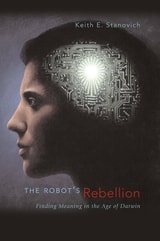
The Robot's Rebellion
Finding Meaning in the Age of DarwinKeith E. Stanovich
University of Chicago Press, 2004
The idea that we might be robots is no longer the stuff of science fiction; decades of research in evolutionary biology and cognitive science have led many esteemed scientists to the conclusion that, according to the precepts of universal Darwinism, humans are merely the hosts for two replicators (genes and memes) that have no interest in us except as conduits for replication. Richard Dawkins, for example, jolted us into realizing that we are just survival mechanisms for our own genes, sophisticated robots in service of huge colonies of replicators to whom concepts of rationality, intelligence, agency, and even the human soul are irrelevant.
Accepting and now forcefully responding to this decentering and disturbing idea, Keith Stanovich here provides the tools for the "robot's rebellion," a program of cognitive reform necessary to advance human interests over the limited interest of the replicators and define our own autonomous goals as individual human beings. He shows how concepts of rational thinking from cognitive science interact with the logic of evolution to create opportunities for humans to structure their behavior to serve their own ends. These evaluative activities of the brain, he argues, fulfill the need that we have to ascribe significance to human life.
We may well be robots, but we are the only robots who have discovered that fact. Only by recognizing ourselves as such, argues Stanovich, can we begin to construct a concept of self based on what is truly singular about humans: that they gain control of their lives in a way unique among life forms on Earth—through rational self-determination.
[more]