Results by title
6 books match the query 'Excavation'
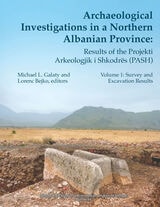
Archaeological Investigations in a Northern Albanian Province
Results of the Projekti Arkeologjik i Shkodrës (PASH): Volume One: Survey and Excavation ResultsMichael L. Galaty and Lorenc Bejko, Editors
University of Michigan Press, 2023
To date, very few northern Albanian archaeological sites have been surveyed and excavated. Situated beyond the reach, and allure, of the Classical Greek colonies of south-central Albania, the region has drawn less scholarly attention. But in various ways, northern Albania is just as important to the ongoing archaeological debates regarding the origins of inequality and the rise of social complexity.
Some of the earliest and largest hill forts and tumuli (burial mounds) in Albania, dating to the Bronze and Iron Age, are located in Shkodër. Shkodër (Rozafa) Castle became the capital of the so-called Illyrian Kingdom, which was conquered by Rome in the early 3rd century BC. This research report, focused on the province of Shkodër, is based on five years of field and laboratory work and is the first synthetic archaeological treatment of this region.
The results of the Projekti Arkeologjik i Shkodrës (or PASH) are presented here in two volumes. Volume 1 includes geological context, a literature review, historical background, and reports on the regional survey and test excavations at three settlements and three tumuli. In Volume 2, the authors describe the artifacts recovered through survey and excavation, including chipped stone, small finds, and pottery from the prehistoric, Classical, Roman, medieval, and post-medieval periods. They also present results of faunal, petrographic, chemical, carpological, and strontium isotope analyses of the artifacts. Extensive supporting data is available on the University of Michigan's Deep Blue data repository: https://doi.org/10.7302/xnpy-0e60
These two volumes place northern Albania—and the Shkodër Province in particular—at the forefront of archaeological research in the Balkans.
[more]
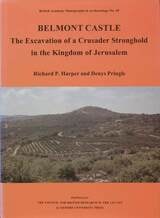
Belmont Castle
The Excavation of a Crusader Stronghold in the Kingdom of JerusalemRichard Harper
Council for British Research in the Levant, 2000
This is the final publication of excavations conducted by the British School of Archaeology in Jerusalem on the Crusader castle of Belmont (Suba) between 1986 and 1989. The account of the excavation is accompanied by specialist reports and concludes with a discussion of the castle's architecture, its military functions, and its economic role.
Library of Congress subject headings for this publication:
Belmont Castle Site (West Bank)
Excavations (Archaeology) -- West Bank.
West Bank -- Antiquities.
Jerusalem -- History -- Latin Kingdom, 1099-1244.
Library of Congress subject headings for this publication:
Belmont Castle Site (West Bank)
Excavations (Archaeology) -- West Bank.
West Bank -- Antiquities.
Jerusalem -- History -- Latin Kingdom, 1099-1244.