Results by title
266 books match the query 'Exegesis & Hermeneutics' and 15 start with a
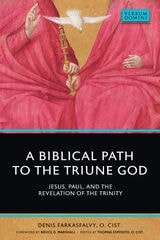
A Biblical Path to the Triune God
Jesus, Paul and the Revelation of the TrinityDenis Farkasfalvy
Catholic University of America Press, 2021

A Catalog of Biblical Passages in the Dead Sea Scrolls
David L. Washburn
SBL Press, 2003
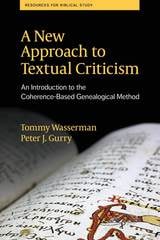
A New Approach to Textual Criticism
An Introduction to the Coherence-Based Genealogical MethodTommy Wasserman
SBL Press, 2017
An essential introduction for scholars and students of New Testament Greek
With the publication of the widely used 28th edition of Nestle-Aland’s Novum Testamentum Graece and the 5th edition of the United Bible Society Greek New Testament, a computer-assisted method known as the Coherence-Based Genealogical Method (CBGM) was used for the first time to determine the most valuable witnesses and establish the initial text. This book offers the first full-length, student-friendly introduction to this important new method. After setting out the method’s history, separate chapters clarify its key concepts, including genealogical coherence, textual flow diagrams, and the global stemma. Examples from across the New Testament are used to show how the method works in practice. The result is an essential introduction that will be of interest to students, translators, commentators, and anyone else who studies the Greek New Testament.
Features
- A clear explanation of how and why the text of the Greek New Testament is changing
- Step-by-step guidance on how to use the CBGM in textual criticism
- Diagrams, illustrations, and glossary of key terms
A Ransom for Israel
Jesus and Jewish Salvation in MatthewNicholas J. Schaser
SBL Press, 2025
Adopting the Stranger as Kindred in Deuteronomy
Mark R. Glanville
SBL Press, 2018
Investigate how Deuteronomy incorporates vulnerable, displaced people
Deuteronomy addresses social contexts of widespread displacement, an issue affecting 65 million people today. In this book Mark R. Glanville investigates how Deuteronomy fosters the integration of the stranger as kindred into the community of Yahweh. According to Deuteronomy, displaced people are to be enfolded within the household, within the clan, and within the nation. Glanville argues that Deuteronomy demonstrates the immense creativity that communities may invest in enfolding displaced and vulnerable people. Inclusivism is nourished through social law, the law of judicial procedure, communal feasting, and covenant renewal. Deuteronomy’s call to include the stranger as kindred presents contemporary nation-states with an opportunity and a responsibility to reimagine themselves and their disposition toward displaced strangers today.
Features:
- Exploration of the relationship of ancient Israel’s social history to biblical texts
- An integrative methodology that brings together literary-historical, legal, sociological, comparative, literary, and theological approaches
- A thorough study of Israelite identity and ethnicity
After the Corinthian Women Prophets
Reimagining Rhetoric and PowerJoseph A. Marchal
SBL Press, 2021
Rhetoric, Power, and Possibilities
Thirty years after the publication of Antoinette Clark Wire’s groundbreaking The Corinthian Women Prophets, an interdisciplinary, international, and intergenerational group of scholars reflects upon Wire’s impact on New Testament scholarship. Essays pursue further historical and theoretical possibilities, often in search of marginalized people, including the women of Corinth, using feminist, rhetorical, materialist, decolonizing, queer, and posthumanist approaches to interpret Paul’s letters and the history of ancient Mediterranean assemblies. Contributions from Cavan Concannon, Arminta Fox, Joseph A. Marchal, Shelly Matthews, Anna Miller, Jorunn Økland, and Antoinette Clark Wire reconsider how both the methods and results of Wire’s work reveal the possibilities of other people beside Paul who are worth our attention and effort. The essays in this collection introduce students and scholars to the possibilities of interdisciplinary and intersectional approaches for engaging the broader Pauline corpus.
Agur's Wisdom and the Coherence of Proverbs 30
Alexander T. Kirk
SBL Press, 2024
In this first in-depth study of Proverbs 30, the Words of Agur, Alexander T. Kirk examines a puzzling text attributed to an unknown figure that has long fascinated scholars. While this material has been read as everything from a devout confession to a cry of despair, few interpreters have found any real coherence in the chapter. In this detailed philological study engaging both genre and tone, Kirk demonstrates that the chapter is best read as a coherent collection that mocks pride and greed while it commends humility and contentment. Kirk draws out many subtle literary features that augment Agur’s message, including humor and animal imagery. Ultimately, Proverbs 30 deepens the presentation of wisdom in the book of Proverbs by orienting it toward a proper relationship with God.
Allusive Soundplay in the Hebrew Bible
Jonathan G. Kline
SBL Press, 2016
The first study to focus exclusively on the use in the Hebrew Bible of soundplay to allude to and interpret earlier literary traditions
This book focuses on the way the biblical writers used allusive soundplay to construct theological discourse, that is, in service of their efforts to describe the nature of God and God's relationship to humanity. By showing that a variety of biblical books contain examples of allusive soundplay employed for this purpose, Kline demonstrates that this literary device played an important role in the growth of the biblical text as a whole and in the development of ancient Israelite and early Jewish theological traditions.
Features:- Demonstrates that allusive soundplay was a productive compositional technique in ancient Israel
- Identifies examples of innerbiblical allusion that have not been identified before
- A robust methodology for identifying soundplay in innerbiblical allusions
An Introduction to Empire in the New Testament
Adam Winn
SBL Press, 2016
Explore how empire is a crucial foreground for reading and interpreting the New Testament
In the last three decades, significant attention has been given to the way in which New Testament texts engage and respond to the imperial world in which they were written. The purpose of the present volume is to introduce students and non-specialists to the growing subfield of New Testament studies known as empire studies. Contributors seek to make readers aware of the significant work that has already been produced, while also pointing them to new ways in which this field is moving forward. The contributors are Bruce W. Longenecker, Richard A. Horsley, Warren Carter, Adam Winn, Eric D. Barreto, Beth M. Sheppard, Neil Elliot, James R. Harrison, Harry O. Maier, Deborah Krause, Jason A.Whitlark, Matthew R. Hauge, Kelly D. Liebengood, and Davina C. Lopez.
Features:
Ancient Christian Apocrypha
Marginalized Texts in Early ChristianityOuti Lehtipuu
SBL Press, 2022
Apocalyptic Sheep and Goats in Matthew and 1 Enoch
Elekosi F. Lafitaga
SBL Press, 2022
An alternative understanding of apocalyptic eschatology in the Gospel of Matthew
Matthew’s eschatological imageries of judgment are often identified as apocalyptic and referred to as Matthew’s apocalyptic discourses. In this volume Elekosi F. Lafitaga reexamines Matthew’s vision of the sheep and goats in the judgment of the nations, which are often interpreted as metaphors for the saved and the condemned. Lafitaga views these images in the wider context of the rhetoric of apocalyptic communication stretching back to Matthew 3. This broader context reveals that the vision of Matthew 25 serves to exhort Israel in the here and now according to the torah, with salvation for Israel involving an indispensable responsibility to love and serve humanity. Central to Lafitaga’s analysis is the highly probable scenario that the material in Matthew is dependent on the Book of Dreams (1 Enoch 83–90).
Apocalyptic Sheep and Goats in Matthew and 1 Enoch
Elekosi F. Lafitaga
SBL Press, 2022
Armenian Apocrypha Relating to Biblical Heroes
Michael E. Stone
SBL Press, 2019
Explore richly embellished Armenian tales of biblical heroes
This fifth book of Michael E. Stone's English translations of stories from medieval Armenian manuscripts illustrates how authors transmitted and transformed accounts of biblical heroes. Texts focus on important figures such as Adam, Noah, Abraham, Solomon, Daniel and Susanna, and more. This collection reflects not only the richness of Armenian creativity stimulated by piety and learning but also Michael E. Stone's career-long search for reworkings of biblical traditions, stories, and persons in the Armenian tradition.
Features:
- A rich tradition of biblical exegesis and commentary, much of it in genres of the older apocryphal and pseudepigraphical literature
- Reflections on the roots of Armenian texts in ancient Judaism and earliest Christianity
- Texts, translations, and a critical apparatus
Aseneth of Egypt
The Composition of a Jewish NarrativePatricia D. Ahearne-Kroll
SBL Press, 2020
An exploration of Aseneth's beginnings
In Aseneth of Egypt: The Composition of a Jewish Narrative, Patricia D. Ahearne-Kroll challenges reliance on reconstructed texts in previous scholarship on the book of Joseph and Aseneth. After outlining the problems with previous prototypes of the Hellenistic narrative, she proposes a way to talk about the story in its initial setting without ignoring the manuscript evidence. Her thorough analysis of the evidence reveals how Joseph and Aseneth reflects the literary impulse of Greek-speaking Jewish writers to redescribe their identity in Egypt and Judean connections to the land of Egypt, while incorporating Ptolemaic strategies of legitimation of power. In the end, Ahearne-Kroll concludes that the base storyline preserved in all the copies of this story demonstrates that it was written for Jewish communities living in Hellenistic Egypt.
Features:
- A focus on Hellenistic stories of heroic ancestors
- A discussion of the possible lives of Jews in Hellenistic Egypt drawn from the narrative of Aseneth
- An examination of the complexities involved in dating the composition of literary texts

Ask the Animals
Developing a Biblical Animal HermeneuticArthur W. Walker-Jones
SBL Press, 2024
Ask the animals, and they will tell you.
Birds, beasts, and creeping things swarm throughout the Bible’s pages. Despite their prevalence, most biblical scholars have viewed them merely as metaphors, passive objects, or background embellishment to the human experience. This collection seeks to move beyond this traditional view of biblical animals by engaging the growing interdisciplinary field of animal studies. Contributors Peter Joshua Atkins, Jared Beverly, William P. Brown, Margaret Cohen, Jacob R. Evers, Michael J. Gilmour, William “Chip” Gruen, Dong Hyeon Jeong, Brian Fiu Kolia, Anne Létourneau, Robert R. MacKay, Suzanna R. Millar, Timothy J. Sandoval, Robert Paul Seesengood, Ken Stone, Brian James Tipton, Arthur W. Walker-Jones, and Jaime L. Waters showcase the breadth and depth of inquiry that animal studies can foster in biblical studies as well as what animal studies can gain from a more rigorous engagement with biblical texts. Together the essays offer an animal hermeneutic that supports the flourishing of all creatures.