Results by title
13 books match the query 'Exercises'
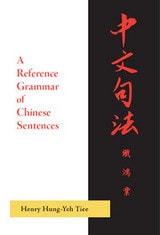
A Reference Grammar of Chinese Sentences with Exercises
Henry Hung-Yeh Tiee
University of Arizona Press, 1986

Anti-Apocalypse
Exercises in Genealogical CriticismLee Quinby
University of Minnesota Press, 1994
Anti-Apocalypse was first published in 1994. Minnesota Archive Editions uses digital technology to make long-unavailable books once again accessible, and are published unaltered from the original University of Minnesota Press editions.
As the year 2000 looms, heralding a new millennium, apocalyptic thought abounds-and not merely among religious radicals. In politics, science, philosophy, popular culture, and feminist discourse, apprehensions of the End appear in images of cultural decline and urban chaos, forecasts of the end of history and ecological devastation, and visions of a new age of triumphant technology or a gender-free utopia. There is, Lee Quinby contends, a threatening "regime of truth" prevailing in the United States-and this regime, with its enforcement of absolute truth and morality, imperils democracy. In Anti-Apocalypse, Quinby offers a powerful critique of the millenarian rhetoric that pervades American culture. In doing so, she develops strategies for resisting its tyrannies.
Drawing on feminist and Foucauldian theory, Quinby explores the complex relationship between power, truth, ethics, and apocalypse. She exposes the ramifications of this relationship in areas as diverse as jeanswear magazine advertising, the Human Genome project, contemporary feminism and philosophy, texts by Henry Adams and Zora Neale Hurston, and radical democratic activism. By bringing together such a wide range of topics, Quinby shows how apocalypse weaves its way through a vast network of seemingly unrelated discourses and practices. Tracing the deployment of power through systems of alliance, sexuality, and technology, Quinby reveals how these power relationships produce conflicting modes of subjectivity that create possibilities for resistance. She promotes a variety of critical stances—genealogical feminism, an ethics of the flesh, and "pissed criticism"—as challenges to apocalyptic claims for absolute truth and universal morality. Far-reaching in its implications for social and cultural theory as well as for political activism, Anti-Apocalypse will engage readers across the cultural spectrum and challenge them to confront one of the most subtle and insidious orthodoxies of our day.Lee Quinby is associate professor of English and American studies at Hobart and William Smith Colleges. She is the author of Freedom, Foucault, and the Subject of America (1991) and coeditor (with Irene Diamond) of Feminism and Foucault: Reflections on Resistance (1988).

Bosnian, Croatian, Serbian, a Textbook
With Exercises and Basic GrammarRonelle Alexander and Ellen Elias-Bursac
University of Wisconsin Press, 2006
•Classroom exercises designed for both small-group and full-class work, allowing for maximum oral participation
•Reading selections written by Bosnian, Croatian, and Serbian authors especially for this book
•Vocabulary lists for each individual section and full glossaries at the end of the book
•A short animated film, on an accompanying DVD, for use with chapter 15
•Brief grammar explanations after each dialogue, with cross-reference to more detailed grammar chapters in Bosnian, Croatian, Serbian, a Grammar
Available separately, the audio supplement (ISBN 0-299-22110-5) offers audio recordings of all dialogues in Bosnian, Croatian, and Serbian, a Textbook.
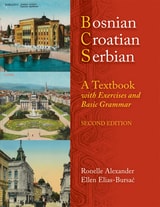
Bosnian, Croatian, Serbian, a Textbook
With Exercises and Basic GrammarRonelle Alexander
University of Wisconsin Press, 2010
• All dialogues, exercises, and homework assignments available in Bosnian, Croatian, and Serbian
• Classroom exercises designed for both small-group and full-class work, allowing for maximum oral participation
• Reading selections written by Bosnian, Croatian, and Serbian authors especially for this book
• Vocabulary lists for each individual section and full glossaries at the end of the book
• A short animated film, on an accompanying DVD, for use with chapter 15
• Brief grammar explanations after each dialogue, with a cross-reference to more detailed grammar chapters in the companion book, Bosnian, Croatian, Serbian, a Grammar.
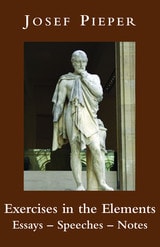
Exercises in the Elements
Essays, Speeches, NotesJosef Pieper
St. Augustine's Press, 2016
A fundamental issue for Pieper is “createdness.” He sees this as the fundamental truth of our being – all being – and the fundamental virtue we can practise is the striving to live according to our perception of real truth in any given situation.
The strength and attraction of Pieper’s writing is its direct and intuitive character which is independent of abstract systematization. He advocates staying in touch with the “real” as we experience it deep within ourselves. Openness to the totality of being – in no matter what context being reveals itself – and the affirmation of all that is founded in this totality are central pillars of all his thinking. Given the “simplicity” of this stance, it is no surprise that much of it is communicated – and successfully – through his gift for illustration by anecdote. Like Plato, this philosopher is a story-teller and, like him, very readable.
Function Of Criticism
Problems and ExercisesYvor Winters
Ohio University Press, 1957
The Function of Criticism: Problems and Exercises brings together five essays by Yvor Winters: “Problems for the Modern Critic of Literature,” “The Audible Reading of Poetry,” “The Poetry of Gerard Manley Hopkins,” “Robert Frost, Or the Spiritual Drifter as Poet,” and “English Literature in the Sixteenth Century.”
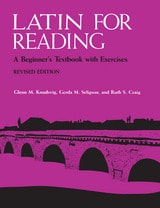
Latin for Reading
A Beginner's Textbook with ExercisesGlenn M. Knudsvig, Ruth S. Craig, and Gerda M. Seligson
University of Michigan Press, 1986
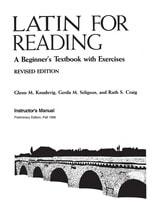
Latin for Reading
A Beginner's Textbook with Exercises, Instructor's ManualGlenn M. Knudsvig, Ruth S. Craig, and Gerda M. Seligson
University of Michigan Press, 1986
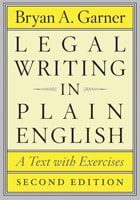
Legal Writing in Plain English, Second Edition
A Text with ExercisesBryan A. Garner
University of Chicago Press, 2013
Accessible and witty, Legal Writing in Plain English draws on real-life writing samples that Garner has gathered through decades of teaching experience. Trenchant advice covers all types of legal materials, from analytical and persuasive writing to legal drafting, and the book’s principles are reinforced by sets of basic, intermediate, and advanced exercises in each section.
In this new edition, Garner preserves the successful structure of the original while adjusting the content to make it even more classroom-friendly. He includes case examples from the past decade and addresses the widespread use of legal documents in electronic formats. His book remains the standard guide for producing the jargon-free language that clients demand and courts reward.
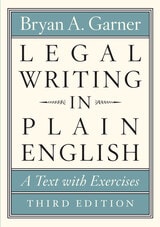
Legal Writing in Plain English, Third Edition
A Text with ExercisesBryan A. Garner
University of Chicago Press, 2023
Admirably clear, concise, down-to-earth, and powerful—all too often, legal writing embodies none of these qualities. Its reputation for obscurity and needless legalese is widespread. Since 2001, Bryan A. Garner’s Legal Writing in Plain English has helped address this problem by providing lawyers, judges, paralegals, law students, and legal scholars with sound advice and practical tools for improving their written work. Now the leading guide to clear writing in the field, this indispensable volume encourages legal writers to challenge conventions and offers valuable insights into the writing process: how to organize ideas, create and refine prose, and improve editing skills.
Accessible and witty, Legal Writing in Plain English draws on real-life writing samples that Garner has gathered through decades of teaching experience. Trenchant advice covers all types of legal materials, from analytical and persuasive writing to legal drafting, and the book’s principles are reinforced by sets of basic, intermediate, and advanced exercises in each section.
For this third edition, Garner has retained the structure of the previous versions, with updates and new material throughout. There are new sections on making your writing vivid and concrete and on using graphics to enhance your argument. The coverage and examples of key topics such as achieving parallelism, avoiding legalese, writing effective openers and summaries, and weaving quotations into your text have also been expanded. And the sample legal documents and exercises have been updated, while newly added checklists provide quick summaries of each section.
Altogether, this new edition will be the most useful yet for legal professionals and students seeking to improve their prose.
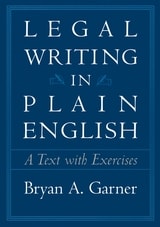
Legal Writing in Plain English
A Text with ExercisesBryan A. Garner
University of Chicago Press, 2001
Replete with common sense and wit, the book draws on real-life writing samples that Garner has gathered through more than a decade of teaching in the field. Trenchant advice covers all types of legal materials, from analytical and persuasive writing to legal drafting. Meanwhile, Garner explores important aspects of document design. Basic, intermediate, and advanced exercises in each section reinforce the book's principles. (An answer key to basic exercises is included in the book; answers to intermediate and advanced exercises are provided in a separate Instructor's Manual, free of charge to instructors.) Appendixes include a comprehensive punctuation guide with advice and examples, and four model documents.
Today more than ever before, legal professionals cannot afford to ignore the trend toward clear language shorn of jargon. Clients demand it, and courts reward it. Despite the age-old tradition of poor writing in law, Legal Writing in Plain English shows how legal writers can unshackle themselves.
Legal Writing in Plain English includes:
*Tips on generating thoughts, organizing them, and creating outlines.
*Sound advice on expressing your ideas clearly and powerfully.
*Dozens of real-life writing examples to illustrate writing problems and solutions.
*Exercises to reinforce principles of good writing (also available on the Internet).
*Helpful guidance on page layout.
*A punctuation guide that shows the correct uses of every punctuation mark.
*Model legal documents that demonstrate the power of plain English.
Physical Expression and the Performing Artist
Moving Beyond the PlateauJerald Schwiebert
University of Michigan Press, 2011
All performers know that "tuning up the body" is necessary to maximize performance. A person's mannerisms, habitual patterns of movement, and posture can block the capacity for expression, often without the performer even noticing. Physical Expression and the Performing Artist offers an organized approach to movement for actors, conductors, dancers, singers, musicians---for performers of any kind.
Capturing the energy of the popular workshops presented by master movement teacher Jerald Schwiebert, the book draws from the wisdom of hatha yoga, tai chi, and Pilates as well as from the teachings of Stanislavski, Structural Integration (Rolfing), Alexander, Feldenkrais, and Laban to provide a fresh and accessible approach to movement. More than 300 anatomical drawings help readers pinpoint specific muscles, joints, and actions as they explore the capacity of the performer's physical instrument, the components of dynamic movement, and the anatomy of expression. The book's many detailed exercises bring awareness of habitual and inefficient movement and introduce the steps necessary for more efficient movement patterns in all parts of the body. This book will prove indispensable in movement courses and as a resource guide for professionals seeking to take their performances to the next level.
The Desire of Psychoanalysis
Exercises in Lacanian ThinkingGabriel Tupinambá; With a foreword by Slavoj Žižek
Northwestern University Press, 2021
The Desire of Psychoanalysis proposes that recognizing how certain theoretical and institutional problems in Lacanian psychoanalysis are grounded in the historical conditions of Lacan’s own thinking might allow us to overcome these impasses. In order to accomplish this, Gabriel Tupinambá analyzes the socioeconomic practices that underlie the current institutional existence of the Lacanian community—its political position as well as its institutional history—in relation to theoretical production.
By focusing on the underlying dynamic that binds clinical practice, theoretical work, and institutional security in Lacanian psychoanalysis today, Tupinambá is able to locate sites for conceptual innovation that have been ignored by the discipline, such as the understanding of the role of money in clinical practice, the place of analysands in the transformation of psychoanalytic theory, and ideological dead-ends that have become common sense in the Lacanian field. The Desire of Psychoanalysis thus suggests ways of opening up psychoanalysis to new concepts and clinical practices and calls for a transformation of how psychoanalysis is understood as an institution.