Results by title
7 books match the query 'Expatriate artists'
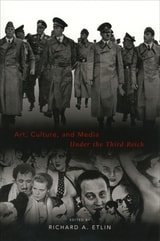
Art, Culture, and Media Under the Third Reich
Edited by Richard A. Etlin
University of Chicago Press, 2002
Contributors address nearly every facet of the arts and mass media under the Third Reich—efforts to define degenerate music and art; the promotion of race hatred through film and public assemblies; views of the racially ideal garden and landscape; race as portrayed in popular literature; the reception of art and culture abroad; the treatment of exiled artists; and issues of territory, conquest, and appeasement. Familiar subjects such as the Munich Accord, Nuremberg Party Rally Grounds, and Lebensraum (Living Space) are considered from a new perspective. Anyone studying the history of Nazi Germany or the role of the arts in nationalist projects will benefit from this book.
Contributors:
Ruth Ben-Ghiat
David Culbert
Albrecht Dümling
Richard A. Etlin
Karen A. Fiss
Keith Holz
Kathleen James-Chakraborty
Paul B. Jaskot
Karen Koehler
Mary-Elizabeth O'Brien
Jonathan Petropoulos
Robert Jan van Pelt
Joachim Wolschke-Bulmahn and Gert Gröning
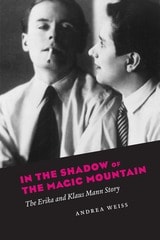
In the Shadow of the Magic Mountain
The Erika and Klaus Mann StoryAndrea Weiss
University of Chicago Press, 2008
Thomas Mann’s two eldest children, Erika and Klaus, were unconventional, rebellious, and fiercely devoted to each other. Empowered by their close bond, they espoused vehemently anti-Nazi views in a Europe swept up in fascism and were openly, even defiantly, gay in an age of secrecy and repression. Although their father’s fame has unfairly overshadowed their legacy, Erika and Klaus were serious authors, performance artists before the medium existed, and political visionaries whose searing essays and lectures are still relevant today. And, as Andrea Weiss reveals in this dual biography, their story offers a fascinating view of the literary and intellectual life, political turmoil, and shifting sexual mores of their times.
In the Shadow of the Magic Mountain begins with an account of the make-believe world the Manns created together as children—an early sign of their talents as well as the intensity of their relationship. Weiss documents the lifelong artistic collaboration that followed, showing how, as the Nazis took power, Erika and Klaus infused their work with a shared sense of political commitment. Their views earned them exile, and after escaping Germany they eventually moved to the United States, where both served as members of the U.S. armed forces. Abroad, they enjoyed a wide circle of famous friends, including Andre Gide, Christopher Isherwood, Jean Cocteau, and W. H. Auden, whom Erika married in 1935. But the demands of life in exile, Klaus’s heroin addiction, and Erika’s new allegiance to their father strained their mutual devotion, and in 1949 Klaus committed suicide.
Beautiful never-before-seen photographs illustrate Weiss’s riveting tale of two brave nonconformists whose dramatic lives open up new perspectives on the history of the twentieth century.
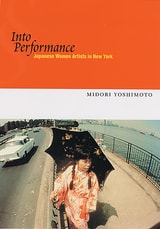
Into Performance
Japanese Women Artists in New YorkYoshimoto, Midori
Rutgers University Press, 2005
The 1960s was a time of incredible freedom and exploration in the art world, particularly in New York City, which witnessed the explosion of New Music, Happenings, Fluxus, New Dance, pop art, and minimalist art. Also notable during this period, although often overlooked, is the inordinate amount of revolutionary art that was created by women.
Into Performance fills a critical gap in both American and Japanese art history as it brings to light the historical significance of five women artists-Yoko Ono, Yayoi Kusama, Takako Saito, Mieko Shiomi, and Shigeko Kubota. Unusually courageous and self-determined, they were among the first Japanese women to leave their country-and its male-dominated, conservative art world-to explore the artistic possibilities in New York. They not only benefited from the New York art scene, however, they played a major role in the development of international performance and intermedia art by bridging avant garde movements in Tokyo and New York.
This book traces the pioneering work of these five women artists and the socio-cultural issues that shaped their careers. Into Performance also explores the transformation of these artists' lifestyle from traditionally confined Japanese women to internationally active artists. Yoshimoto demonstrates how their work paved the way for younger Japanese women artists who continue to seek opportunities in the West today.
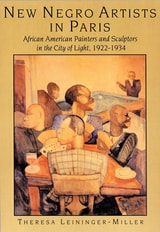
New Negro Artists in Paris
African American Painters and Sculptors in the City of Light, 1922-1934Leininger-Miller, Theresa
Rutgers University Press, 2001
These artists exhibited the works they created in Paris at prestigious salons in France and in the United States, winning fellowships, grants, and awards. Leininger-Miller argues that it was study abroad that won these artists critical acclaim, establishing their reputations as some of the most significant leaders of the New Negro movement in the visual arts. She begins her study with a history of the debut of African American artists in Paris, 1830–1914, then provides readers with rarely seen profiles of each of the six artists from their birth through the end of their time abroad. Finally, Leininger-Miller examines patterns and differences in these individuals’ backgrounds and development, their patronage in the United States and France, their shared experiences abroad, and the impact their study in Paris had on the rest of their careers.

Performing Exile
Foreign BodiesEdited by Judith Rudakoff
Intellect Books, 2017
In a world where exiled populations continue to grow, the role of art to document and engage with these experiences will continue to be essential, and this diverse book offers an important model for understanding the rich body of work being created today.
A PDF version of this book is available for free in open access via the OAPEN Library platform, www.oapen.org It has been made available under a Creative Commons Attribution 4.0 International Public License and is part of Knowledge Unlatched.

Romaine Brooks
A LifeCassandra Langer
University of Wisconsin Press, 2015
Romaine Brooks: A Life introduces much fresh information from Langer's decades of research on Brooks and establishes this groundbreaking artist's centrality to feminism and contemporary sexual politics as well as to visual culture.
The Modern Israeli and Palestinian Diasporas
A Comparative ApproachEdited by Nahum Karlinsky
University of Texas Press, 2024
A comparative study of contemporary Israeli and Palestinian diasporas.
Exilic and diasporic experience have become ubiquitous in recent decades. Jews, lacking a homeland, spread to various parts of the world, making the Jewish diaspora paradigmatic. But after the establishment of Israel in 1948, a different kind of diaspora emerged, as more than a tenth of Israeli citizens have chosen to leave their newly established state and resettle. Meanwhile, about half of all Palestinians, including Palestinian citizens of Israel, now reside in exile, predominantly as a result of the ongoing Palestinian-Israeli conflict.
Recognizing that Israeli-Jewish and Palestinian-Arab societies coexist and are engaged in constant relations, Nahum Karlinsky has assembled an impressive array of contributors to explore these diasporas alongside one another and in dialogue with other diasporic communities. The collected essays cover such topics as Palestinian exiles and diasporas, the demographics of today’s Israeli diaspora, immigrant enterprises, transnationalism and development, the unique place of Israeli Jews in the United States, the literature of Palestinian transnationals, and the emergence of Berlin as a queer Israeli-Jewish immigrant enclave.The Modern Israeli and Palestinian Diasporas challenges and reimagines the very notion of a homeland.