Results by title
2 books match the query 'Expatriate musicians'
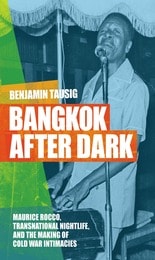
Bangkok after Dark
Maurice Rocco, Transnational Nightlife, and the Making of Cold War IntimaciesBenjamin Tausig
Duke University Press, 2025
From the 1930s to the 1950s, jazz pianist Maurice Rocco was a mainstay in Hollywood and American nightlife scenes. As rock and roll surpassed jazz as America’s most popular music in the 1950s, the queer Black pianist’s fortunes faded and he was forced to go abroad for new opportunities. In 1964 Rocco settled in Bangkok, where he thrived and enjoyed a relatively privileged life until he was murdered by two young male sex workers in 1976. In Bangkok after Dark, Benjamin Tausig uses Rocco’s intriguing story to trace the history of transnational nightlife encounters between Thais and Americans during the long American war in Vietnam. Tausig shows how these encounters, which included musical collaborations, romantic and sexual relationships, and new labor, identity, and geopolitical configurations, remade Thailand in crucial and enduring ways. As Tausig demonstrates, Rocco’s Blackness, queerness, and musical life in Thailand illuminate how Thai-American relationships complicated neat distinctions between the two countries. In teasing out these complexities through the figure of Rocco, Tausig challenges conventional understandings of the global Cold War on individual and transnational scales.
[more]
Jazz Exiles
Bill Moody
University of Nevada Press, 2000
The Jazz Exiles chronicles the expatriate movement of American jazz musicians during the post-World War II era. While the term "exiles" normally conjures up images of ousted Third World leaders or deposed kings, it is as much a part of the jazz vocabulary as improvization or Birdland. Like the American writers of the 1920s who went to Europe and became Gertrude Stein's "lost generation", jazz musicians from the United States also made the Atlantic crossing at a steadily increasing rate until many of the major names in jazz lived or worked almost exclusively abroad. Throughout "The Jazz Exiles", the musicians speak for themselves in describing their motivation for joining the exodus to Europe which is now regarded as the third largest migration in jazz history. The exiles include many of the biggest names in jazz - Dexter Gordon, Johnny Griffin, Phil Woods, Coleman Hawkins, Louis Armstrong, Stan Getz, Benny Carter, and Bud Powell, among others. This work also assesses the impact of foreign residence on the careers of these musicians and on the history of jazz. Moody, a jazz musician himself, charts the movement of American musicians to Europe from a historical perspective and examines the exile experience from a number of sociological and economic viewpoints, all of which are factors in understanding jazz history. With stories narrated through personal interviews in the musicians' own words, "The Jazz Exiles" aims to shed new light on America's attitude toward its own original art form and examines the dilemma of the American artist both at home and abroad. Jazz aficionados, rhythm and blues fans - in fact, anyone who appreciates American music - should read the stories of these jazz exiles. "
[more]