Results by title
10 books match the query 'Experimental Methods'
Empirical and Experimental Methods in Cognitive/Functional Research
Edited by Sally Rice and John Newman
CSLI, 2010
Empirical and Experimental Methods in Cognitive/Functional Research consists of selected papers from the seventh meeting of the Conceptual Structure, Discourse, and Language Conference, held at the University of Alberta in October 2004. The papers fall into five main categories, reflecting the cognitive and functional orientation of the conference: reciprocity between lexis and syntax, semantic factors affecting form patterning, grammaticalization of basic verbs, form/meaning pairings in discourse, and experimental investigations of language/mind and language/use interactions. In addition, a plenary paper by Nick Evans on complex events, propositional overlay, and the special status of reciprocal clauses is included.

Franklin Furnace and the Spirit of the Avant-Garde
A History of the FutureToni Sant
Intellect Books, 2011
Franklin Furnace is a renowned New York–based artsorganization whose mission is to preserve, document, and present works of avant-garde art by emerging artists—particularly those whose works may be vulnerable due to institutional neglect or politically unpopular content. Over more than thirty years, Franklin Furnace has exhibited works by hundreds of avant-garde artists, some of whom—Laurie Anderson, Vito Acconci, Karen Finley, Guillermo Gómez-Peña, Jenny Holzer, and the Blue Man Group, to name a few—are now established names in contemporary art.
Here, for the first time, is a comprehensive history of this remarkable organization from its conception to the present. Organized around the major art genres that emerged in the second half of the twentieth century, this book intersperses first-person narratives with readings by artists and scholars on issues critical to the organization's success as well as Franklin Furnace's many contributions to avant-garde art.
In and Out of Phase
An Episodic History of Art and Music in the 1960sMichael Maizels
University of Michigan Press, 2020
In and Out of Phase is the first sustained look at the creative interactions between artists and musicians of this era, looking at four pairs of creators who used process-oriented ideas and techniques in their music and art: Dan Flavin and La Monte Young; Sol LeWitt and Milton Babbitt; Richard Serra and Steve Reich; and Bruce Nauman and Meredith Monk. Maizels uncovers not just the social and intellectual connections between these two groups of creators, but illuminates how the focus on repetitive actions, pattern and process, and an emphasis on “surface” created mutual influence—and stylistic change—between music and art during this period. The book’s concluding chapter briefly addresses the enduring influence of the innovations of the 1960s on more recent works.
Sensing the Future
Experiments in Art and Technology (E.A.T.)Nancy Perloff
J. Paul Getty Trust, The, 2024
In 1966, Billy Klüver and Fred Waldhauer, engineers at Bell Labs in Murray Hill, New Jersey, teamed up with artists Robert Rauschenberg and Robert Whitman to form a nonprofit organization, Experiments in Art and Technology (E.A.T.). E.A.T.’s debut event, 9 Evenings: Theatre & Engineering, integrated art, theater, and groundbreaking technology in a series of performances at the 69th Regiment Armory in Manhattan. Its second major event, the Pepsi Pavilion at Expo ’70 in Osaka, Japan, presented a multisensory environment for the first world exposition held in Asia. At these events, and in the hundreds of collaborations E.A.T. facilitated in between, the participants—including John Cage, Lucinda Childs, Deborah Hay, Steve Paxton, Yvonne Rainer, and David Tudor—imagined innovative ways for art and science to intersect and enrich society.
Sensing the Future tells the story of these collaborations between artists and engineers and how they led to new installations and technology-based artworks. Through the examination of films, photographs, diagrams, and artists’ records from the E.A.T. archive at the Getty Research Institute, this volume provides a new perspective on multimedia art in the 1960s and ’70s and highlights the ways E.A.T. pushed the role of the artist beyond the traditional art world.
This volume is published to accompany an exhibition on view at the Getty Research Institute at the Getty Center from September 10, 2024, to February 23, 2025.
Speculation, Now
Essays and ArtworkVyjayanthi Venuturupalli Rao, with Prem Krishnamurty and Carin Kuoni, eds.
Duke University Press, 2014
Artists and essayists include William Darity Jr., Filip De Boeck, Boris Groys, Hans Haacke, Darrick Hamilton, Laura Kurgan, Lin + Lam, Gary Lincoff, Lize Mogel, Christina Moon, Stefania Pandolfo, Satya Pemmaraju, Mary Poovey, Walid Raad, Sherene Schostak, Robert Sember, and Srdjan Jovanović Weiss.
Published by Duke University Press and the Vera List Center for Art and Politics at The New School
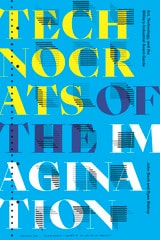
Technocrats of the Imagination
Art, Technology, and the Military-Industrial Avant-GardeJohn Beck and Ryan Bishop
Duke University Press, 2020
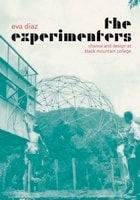
The Experimenters
Chance and Design at Black Mountain CollegeEva Díaz
University of Chicago Press, 2014
Díaz’s focus is on experimentation. Albers, Cage, and Fuller, she shows, taught new models of art making that favored testing procedures rather than personal expression. These methodologies represented incipient directions for postwar art practice, elements of which would be sampled, and often wholly adopted, by Black Mountain students and subsequent practitioners. The resulting works, which interrelate art and life in a way that imbues these projects with crucial relevance, not only reconfigured the relationships among chance, order, and design—they helped redefine what artistic practice was, and could be, for future generations.
Offering a bold, compelling new angle on some of the most widely studied creative figures of modern times, The Experimenters does nothing less than rewrite the story of art in the mid-twentieth century.
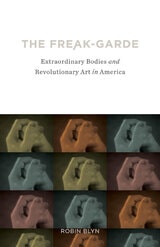
The Freak-garde
Extraordinary Bodies and Revolutionary Art in AmericaRobin Blyn
University of Minnesota Press, 2013
Since the 1890s, American artists have employed the arts of the freak show to envision radically different ways of being. The result is a rich avant-garde tradition that critiques and challenges capitalism from within.
The Freak-garde traces the arts of the freak show from P. T. Barnum to Matthew Barney and demonstrates how a form of mass culture entertainment became the basis for a distinctly American avant-garde tradition. Exploring a wide range of writers, filmmakers, photographers, and artists who have appropriated the arts of the freak show, Robin Blyn exposes the disturbing power of human curiosities and the desires they unleash. Through a series of incisive and often startling readings, Blyn reveals how such figures as Mark Twain, Djuna Barnes, Tod Browning, Lon Chaney, Nathanael West, and Diane Arbus use these desires to propose alternatives to the autonomous and repressed subject of liberal capitalism. Blyn explains how, rather than grounding revolutionary subjectivities in imaginary realms innocent of capitalism, freak-garde works manufacture new subjectivities by exploiting potentials inherent to capitalism.
Defying conventional wisdom, The Freak-garde ultimately argues that postmodernism is not the death of the avant-garde but the inheritor of a vital and generative legacy. In doing so, the book establishes innovative approaches to American avant-garde practices and embodiment and lays the foundation for a more nuanced understanding of the disruptive potential of art under capitalism.
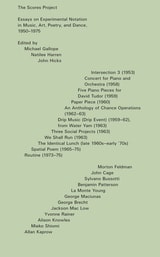
The Scores Project
Essays on Experimental Notation in Music, Art, Poetry, and Dance, 1950–1975Michael Gallope
J. Paul Getty Trust, The, 2025
Individuals working in and across the fields of visual art, music, poetry, theater, and dance in the mid–twentieth century began to use experimental scores in ways that revolutionized artistic practice and opened up new forms of interdisciplinary collaboration. Their experimental methods—associated with the neo-avant-garde, neo-Dadaism, intermedia, Fluxus, and postmodernism—exploded in notoriety during the 1960s in locales from New York to Europe, East Asia, and Latin America, becoming foundational to global trends in contemporary art and performance.
The Scores Project provides an in-depth view of this historical moment. Through expert commentaries from an interdisciplinary team of scholars with accompanying illustrations, this publication examines a series of experimental scores by John Cage, George Brecht, Sylvano Bussotti, Morton Feldman, Allan Kaprow, Alison Knowles, Jackson Mac Low, Benjamin Patterson, Yvonne Rainer, Mieko Shiomi, David Tudor, and La Monte Young. Ambitious, provocative, and playful, The Scores Project is an illuminating resource to scholars and students who seek to understand this innovative and historically complex moment in the history of art.
An expanded edition of this open-access publication is available for free online at www.getty.edu/publications/scores/. It includes more than 2,800 images, audio/video files, and interactive features. Also available are free PDF and EPUB downloads of the book.
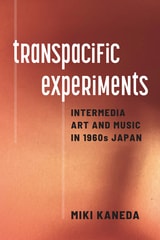
Transpacific Experiments
Intermedia Art and Music in 1960s JapanMiki Kaneda
University of Michigan Press, 2026
Intermedia art—an avant-garde multimedia practice that combines sound and moving images—took root in Japan alongside other places in the 1960s. In Transpacific Experiments, Miki Kaneda analyzes intermedia as a practice that gives form to errant possibilities, unfolding in spaces of the everyday, to offer nuanced insights into the global flow of ideas, influence, and discourses of appropriation. The stories of intermedia art throughout the study offer feminist and transnational perspectives on experimental music and art that disorient existing narratives about the experimental and political in unexpected ways.
Transpacific Experiments contends that social, cultural, and political arrangements local to Japan had a greater influence on the transnational experimental music scene than previously acknowledged. Kaneda’s perspective extends, exceeds, and at times unsettles frameworks for experimental practices, revealing the limitations of any single political or aesthetic lens.