Results by title
7 books match the query 'Experimental Psychology'

Operationism in Psychology
An Epistemology of ExplorationUljana Feest
University of Chicago Press, 2025
Psychology has seen an intense debate about the lack of replicability of results in recent years. Uljana Feest uses history and philosophy of science to shed light on the nature of experiment in psychology in general, but her aim reaches beyond debates about replication to provide a novel and comprehensive analysis of the investigative process in experimental psychology. She shows that the central unit of analysis for our epistemological considerations of psychological research should be not theories but, rather, concepts. Her guiding question is: How do psychological concepts figure in the experimental exploration of the objects of psychological research? For Feest, this question has two intertwined aspects: What role do concepts play in the design of experiments and the production of data, and how can concepts be revised or adapted in response to experimental results. Following the historical trajectory of debates about operationism in psychology, she argues that this debate was not concerned with philosophical theories of meaning but, instead, closely connected to the investigative practices of experimental psychologists. The book offers a broad analytical framework for thinking philosophically about the investigative process in psychology, including analyses of the relationship between data and phenomena in psychology, the relationship between folk- and scientific psychological concepts, the relationship between genuine results and experimental artifacts, and the nature and exploration of psychological kinds.
RSF
The Russell Sage Foundation Journal of the Social Sciences: Status: What Is It and Why It Matters for InequalityCecilia L. Ridgeway
Russell Sage Foundation, 2022
Note the copy pertains to two issues of RSF:
Status – a form of inequality based on esteem, respect, and honor – affects how people are treated in all aspects of their lives, including in schools, workplaces, politics, and even the family. It shapes people’s access to valued outcomes in life, such as income, education, and health. However, status is poorly understood and its significance in the construction of inequality is often underestimated. In this special double issue of RSF, sociologist Cecilia L. Ridgeway, social psychologist Hazel Rose Markus, and an interdisciplinary group of contributors examine how status functions in society and its role in inequality.
Issue 1 demonstrates that status is fundamental to inequality and shows that it is different from other forms of inequality. Tali Mendelberg presents a theory of how status functions in politics and differentiates the potent symbolic value of achieving greater esteem from status-seeking as a means to obtain resources, such as income, assets, or property. Biko Koeing finds that Trump voters were motivated not only by a perceived loss of status, but by the belief that this loss was unjust. Fabien Accominotti and colleagues assess the characteristics of status hierarchies and find that those with greater clarity, rigidity, and order have greater inequality between high and low status members.
Issue 2 examines how status is created and reinforced through cultural norms and in our relationships with one another. Hilary Holbrow finds that the gender pay gap is nearly three times greater in companies where low-status support roles are held primarily by females. Natasha Quadlin finds that college graduates who are perceived to be wealthy are also perceived to be more intelligent than they would be if they were perceived to be members of a lower socioeconomic group. Annette Lareau finds that married women often behave in ways – such as disengagement from financial matters or downplaying their own financial knowledge – that sustain their husband’s status as economic expert of the family. Bianca Manago and colleagues find that prior contact and group interaction between Whites, Blacks, and Mexican Americans decreases Whites’ anxiety about working with Blacks and Mexican Americans, but does not increase Whites’ perceptions of Blacks’ and Mexican Americans’ competence. Status interventions during interaction, however, do increase Whites’ perceptions of Mexican Americans’ competence and their influence in the group. Lehn Benjamin finds that staff at nonprofit organizations who share control and establish common ground with their clients reduce status hierarchies between staff and clients.
This volume of RSF sheds light on status as a powerful social force which pervades our lives, and demonstrates its role in creating and preserving inequality.
RSF
The Russell Sage Foundation Journal of the Social Sciences: Status: What It Is and Why It Matters for InequalityCecilia L. Ridgeway
Russell Sage Foundation, 2002
Note the copy pertains to two issues of RSF:
Status – a form of inequality based on esteem, respect, and honor – affects how people are treated in all aspects of their lives, including in schools, workplaces, politics, and even the family. It shapes people’s access to valued outcomes in life, such as income, education, and health. However, status is poorly understood and its significance in the construction of inequality is often underestimated. In this special double issue of RSF, sociologist Cecilia L. Ridgeway, social psychologist Hazel Rose Markus, and an interdisciplinary group of contributors examine how status functions in society and its role in inequality.
Issue 1 demonstrates that status is fundamental to inequality and shows that it is different from other forms of inequality. Tali Mendelberg presents a theory of how status functions in politics and differentiates the potent symbolic value of achieving greater esteem from status-seeking as a means to obtain resources, such as income, assets, or property. Biko Koeing finds that Trump voters were motivated not only by a perceived loss of status, but by the belief that this loss was unjust. Fabien Accominotti and colleagues assess the characteristics of status hierarchies and find that those with greater clarity, rigidity, and order have greater inequality between high and low status members.
Issue 2 examines how status is created and reinforced through cultural norms and in our relationships with one another. Hilary Holbrow finds that the gender pay gap is nearly three times greater in companies where low-status support roles are held primarily by females. Natasha Quadlin finds that college graduates who are perceived to be wealthy are also perceived to be more intelligent than they would be if they were perceived to be members of a lower socioeconomic group. Annette Lareau finds that married women often behave in ways – such as disengagement from financial matters or downplaying their own financial knowledge – that sustain their husband’s status as economic expert of the family. Bianca Manago and colleagues find that prior contact and group interaction between Whites, Blacks, and Mexican Americans decreases Whites’ anxiety about working with Blacks and Mexican Americans, but does not increase Whites’ perceptions of Blacks’ and Mexican Americans’ competence. Status interventions during interaction, however, do increase Whites’ perceptions of Mexican Americans’ competence and their influence in the group. Lehn Benjamin finds that staff at nonprofit organizations who share control and establish common ground with their clients reduce status hierarchies between staff and clients.
This volume of RSF sheds light on status as a powerful social force which pervades our lives, and demonstrates its role in creating and preserving inequality.

The Handbook of Research Synthesis
Harris Cooper
Russell Sage Foundation, 1994

The Handbook of Research Synthesis and Meta-Analysis
Harris Cooper
Russell Sage Foundation, 2009

The Handbook of Research Synthesis and Meta-Analysis
Harris Cooper
Russell Sage Foundation, 2019
The Handbook of Research Synthesis and Meta-Analysis draws upon groundbreaking advances that have transformed research synthesis from a narrative craft into an important scientific process in its own right. The editors and leading scholars guide the reader through every stage of the research synthesis process—problem formulation, literature search and evaluation, statistical integration, and report preparation. The Handbook incorporates state-of-the-art techniques from all quantitative synthesis traditions and distills a vast literature to explain the most effective solutions to the problems of quantitative data integration. Among the statistical issues addressed are the synthesis of non-independent data sets, fixed and random effects methods, the performance of sensitivity analyses and model assessments, the development of machine-based abstract screening, the increased use of meta-regression and the problems of missing data. The Handbook also addresses the non-statistical aspects of research synthesis, including searching the literature and developing schemes for gathering information from study reports. Those engaged in research synthesis will find useful advice on how tables, graphs, and narration can foster communication of the results of research syntheses.
The third edition of the Handbook provides comprehensive instruction in the skills necessary to conduct research syntheses and represents the premier text on research synthesis.
Praise for the first edition: "The Handbook is a comprehensive treatment of literature synthesis and provides practical advice for anyone deep in the throes of, just teetering on the brink of, or attempting to decipher a meta-analysis. Given the expanding application and importance of literature synthesis, understanding both its strengths and weaknesses is essential for its practitioners and consumers. This volume is a good beginning for those who wish to gain that understanding." —Chance "Meta-analysis, as the statistical analysis of a large collection of results from individual studies is called, has now achieved a status of respectability in medicine. This respectability, when combined with the slight hint of mystique that sometimes surrounds meta-analysis, ensures that results of studies that use it are treated with the respect they deserve….The Handbook of Research Synthesis is one of the most important publications in this subject both as a definitive reference book and a practical manual."—British Medical Journal When the first edition of The Handbook of Research Synthesis was published in 1994, it quickly became the definitive reference for researchers conducting meta-analyses of existing research in both the social and biological sciences. In this fully revised second edition, editors Harris Cooper, Larry Hedges, and Jeff Valentine present updated versions of the Handbook's classic chapters, as well as entirely new sections reporting on the most recent, cutting-edge developments in the field. Research synthesis is the practice of systematically distilling and integrating data from a variety of sources in order to draw more reliable conclusions about a given question or topic. The Handbook of Research Synthesis and Meta-Analysis draws upon years of groundbreaking advances that have transformed research synthesis from a narrative craft into an important scientific process in its own right. Cooper, Hedges, and Valentine have assembled leading authorities in the field to guide the reader through every stage of the research synthesis process—problem formulation, literature search and evaluation, statistical integration, and report preparation. The Handbook of Research Synthesis and Meta-Analysis incorporates state-of-the-art techniques from all quantitative synthesis traditions. Distilling a vast technical literature and many informal sources, the Handbook provides a portfolio of the most effective solutions to the problems of quantitative data integration. Among the statistical issues addressed by the authors are the synthesis of non-independent data sets, fixed and random effects methods, the performance of sensitivity analyses and model assessments, and the problem of missing data. The Handbook of Research Synthesis and Meta-Analysis also provides a rich treatment of the non-statistical aspects of research synthesis. Topics include searching the literature, and developing schemes for gathering information from study reports. Those engaged in research synthesis will also find useful advice on how tables, graphs, and narration can be used to provide the most meaningful communication of the results of research synthesis. In addition, the editors address the potentials and limitations of research synthesis, and its future directions. The past decade has been a period of enormous growth in the field of research synthesis. The second edition Handbook thoroughly revises original chapters to assure that the volume remains the most authoritative source of information for researchers undertaking meta-analysis today. In response to the increasing use of research synthesis in the formation of public policy, the second edition includes a new chapter on both the strengths and limitations of research synthesis in policy debates
The Stone Soup Experiment
Why Cultural Boundaries PersistDeborah Downing Wilson
University of Chicago Press, 2015
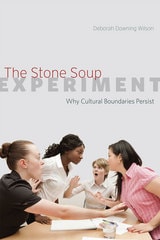
The experience of the Stoners and Traders is a profound testament to human sociality. Even in the form of simulation, even as a game, the participants found themselves quickly—and with real conviction—bound to the ideologies and practices of their in-group. The Stoners enjoyed their days lounging, chatting, and making crafts, while the Traders—through a complex market of playing cards—competed for the highest bankrolls. When they came into contact, misunderstanding, competition, and even manipulation prevailed, to the point that each group became so convinced of its own superiority that even after the simulation’s end the students could not reconcile.
Throughout her riveting narrative, Downing Wilson interweaves fascinating discussions on the importance of play, emotions, and intergroup interaction in the formation and maintenance of group identities, as well as on the dynamic social processes at work when different cultural groups interact. A fascinating account of social experimentation, the book paints a vivid portrait of our deepest social tendencies and the powers they have over how we make friends and enemies alike.