Results by title
7 books match the query 'Experimental fiction, American'
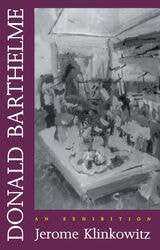
Donald Barthelme
An ExhibitionJerome Klinkowitz
Duke University Press, 1991
Klinkowitz argues that the central piece in the Barthelme canon, and the key to his artistic method, is his widely acknowledged masterpiece, The Dead Father. In turning to this pivotal work, as well as to Barthelme’s short stories and other novels, Klinkowitz explores the way in which Barthelme reinvented the tools of narration, characterization, and thematics at a time when fictive techniques were largely believed to be exhausted.
Klinkowitz, who was one of the first scholars to study Barthelme’s work and became its definitive bibliographer, situates Barthelme’s life and work within a broad spectrum of influences and affinities. A consideration of developments in painting and sculpture, for example, as well as those of contemporaneous fiction, contribute to Klinkowitz’s analysis. This astute reading will provide great insight for readers, writers, and critics of contemporary American fiction seeking explanations and justifications of Barthelme’s critical importance in the literature of our times.
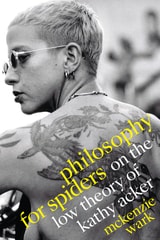
Philosophy for Spiders
On the Low Theory of Kathy AckerMcKenzie Wark
Duke University Press, 2021
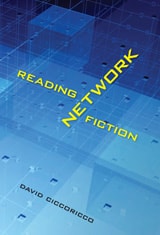
Reading Network Fiction
David Ciccoricco
University of Alabama Press, 2007
A theoretical framework for understanding fiction built on nodes, links, and distributed narrative systems.
The marriage of narrative and the computer dates back to the 1980s, with the hypertext experiments of luminaries such as Judy Malloy and Michael Joyce. What has been variously called "hypertext fiction," "literary hypertext," and "hyperfiction" has surely surrendered any claim to newness in the 21st century.
David Ciccoricco establishes the category of "network fiction" as distinguishable from other forms of hypertext and cybertext: network fictions are narrative texts in digitally networked environments that make use of hypertext technology in order to create emergent and recombinant narratives. Though they both pre-date and post-date the World Wide Web, they share with it an aesthetic drive that exploits the networking potential of digital composition and foregrounds notions of narrative recurrence and return.
Ciccoricco analyzes innovative developments in network fiction from first-generation writers Michael Joyce (Twilight, a symphony, 1997) and Stuart Moulthrop (Victory Garden, 1991) through Judd Morrissey’s The Jew's Daughter (2000), an acclaimed example of digital literature in its latter instantiations on the Web. Each investigation demonstrates not only what the digital environment might mean for narrative theory but also the ability of network fictions to sustain a mode of reading that might, arguably, be called "literary." The movement in the arts away from representation and toward simulation, away from the dynamics of reading and interpretation and toward the dynamics of interaction and play, has indeed led to exaggerated or alarmist claims of the endangerment of the literary arts. At the same time, some have simply doubted that the conceptual and discursive intricacy of print fiction can migrate to new media. Against these claims, Reading Network Fiction attests to the verbal complexity and conceptual depth of a body of writing created for the surface of the screen.

Stories Of Raymond Carver
A Critical StudyKirk Nesset
Ohio University Press, 1994
In this comprehensive study of Carver, Nesset discusses the relationship of minimalism and postmodern trends and the rise of new realism. By locating Carver in the gallery of American letters, Nesset shows him to be at once more simple and more complex than we might have believed, skillfully laying the groundwork for Carver studies to come.
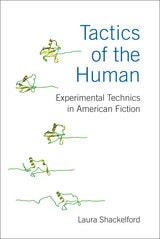
Tactics of the Human
Experimental Technics in American FictionLaura Shackelford
University of Michigan Press, 2015
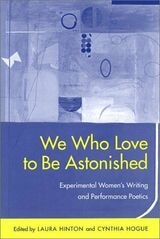
We Who Love to Be Astonished
Experimental Women's Writing and Performance PoeticsLaura Hinton
University of Alabama Press, 2001
The first critical volume devoted to the full range of women's postmodern works
We Who Love to Be Astonished collects a powerful group of previously unpublished essays to fill a gap in the critical evaluation of women's contributions to postmodern experimental writing. Contributors include Alan Golding, Aldon Nielsen, and Rachel Blau DuPlessis; discussions include analyses of the work of Kathleen Fraser, Harryette Mullen, and Kathy Acker, among others. The editors take as their title a line from the work of Lyn Hejinian, one of the most respected of innovative women poets writing today.
The volume is organized into four sections: the first two seek to identify, from two different angles, the ways women of different sociocultural backgrounds are exploring their relationships to their cultures' inherited traditions; the third section investigates the issue of visuality and the problems and challenges it creates; and the fourth section expands on the role of the body as material and performance.
The collection will breach a once irreconcilable divide between those who theorize about women's writing and those who focus on formalist practice. By embracing "astonishment" as the site of formalist-feminist investigation, the editors seek to show how form configures feminist thought, and, likewise, how feminist thought informs words and letters on a page. Students and scholars of avant-garde poetry, women's writing, and late-20th-century American literature will welcome this lively discussion.
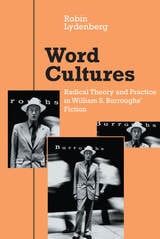
Word Cultures
Radical Theory and Practice in William S. Burroughs' FictionRobin Lydenberg
University of Illinois Press, 1987
Lydenberg focuses upon the stylistic accomplishments of this controversial and
experimental writer. In doing so, she skillfully demonstrates that the ideas
we now recognize as characteristic of post-structuralism and deconstruction
were being developed independently by Burroughs long ago.