Results by title
27 books match the query 'Experimental films'
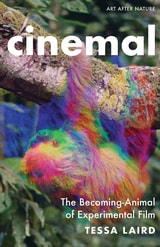
Cinemal
The Becoming-Animal of Experimental FilmTessa Laird
University of Minnesota Press, 2025
A foray through the wilds where experimental films and animals collide
Like the flash of a tropical bird’s iridescent wing, cinema can be furtive and intensely beautiful—and it can leave a viewer craving more. Cinemal is Tessa Laird’s passionate inquiry into the ways that films mimic the majesty, mystery, and movements of animals,her field notes from countless hair-raising encounters with films in their natural habitat.
Part of a growing focus on nonhuman animals in film, Cinemal ventures to the “furry underbelly” of global experimental film practice, focusing on films from New Zealand, Australia, and South America. Laird examines how animals are depicted in film and analyzes the various animal qualities of cinema, like scratching and sniffing, vibrant colors, and voices (barking, howling, or echolocation). Burrowing into the work of filmmakers such as Arthur and Corinne Cantrill, Sriwhana Spong, and Ana Vaz, Laird’s energetic prose embodies the films she discusses, seamlessly combining personal anecdotes with art theory and philosophy to spread a wide sensory buffet.
Lively and optimistic, Laird uses cinematic animal tropes to encourage readers to rethink what it means to be human. She argues that, in a time of ecological collapse, such an impulse is a necessary means of imagining other, healthier ways of being in this world. Connecting us with the more-than-human, Cinemal lures us toward the beastly becomings of film and, ultimately, our own animal natures.
Retail e-book files for this title are screen-reader friendly.
Cutting Edge
Art-Horror and the Horrific Avant-gardeJoan Hawkins
University of Minnesota Press, 2000
Explores what horror movies tell us about issues of taste.
Even before Jean-Luc Godard and other members of the French New Wave championed Hollywood B movies, aesthetes and cineasts relished the raw emotions of genre films. This contradiction has been particularly true of horror cinema, in which the same images and themes found in exploitation and splatter movies are also found in avant-garde and experimental films, blurring boundaries of taste and calling into question traditional distinctions between high and low culture.
In Cutting Edge, Joan Hawkins offers an original and provocative discussion of taste, trash aesthetics, and avant-garde culture of the 1960s and 1970s to reveal horror’s subversiveness as a genre. In her treatment of what she terms "art-horror" films, Hawkins examines home viewing, video collection catalogs, and fanzines for insights into what draws audiences to transgressive films. Cutting Edge provides the first extended political critique of Yoko Ono’s rarely seen Rape and shows how a film such as Franju’s Eyes without a Face can work simultaneously as an art, political, and splatter film. The rediscovery of Tod Browning’s Freaks as an art film, the "eurotrash" cinema of Jess Franco, camp cults like the one around Maria Montez, and the "cross-over" reception of Andy Warhol’s Frankenstein are all studied for what they reveal about cultural hierarchies. Looking at the low aspects of high culture and the high aspects of low culture, Hawkins scrutinizes the privilege habitually accorded "high" art-a tendency, she argues, that lets highbrow culture off the hook and removes it from the kinds of ethical and critical social discussions that have plagued horror and porn. Full of unexpected insights, Cutting Edge calls for a rethinking of high/low distinctions-and a reassigning of labels at the video store.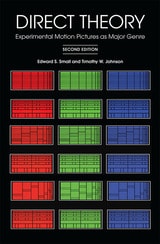
Direct Theory
Experimental Motion Pictures as Major GenreEdward S. Small and Timothy W. Johnson
Southern Illinois University Press, 2013
Making the case for the significance of experimental motion pictures
Undulating water patterns; designs etched or painted directly onto clear or black film leader; computer-generated, pulsating, multihued light tapestries—the visual images that often constitute experimental motion pictures are unlike anything found in either fictive narratives or documentary works. Thus, Direct Theory provides an historical and theoretical survey of this overlooked and misunderstood body of international films, videos, and digital productions that offers a strong case for the understanding of experimental motion pictures as a separate, major motion picture genre.
In a radical revision of film-theory that incorporates Ferdinand de Saussure's semiotic system, and adds to it historian Raymond Fielding’s technological determinism, Edward S. Small and Timothy W. Johnson argue that experimental moviemaking constitutes a special mode of theory that bypasses written and spoken words. By exploring the development of experimental motion pictures over nine decades, they trace the practice from its beginnings in the European avant-garde movement in the 1920s, through American underground productions, into international structuralist works that marked the experimental films of the 1970’s, and finally the digital experimental innovations of the twenty-first century.
To demonstrate that the aesthetic of experimental motion pictures is best understood separately from other major film genres such as fictive narrative and documentary, Small and Johnson highlight eight defining technical and structural characteristics of experimental productions, including the autonomy of the artist, economic independence, brevity, and the use of dreams, reveries, hallucinations, and other mental imagery. They also highlight a number of films, including Ralph Steiner’s 1929 H2Oand Bruce Conner’s 1958 A Movie,and provide a sampling of frames from them to demonstrate that the heightened reflexivity of these films transmit meaning through images rather than words.
A deft historical interweaving of experimental production and scholarly discourse, this thought-provoking work firmly establishes the importance of experimental motion pictures in the discipline of film studies (theory and history) and production.
Essential Film History
The Evolution of Movie StorytellingCharles Ramírez Berg and John Bruns
University of Texas Press, 2026
A guide to the fundamentals of understanding film history, filmmaking, and film appreciation.
Film is not just a medium; it is also a language—and a global one at that. Essential Film History describes how this language emerged and how it has matured over the course of more than 125 years. Beginning with the experiments of the late nineteenth century, and tracking the development of cinematic storytelling, commercial distribution, and audience reception into the era of digital recording, Charles Ramírez Berg and John Bruns offer a comprehensive course in both the history and artistry of film.
Essential Film History breaks cinematic language into three core components: image, sound, and narrative. Between the 1890s and 1940s, this audiovisual language both consolidated and spread, becoming comprehensible worldwide. Since then, filmmakers have adapted and extended the language of cinema to suit an ever-growing range of aesthetic and narrative projects, from documentaries and full-length animation to avant-garde and made-for-TV movies. Covering major figures, studios, and events as well as key technological and sociopolitical developments, Essential Film History is an indispensable guide to the evolution of cinematic style.
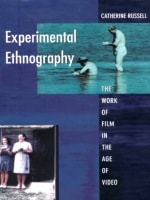
Experimental Ethnography
The Work of Film in the Age of VideoCatherine Russell
Duke University Press, 1999
Russell provides detailed analyses of more than thirty-five films and videos from the 1890s to the 1990s and discusses a wide range of film and videomakers, including Georges Méliès, Maya Deren, Peter Kubelka, Ray Birdwhistell, Jean Rouch, Su Friedrich, Bill Viola, Kidlat Tahimik, Margaret Mead, Tracey Moffatt, and Chantal Akerman. Arguing that video enables us to see film differently—not as a vanishing culture but as bodies inscripted in technology, Russell maps the slow fade from modernism to postmodern practices. Combining cultural critique with aesthetic analysis, she explores the dynamics of historical interruption, recovery, and reevaluation. As disciplinary boundaries dissolve, Russell contends, ethnography is a means of renewing the avant-gardism of “experimental” film, of mobilizing its play with language and form for historical ends. “Ethnography” likewise becomes an expansive term in which culture is represented from many different and fragmented perspectives.
Original in both its choice of subject and its theoretical and methodological
approaches, Experimental Ethnography will appeal to visual anthropologists, as well as film scholars interested in experimental and documentary practices.
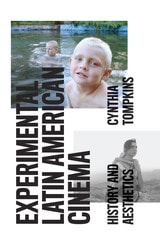
Experimental Latin American Cinema
History and AestheticsBy Cynthia Tompkins
University of Texas Press, 2013
While there are numerous film studies that focus on one particular grouping of films—by nationality, by era, or by technique—here is the first single volume that incorporates all of the above, offering a broad overview of experimental Latin American film produced over the last twenty years.
Analyzing seventeen recent films by eleven different filmmakers from Argentina, Brazil, Cuba, Mexico, Paraguay, and Peru, Cynthia Tompkins uses a comparative approach that finds commonalities among the disparate works in terms of their influences, aesthetics, and techniques. Tompkins introduces each film first in its sociohistorical context before summarizing it and then subverting its canonical interpretation. Pivotal to her close readings of the films and their convergences as a collective cinema is Tompkins’s application of Deleuzian film theory and the concept of the time-image as it pertains to the treatment of time and repetition. Tompkins also explores such topics as the theme of decolonization, the consistent use of montage, paratactically structured narratives, and the fusion of documentary conventions and neorealism with drama. An invaluable contribution to any dialogue on the avant-garde in general and to filmmaking both in and out of Latin America, Experimental Latin American Cinema is also a welcome and insightful addition to Latin American studies as a whole.
Extreme Cinema
The Transgressive Rhetoric of Today's Art Film CultureFrey, Mattias
Rutgers University Press, 2016
From Shortbus to Shame and from Oldboy to Irreversible, film festival premieres regularly make international headlines for their shockingly graphic depictions of sex and violence. Film critics and scholars alike often regard these movies as the work of visionary auteurs, hailing directors like Michael Haneke and Lars von Trier as heirs to a tradition of transgressive art. In this provocative new book, Mattias Frey offers a very different perspective on these films, exposing how they are also calculated products, designed to achieve global notoriety in a competitive marketplace.
Films That Spill
Beyond the Cinema of TransgressionMarie Sophie Beckmann
Rutgers University Press, 2025
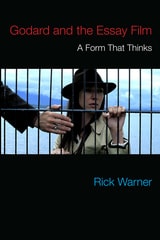
Godard and the Essay Film
A Form That ThinksRick Warner
Northwestern University Press, 2018
The essay film has often been understood by scholars as an eccentric development within documentary, but Warner shows how an essayistic process of thinking can materialize just as potently within narrative fiction films, through self-critical investigations into the aesthetic, political, and philosophical resources of the medium. Studying examples by Godard and other directors, such as Orson Welles, Chris Marker, Agnès Varda, and Harun Farocki, Warner elaborates a fresh account of essayistic reflection that turns on the imaginative, constructive role of the viewer.
Through fine-grained analyses, this book contributes the most nuanced description yet of the relational interface between viewer and screen in the context of the essay film. Shedding new light on Godard’s work, from the 1960s to the 2010s, in film, television, video, and digital stereoscopy, Warner distills an understanding of essayistic cinema as a shared exercise of critical rumination and perceptual discovery.

Kurt Kren
Structural FilmsEdited by Nicky Hamlyn, Simon Payne, and A. L. Rees
Intellect Books, 2016

Line Of Sight
American Avant-Garde Film Since 1965Paul Arthur
University of Minnesota Press, 2005
For three decades, Paul Arthur has been a leading observer and critic as well as a direct participant in America’s avant-garde cinema. In A Line of Sight, he provides a sweeping new account of the extravagant energies of American experimental cinema since 1965.
Balancing close analysis of both major and lesser-known films with detailed examinations of their production, distribution, and exhibition, Arthur addresses the avant-garde’s cultural significance while offering a timely reconsideration of accepted critical categories and artistic options. Rather than treating American avant-garde cinema as a series of successive artistic breakthroughs, A Line of Sight emphasizes the importance of social and institutional networks, material exchanges, and historical disruptions and continuities. Throughout, Arthur pays close attention to themes and visual practices neglected or underrepresented in previous studies, scrutinizing portraiture as a vehicle for projecting dissident identities, highlighting the essay film and the contemporary city symphony, and assessing the contributions of regional and African American filmmaking to the avant-garde. He also explores thematic and formal questions that have been central to the avant-garde achievement: experimental film's relationship with mainstream narrative cinema and postwar American painting as well as the legacy of sixties’s counterculture; the uses and theoretical implications of found footage and the allegorizing of technology; and the schism between a poetic, expressive cinema and the antisubjective, rationalist bias of structural filmmaking.
Amid the current resurgence of experimental filmmakers and the emergence of a new audience for their work, A Line of Sight reaffirms the extraordinary breadth and diversity of the avant-garde tradition in America.
Mad to Be Saved
The Beats, the 50's, and FilmDavid Sterritt
Southern Illinois University Press, 1998
Film critic David Sterritt presents an interdisciplinary exploration of the Beat Generation, its intersections with main-stream and experimental film, and the interactions of all of these with American society and the culture of the 1950s. Sterritt balances the Beat countercultural goal of rebellion through both artistic creation and everyday behavior against the mainstream values of conformity and conservatism, growing worry over cold-war hostilities, and the "rat race" toward material success.
After an introductory overview of the Beat Generation, its history, its antecedents, and its influences, Sterritt shows the importance of "visual thinking" in the lives and works of major Beat authors, most notably Jack Kerouac, Allen Ginsberg, and William S. Burroughs. He turns to Mikhail Bakhtin's dialogic theory to portray the Beat writers-who were inspired by jazz and other liberating influences-as carnivalesque rebels against what they perceived as a rigid and stifling social order.
Showing the Beats as social critics, Sterritt looks at the work of 1950s photographers Robert Frank and William Klein; the attack against Beat culture in the pictures and prose of Life magazine; and the counterattack in Frank's film Pull My Daisy, featuring key Beat personalities. He further explores expressions of rebelliousness in film noir, the melodramas of director Douglas Sirk, and other Hollywood films.
Finally, Sterritt shows the changing attitudes toward the Beat sensibility in Beat-related Hollywood movies like A Bucket of Blood and The Beat Generation; television programs like Route 66 and The Many Loves of Dobie Gillis; nonstudio films like John Cassavetes's improvisational Shadows and Shirley Clarke's experimental The Connection; and radically avant-garde works by such doggedly independent screen artists as Stan Brakhage, Ron Rice, Bruce Connor, and Ken Jacobs, drawing connections between their achievements and the most subversive products of their Beat contemporaries.
Monuments Askew
An Elliptical History of the Factory of the Eccentric ActorMaria Corrigan
Rutgers University Press, 2025
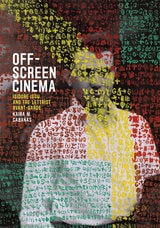
Off-Screen Cinema
Isidore Isou and the Lettrist Avant-GardeKaira M. Cabañas
University of Chicago Press, 2015
Off-Screen Cinema is the first monograph in English of the Lettrists. Offering a full portrait of the avant-garde scene of 1950s Paris, it focuses on the film works of key Lettrist figures like Gil J Wolman, Maurice Lemaître, François Dufrêne, and especially the movement's founder, Isidore Isou, a Romanian immigrant whose “discrepant editing” deliberately uncoupled image and sound. Through Cabañas's history, we see not only the full scope of the Lettrist project, but also its clear influence on Situationism, the French New Wave, the New Realists, as well as American filmmakers such as Stan Brakhage.

POINTS OF RESISTANCE
Lauren Rabinovitz
University of Illinois Press, 2003
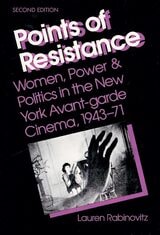
POINTS OF RESISTANCE
Lauren Rabinovitz
University of Illinois Press, 2003
At a time when there were few women directors in commercial films, the postwar avant-garde movement offered an opportunity. Rabinovitz argues that avant-garde cinema, open to women because of its marginal status in the art world, included women as filmmakers, organizers, and critics.
Focusing on Maya Deren, Shirley Clarke, and Joyce Wieland, Rabinovitz illustrates how women used bold physical images to enhance their work and how each provided entrée to her subversive art while remaining culturally acceptable. She combines archival materials with her own interviews to show how the women’s labor and films, even their identities as women filmmakers, were produced, disseminated, and understood. With a new preface and an updated bibliography, Points of Resistance simultaneously demonstrates the avant-garde’s importance as an organizational network for women filmmakers and the processes by which women remained marginal figures within that network.
Shadows, Specters, Shards
Making History in Avant-Garde FilmJeffrey Skoller
University of Minnesota Press, 2005
The Future of an Illusion
Film, Feminism, and PsychoanalysisConstance Penley
University of Minnesota Press, 1989
The Future of an Illusion was first published in 1989. Minnesota Archive Editions uses digital technology to make long-unavailable books once again accessible, and are published unaltered from the original University of Minnesota Press editions.
The Future of an Illusion documents the pivotal role Constance Penley has played in the development of feminist film theory. Penley analyzes the primary movements that have shaped the field: the conjunction of feminism, film theory, and psychoanalysis, and the inherent debates surrounding the politics of women and representation. These debates center on the position of women in the classical Hollywood narrative, the construction of the spectator's desire in pornography and eroticism, and the implicitly male bias in psychoanalytically oriented film theory. Essential to anyone studying the sexual policies of representation, The Future of an Illusion ranges from avant-garde films to video, popular cinema, television, literature, and critical and cultural theory.
Constance Penley is associate professor of English and film studies at the University of Rochester. A co-editor of the journal Camera Obscura,she is the editor of Feminism and Film Theory.
Theorizing Art Cinemas
Foreign, Cult, Avant-Garde, and BeyondBy David Andrews
University of Texas Press, 2013
The term “art cinema” has been applied to many cinematic projects, including the film d’art movement, the postwar avant-gardes, various Asian new waves, the New Hollywood, and American indie films, but until now no one has actually defined what “art cinema” is. Turning the traditional, highbrow notion of art cinema on its head, Theorizing Art Cinemas takes a flexible, inclusive approach that views art cinema as a predictable way of valuing movies as “art” movies—an activity that has occurred across film history and across film subcultures—rather than as a traditional genre in the sense of a distinct set of forms or a closed historical period or movement.
David Andrews opens with a history of the art cinema “super-genre” from the early days of silent movies to the postwar European invasion that brought Italian Neorealism, the French New Wave, and the New German Cinema to the forefront and led to the development of auteur theory. He then discusses the mechanics of art cinema, from art houses, film festivals, and the academic discipline of film studies, to the audiences and distribution systems for art cinema as a whole. This wide-ranging approach allows Andrews to develop a theory that encompasses both the high and low ends of art cinema in all of its different aspects, including world cinema, avant-garde films, experimental films, and cult cinema. All of these art cinemas, according to Andrews, share an emphasis on quality, authorship, and anticommercialism, whether the film in question is film festival favorite or a midnight movie.
This Is Called Moving
A Critical Poetics of FilmAbigail Child, with a foreword by Tom Gunning
University of Alabama Press, 2005
A pioneering exploration of how poetry and experimental cinema intersect to reconstruct meaning across visual and linguistic forms.
As the writer, director, producer, and cinematographer of almost all her 30 films, videos, and shorts, Abigail Child has been recognized as a major and influential practitioner of experimental cinema since the early 1970s. Hallmarks of her style are the appropriation and reassembly of found footage and fragments from disparate visual sources, ranging from industrial films and documentaries to home movies, vacation photography, and snippets of old B movies.
The resulting collages and montages are cinematic narratives that have been consistently praised for their beauty and sense of wonder and delight in the purely visual. At the same time, Child's films are noted for their incisive political commentary on issues such as gender and sexuality, class, voyeurism, poverty, and the subversive nature of propaganda.
In the essays of This Is Called Moving, Child draws on her long career as a practicing poet as well as a filmmaker to explore how these two language systems inform and cross-fertilize her work. For Child, poetry and film are both potent means of representation, and by examining the parallels between them—words and frames, lines and shots, stanzas and scenes—she discovers how the two art forms re-construct and re-present social meaning, both private and collective.
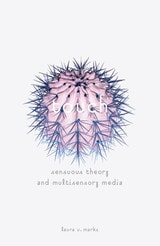
Touch
Sensuous Theory And Multisensory MediaLaura U. Marks
University of Minnesota Press, 2002
Proposes a revolutionary approach to the interpretation of art, film, and the digital.
In Touch, Laura U. Marks develops a critical approach more tactile than visual, an intensely physical and sensuous engagement with works of media art that enriches our understanding and experience of these works and of art itself.
These critical, theoretical, and personal essays serve as a guide to developments in nonmainstream media art during the past ten years—sexual representation debates, documentary ethics, the shift from analog to digital media, a new social obsession with smell. Marks takes up well-known artists like experimental filmmaker Ken Jacobs and mysterious animators the Brothers Quay, and introduces groundbreaking, lesser-known film, video, and digital artists. From this emerges a materialist theory—an embodied, erotic relationship to art and to the world. Marks’s approach leads to an appreciation of the works’ mortal bodies: film’s volatile emulsion, video’s fragile magnetic base, crash-prone Net art; it also offers a productive alternative to the popular understanding of digital media as "virtual" and immaterial. Weaving a continuous fabric from philosophy, fiction, science, dreams, and intimate experience, Touch opens a new world of art media to readers.Unbecoming Cinema
Unsettling Encounters with Ethical Event FilmsDavid H. Fleming
Intellect Books, 2017
A PDF version of this book is available for free in open access via the OAPEN Library platform, www.oapen.org It has been made available under a Creative Commons Attribution 4.0 International Public License and is part of Knowledge Unlatched.
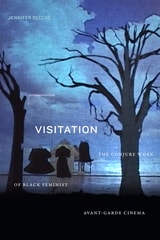
Visitation
The Conjure Work of Black Feminist Avant-Garde CinemaJennifer DeClue
Duke University Press, 2022
Duke University Press Scholars of Color First Book Award recipient
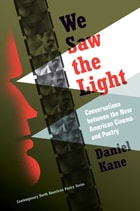
We Saw the Light
Conversations between New American Cinema and PoetryDaniel Kane
University of Iowa Press, 2009
Drawing on unpublished correspondences and personal interviews with key figures in the innovative poetry and film communities, Daniel Kane’s stunningly erudite and accessible work not only provides a fresh look at avant-garde poetry and film but also encourages readers to rethink the artistic scenes of the 1960s and today. We Saw the Light will reframe the very way we talk about how film influences poetry and force us to think anew about the radical ways in which art is created and in turn influences subsequent work.
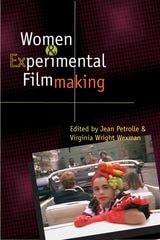
Women and Experimental Filmmaking
Edited by Jean Petrolle and Virginia Wright Wexman
University of Illinois Press, 2005
The introduction sets out by addressing the basic difficulties of both historiography and definition before providing a historical overview of how these particular filmmakers have helped shape moviemaking traditions. The essays explore the major theoretical controversies that have arisen around the work of groundbreaking women such as Leslie Thornton, Su Friedrich, Nina Menkes, and Faith Hubley. With the filmmakers re-presentations of women's subjectivity ranging across film, video, digital media, ethnography, animation, and collage, Women and Experimental Filmmaking represents the full spectrum of genres, techniques, and modes. Taken together, these essays comprise a sustained analysis of the conjunction of aesthetics and politics in the work of both pioneer and contemporary experimental women filmmakers.
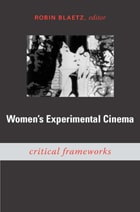
Women's Experimental Cinema
Critical FrameworksRobin Blaetz, ed.
Duke University Press, 2007
The contributors examine the work of Marie Menken, Joyce Wieland, Gunvor Nelson, Yvonne Rainer, Carolee Schneemann, Barbara Rubin, Amy Greenfield, Barbara Hammer, Chick Strand, Marjorie Keller, Leslie Thornton, Abigail Child, Peggy Ahwesh, Su Friedrich, and Cheryl Dunye. The essays highlight the diversity in these filmmakers’ forms and methods, covering topics such as how Menken used film as a way to rethink the transition from abstract expressionism to Pop Art in the 1950s and 1960s, how Rubin both objectified the body and investigated the filmic apparatus that enabled that objectification in her film Christmas on Earth (1963), and how Dunye uses film to explore her own identity as a black lesbian artist. At the same time, the essays reveal commonalities, including a tendency toward documentary rather than fiction and a commitment to nonhierarchical, collaborative production practices. The volume’s final essay focuses explicitly on teaching women’s experimental films, addressing logistical concerns (how to acquire the films and secure proper viewing spaces) and extending the range of the book by suggesting alternative films for classroom use.
Contributors. Paul Arthur, Robin Blaetz, Noël Carroll, Janet Cutler, Mary Ann Doane, Robert A. Haller, Chris Holmlund, Chuck Kleinhans, Scott MacDonald, Kathleen McHugh, Ara Osterweil, Maria Pramaggiore, Melissa Ragona, Kathryn Ramey, M. M. Serra, Maureen Turim, William C. Wees
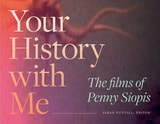
Your History with Me
The Films of Penny SiopisSarah Nuttall, editor
Duke University Press, 2024
Contributors. John Akomfrah, Sinazo Chiya, Mark Gevisser, Pumla Dineo Gqola, Katerina Gregos, Brenda Hollweg, William Kentridge, Achille Mbembe, Sarah Nuttall, Griselda Pollock, Laura Rascaroli, Zineb Sedira, Penny Siopis, Hedley Twidle, Zoé Whitley