Results by title
2 books match the query 'Experimental poetry, Russian'
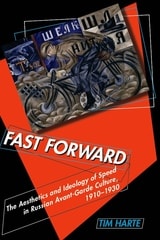
Fast Forward
The Aesthetics and Ideology of Speed in Russian Avant-Garde Culture, 1910–1930Tim Harte
University of Wisconsin Press, 2009
Although modernism arrived somewhat late in Russia, the increased tempo of life at the start of the twentieth century provided Russia’s avant-garde artists with an infusion of creative dynamism and crucial momentum for revolutionary experimentation. In Fast Forward Tim Harte presents a detailed examination of the images and concepts of speed that permeated Russian modernist poetry, visual arts, and cinema. His study illustrates how a wide variety of experimental artistic tendencies of the day—such as “rayism” in poetry and painting, the effort to create a “transrational” language (zaum’) in verse, and movements seemingly as divergent as neo-primitivism and constructivism—all relied on notions of speed or dynamism to create at least part of their effects.
Fast Forward reveals how the Russian avant-garde’s race to establish a new artistic and social reality over a twenty-year span reflected an ambitious metaphysical vision that corresponded closely to the nation’s rapidly changing social parameters. The embrace of speed after the 1917 Revolution, however, paradoxically hastened the movement’s demise. By the late 1920s, under a variety of historical pressures, avant-garde artistic forms morphed into those more compatible with the political agenda of the Russian state. Experimentation became politically suspect and abstractionism gave way to orthodox realism, ultimately ushering in the socialist realism and aesthetic conformism of the Stalin years.
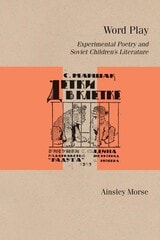
Word Play
Experimental Poetry and Soviet Children’s LiteratureAinsley Morse
Northwestern University Press, 2021
Word Play traces the history of the relationship between experimental aesthetics and Soviet children’s books, a relationship that persisted over the seventy years of the Soviet Union’s existence. From the earliest days of the Soviet project, children’s literature was taken unusually seriously—its quality and subject matter were issues of grave political significance. Yet, it was often written and illustrated by experimental writers and artists who found the childlike aesthetic congenial to their experiments in primitivism, minimalism, and other avant‑garde trends. In the more repressive environment following Stalin’s rise to power, experimental aesthetics were largely relegated to unofficial and underground literature, but unofficial writers continued to author children’s books, which were often more appealing than adult literature of the time.
Word Play focuses on poetry as the primary genre for both children’s and unofficial literature throughout the Soviet period. Five case studies feature poets‑cum‑children’s writers—Leonid Aronzon, Oleg Grigoriev, Igor Kholin, Vsevolod Nekrasov, and Dmitri Prigov—whose unpublished work was not written for children but features lexical and formal elements, abundant humor, and childlike lyric speakers that are aspects of the childlike aesthetic. The book concludes with an exploration of the legacy of this aesthetic in Russian poetry today. Drawing on rich primary sources, Word Play joins a growing literature on Russian children’s books, connecting them to avant-garde poetics in fresh, surprising ways.