Results by title
5 books match the query 'Explaining'

A Socialist Peace?
Explaining the Absence of War in an African CountryMike McGovern
University of Chicago Press, 2017
Guinea is rich in resources, but its people are some of the poorest in the world. Its political situation is polarized by fiercely competitive ethnic groups. Weapons flow freely through its lands and across its borders. And, finally, it is still recovering from the oppressive regime of Sékou Touré. McGovern argues that while Touré’s reign was hardly peaceful, it was successful—often through highly coercive and violent measures—at establishing a set of durable national dispositions, which have kept the nation at peace. Exploring the ambivalences of contemporary Guineans toward the afterlife of Touré’s reign as well as their abiding sense of socialist solidarity, McGovern sketches the paradoxes that undergird political stability.

Explaining the East Asian Peace
A Research StoryStein Tønnesson
National University of Singapore Press, 2017

Maxwell's Handbook for AACR2
Explaining and Illustrating the Anglo-American Cataloguing Rules through the 2003 UpdateRobert L. Maxwell
American Library Association, 2004
Maxwell's Handbook for RDA
Explaining and Illustrating RDARobert L. Maxwell
American Library Association, 2013
Winner of several prestigious honors, including the 2014 ABC-CLIO Greenwood Award for the Best Book in Library Literature, the first edition of this clear and comprehensive handbook has become an essential resource for catalogers, LIS students, and cataloging instructors. Now, in this second edition, Maxwell explains the changes to RDA: Resource Description and Access brought about by 3R, and brings his handbook fully in line with all the new developments. Designed to interpret and explain RDA, this resource illustrates the cataloging standard for every type of information format. From books to electronic materials to music and beyond, Maxwell
- explains the alignment of the new RDA with the IFLA’s Library Reference Model (LRM), offering value to library and cultural heritage communities;
- incorporates the changes made to the RDA Toolkit after the completion of the 3R Project that allow for greater personalization and accessibility;
- addresses the new structural changes to RDA that allow for greater flexibility and reuse;
- explores the new emphasis on relationships between entities and what it means for RDA users; and
- provides abundant sample records to illustrate RDA principles.
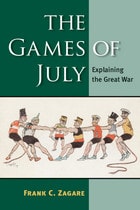
The Games of July
Explaining the Great WarFrank C. Zagare
University of Michigan Press, 2011
"Frank C. Zagare combines a deep command of historical scholarship and the sophisticated skills of an applied game theorist to develop and test a theory of why deterrence failed, catastrophically, in July 1914. . . . Zagare concludes with sage advice on how to avoid even more cataclysmic breakdowns in a nuclear world."
---Steven J. Brams, New York University
"Zagare's deft study of the origins of the First World War using his perfect deterrence theory uncovers new insights into that signal event and shows the value of formal theory applied to historical events. A must-read for those interested in security studies."
---James D. Morrow, University of Michigan
"Through an exemplary combination of formal theory, careful qualitative analysis, and lucid prose, The Games of July delivers important and interesting answers to key questions concerning the international political causes of World War I. Its well-formed narratives and its sustained engagement with leading works in IR and diplomatic history . . . make it a rewarding read for security scholars in general and a useful teaching tool for international security courses."
---Timothy W. Crawford, Boston College
Taking advantage of recent advances in game theory and the latest historiography, Frank C. Zagare offers a new, provocative interpretation of the events that led to the outbreak of World War I. He analyzes key events from Bismarck's surprising decision in 1879 to enter into a strategic alliance with Austria-Hungary to the escalation that culminated in a full-scale global war. Zagare concludes that, while the war was most certainly unintended, it was in no sense accidental or inevitable.
The Games of July serves not only as an analytical narrative but also as a work of theoretical assessment. Standard realist and liberal explanations of the Great War are evaluated along with a collection of game-theoretic models known as perfect deterrence theory.
Frank C. Zagare is UB Distinguished Professor of Political Science at the State University of New York at Buffalo.
Cover illustration: Satirical Italian postcard from World War I. Used with permission from The University of North Carolina at Chapel Hill Libraries.