Results by title
5 books match the query 'Explication'

A Student Guide to Play Analysis
David Rush
Southern Illinois University Press, 2005
With the skills of a playwright, the vision of a producer, and the wisdom of an experienced teacher, David Rush offers a fresh and innovative guide to interpreting drama in A Student Guide to Play Analysis, the first undergraduate teaching tool to address postmodern drama in addition to classic and modern. Covering a wide gamut of texts and genres, this far-reaching and user-friendly volume is easily paired with most anthologies of plays and is accessible even to those without a literary background.
Contending that there are no right or wrong answers in play analysis, Rush emphasizes the importance of students developing insights of their own. The process is twofold: understand the critical terms that are used to define various parts and then apply these to a particular play. Rush clarifies the concepts of plot, character, and language, advancing Aristotle’s concept of the Four Causes as a method for approaching a play through various critical windows. He describes the essential difference between a story and a play, outlines four ways of looking at plays, and then takes up the typical structural devices of a well-made play, four primary genres and their hybrids, and numerous styles, from expressionism to postmodernism.
For each subject, he defines critical norms and analyzes plays common to the canon. A Student Guide to Play Analysis draws on thoughtful examinations of such dramas as The Cherry Orchard, The Good Woman of Setzuan, Fences, The Little Foxes, A Doll House, The Glass Menagerie, and The Emperor Jones. Each chapter ends with a list of questions that will guide students in further study.
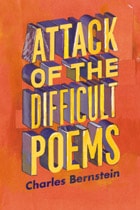
Attack of the Difficult Poems
Essays and InventionsCharles Bernstein
University of Chicago Press, 2011
Charles Bernstein is our postmodern jester of American poesy, equal part surveyor of democratic vistas and scholar of avant-garde sensibilities. In a career spanning thirty-five years and forty books, he has challenged and provoked us with writing that is decidedly unafraid of the tensions between ordinary and poetic language, and between everyday life and its adversaries. Attack of the Difficult Poems, his latest collection of essays, gathers some of his most memorably irreverent work while addressing seriously and comprehensively the state of contemporary humanities, the teaching of unconventional forms, fresh approaches to translation, the history of language media, and the connections between poetry and visual art.
Applying an array of essayistic styles, Attack of the Difficult Poems ardently engages with the promise of its title. Bernstein introduces his key theme of the difficulty of poems and defends, often in comedic ways, not just difficult poetry but poetry itself. Bernstein never loses his ingenious ability to argue or his consummate attention to detail. Along the way, he offers a wide-ranging critique of literature’s place in the academy, taking on the vexed role of innovation and approaching it from the perspective of both teacher and practitioner.
From blues artists to Tin Pan Alley song lyricists to Second Wave modernist poets, The Attack of the Difficult Poems sounds both a battle cry and a lament for the task of the language maker and the fate of invention.
Experiencing Fiction
Judgments, Progressions, and the Rhetorical Theory of NarrativeJames Phelan
The Ohio State University Press, 2007
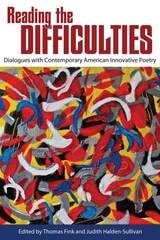
Reading the Difficulties
Dialogues with Contemporary American Innovative PoetryThomas Fink
University of Alabama Press, 2013
New Strategies for Reading the Most Innovative Poetry of Our Time.
Definitions of what constitutes innovative poetry are innumerable and are offered from every quarter. Some critics and poets argue that innovative poetry concerns free association (John Ashbery), others that experimental poetry is a “re-staging” of language (Bruce Andrews) or a syntactic and cognitive break with the past (Ron Silliman and Lyn Hejinian). The tenets of new poetry abound.
But what of the new reading that such poetry demands? Essays in Reading the Difficulties ask what kinds of stances allow readers to interact with verse that deliberately removes many of the comfortable cues to comprehension—poetry that is frequently nonnarrative, nonrepresentational, and indeterminate in subject, theme, or message.
Some essays in Thomas Fink and Judith Halden-Sullivan’s collection address issues of reader reception and the way specific stances toward reading support or complement the aesthetic of each poet. Others suggest how we can be open readers, how innovative poetic texts change the very nature of reader and reading, and how critical language can capture this metamorphosis. Some contributors consider how the reader changes innovative poetry, what language reveals about this interaction, which new reading strategies unfold for the audiences of innovative verse, and what questions readers should ask of innovative verse and of events and experiences that we might bring to reading it.
Scriptwork
A Director's Approach to New Play DevelopmentDavid Kahn and Donna Breed. Foreword by Lanford Wilson
Southern Illinois University Press, 1995
Despite the popular myth that plays arrive at the theater fully formed and ready for production, the truth is that for centuries, most scripts have been developed through a collaborative process in rehearsal and in concert with other theater artists. David Kahn and Donna Breed provide the first codified approach to this time-honored method of play development, with a flexible methodology that takes into account differing environments and various stages of formation.
Directors can use this unique guidebook for new play development from the beginning to the end of the process. Kahn and Breed explore ways of choosing new projects, talk about where to find new scripts, and explore the legal aspects of script development. They present a detailed system for theatrical analysis of the new script and show how to continue exploration and development of the script within the laboratory of the theater. Most importantly, they delineate the parameters of the relationship between the director and the playwright, offering proven methods to help the playwright and help facilitate the healthy development of the script.
Breed and Kahn offer suggestions on casting, incorporating rewrites, and script handling plus how and when to use audience response and how to decide what step to take next. They also include extended interviews with developmental directors, dramaturgs, and playwrights, who give credence to the new script development process.
In short, Kahn and Breed demystify a common, though often convoluted, theater process, providing a unique codification of ways to work on new plays.