Results by title
4 books match the query 'Extraction'
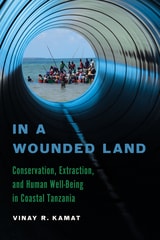
In a Wounded Land
Conservation, Extraction, and Human Well-Being in Coastal TanzaniaVinay R. Kamat
University of Arizona Press, 2024
Global efforts to conserve nature and prevent biodiversity loss have intensified in response to planetary-scale challenges—nowhere more so than in coastal regions. Accordingly, international conservation organizations have increased their efforts to promote marine protected areas as one of the interventions to prevent biodiversity loss in global hotspots.
Focusing on the human element of marine conservation and the extractive industry in Tanzania, this volume illuminates what happens when impoverished people living in underdeveloped regions of Africa are suddenly subjected to state-directed conservation and natural resource extraction projects, implemented in their landscapes of subsistence. In a Wounded Land draws on ethnographically rich case studies and vignettes collected over a ten-year period in several coastal villages on Tanzania’s southeastern border with Mozambique. In seven chapters, the book demonstrates how state power, processes of displacement and dispossession, forms of local resistance and acquiescence, environmental and social justice, and human well-being become interconnected.
Written in lucid, accessible language, this is the first book that reveals the social implications of the co-presence of a marine park and a gas project at a time when internationally funded conservation initiatives and extraction projects among rural African populations are engendering rapid social transformation.
[more]
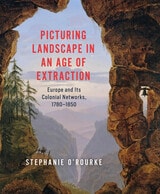
Picturing Landscape in an Age of Extraction
Europe and Its Colonial Networks, 1780–1850Stephanie O'Rourke
University of Chicago Press, 2025
O’Rourke argues that artistic representations played a pivotal role in shaping how people thought about the natural world during the Industrial Revolution.
In the late eighteenth and early nineteenth centuries, European artists confronted the emergence of a new way of thinking about and treating the Earth and its resources. Centered on extraction, this new paradigm was characterized by large-scale efforts to transform and monetize the physical environment across the globe. With this book, Stephanie O’Rourke considers such practices, looking at what was at stake in visual representations of the natural world during the first decades of Europe’s industrial revolutions.
O’Rourke argues that key developments in the European landscape painting tradition were profoundly shaped by industries including mining and timber harvesting, as well as by interlinked ideas about race, climate, and waste. Focusing on developments in Britain, France, Germany, and across Europe’s colonial networks, she explores how artworks and technical illustrations portrayed landscapes in ways that promoted—or pushed against—the logic of resource extraction.
[more]
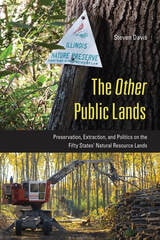
The Other Public Lands
Preservation, Extraction, and Politics on the Fifty States' Natural Resource LandsSteven Davis
Temple University Press, 2025
For most Americans, state lands are the most readily accessible type of public land; however, despite their ubiquity, they remain largely terra incognita. The Other Public Lands is a primer on state public lands and the political dynamics that underlie their management. Offering a wide-angle overview, Steven Davis focuses on how states prioritize competing claims related to conservation, resource development, tourism, recreation, and finances.
The Other Public Lands looks at both differences and common patterns in state land management, including the structure of natural resource agencies. Davis examines the privatization and commercialization of state parks, and the tensions between recreation, revenue and the preservation of biodiversity and natural landscapes. He also raises issues about equity, access, appropriate development, and ecological health. Chapters review state forests, state wildlife management areas, and school trust lands. In addition, the roles of interest groups, the courts, and agency culture and behavior are compared and analyzed both between states and the federal government and between states with differing approaches to specific issues.
As there has been a demand to transfer at least some federal lands to the states, The Other Public Lands concludes with an appraisal of whether states could handle this transfer and goes on to suggest ways to ensure adequate access in an era of increased demand.
[more]
Underdeveloping the Amazon
Extraction, Unequal Exchange, and the Failure of the Modern StateStephen G. Bunker
University of Chicago Press, 1988
Underdeveloping the Amazon shows how different extractive economies have periodically enriched various dominant classes but progressively impoverished the entire region by disrupting both the Amazon Basin's ecology and human communities. Contending that traditional models of development based almost exclusively on the European and American experience of industrial production cannot apply to a regional economy founded on extraction, Stephen G. Bunker proposes a new model based on the use and depletion of energy values in natural resources as the key to understanding the disruptive forces at work in the Basin.
[more]