Results by title
5 books match the query 'F . Scott Fitzgerald'
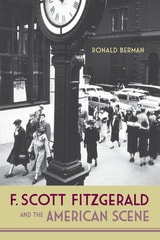
F. Scott Fitzgerald and the American Scene
Ronald Berman
University of Alabama Press, 2017
A study of the philosophical, intellectual, and political influences on the artistic creations of Fitzgerald and key early American modernist writers
F. Scott Fitzgerald and the American Scene continues Ronald Berman’s lifelong study of the philosophical, intellectual, and political influences on the artistic creations of key early American modernist writers. Each chapter in this volume elaborates on a crucial aspect of F. Scott Fitzgerald’s depiction of American society, specifically through the lens of the social sciences that most influenced his writing and thinking.
Berman addresses, among other subjects, Fitzgerald’s use of philosophy, cultural analyses, and sociology—all enriched by the insights of his own experience living an American life. He was especially interested in how life had changed from 1910 to 1920. Many Americans were unable to navigate between the 1920s and their own memories of a very different world before the Great War; especially Daisy Buchanan who evolves from girlhood (as typified in sentimental novels of the time) to wifehood (as actually experienced in the new decade). There is a profound similarity between what happens to Fitzgerald’s characters and what happened to the nation.
Berman revisits classics like The Great Gatsby but also looks carefully at Fitzgerald’s shorter fictions, analyzing a stimulating spectrum of scholars from more contemporary critics like Thomas Piketty to George Santayana, John Maynard Keynes, John Dewey, and Walter Lippmann. This fascinating addition to F. Scott Fitzgerald scholarship, although broad in its content, is accessible to a wide audience. Scholars and students of Fitzgerald and twentieth-century American literature, as well as dedicated Fitzgerald readers, will enjoy Berman’s take on a long-debated and celebrated author.
F. Scott Fitzgerald in the Twenty-First Century
Jackson R. Bryer
University of Alabama Press, 2003
This thought-provoking collection explores significant new facets of an American author of lasting international stature.
“Edited by three eminent Fitzgerald scholars, this fine book comprises nineteen incisive and provocative essays (most written for this collection) by . . . well-known Fitzgerald critics. The content is as varied as the international origins of its authors.” —Choice
As the author of some of the most compelling short stories ever written, two of the central novels in American literature, and some of the most beautiful prose ever penned, F. Scott Fitzgerald is read and studied all over the world. Sixty-two years after his death, his works—protean, provocative, multilayered, and rich—continue to elicit spirited responses. This collection grew out of the F. Scott Fitzgerald Conference that convened in Princeton at the centennial of this author's birth. Bringing together dozens of the world's leading scholars and commentators, the conference and the book celebrate the ever-growing legacy of Fitzgerald's art.
The subjects of these 19 essays reflect the contributors' wish to shine new light on less-frequently discussed aspects of Fitzgerald's work. Topics include Fitzgerald's Princeton influences and his expression of Catholic romanticism; his treatments of youth culture, the devil, and waste; parallels in the work of Mencken, Cather, and Murakami; and the ways gender, pastoral mode, humor, and the Civil War are variously presented in his work. One illustrated summary examines Fitzgerald's effect on popular culture through his appearance in the comics. Two broad overviews—one on Fitzgerald's career and another on the final developments in the author's style—round out the collection.
The international scope of the contributors to this volume reflects Fitzgerald's worldwide reputation and appeal. With extensive treatments of This Side of Paradise, The Beautiful and Damned, The Last Tycoon, and the Pat Hobby stories, this collection makes an unusual and significant contribution to the field of Fitzgerald studies.
F. Scott Fitzgerald
A Composite BiographyNiklas Salmose
University of Minnesota Press, 2023
A comprehensive study of the life of F. Scott Fitzgerald, related in two-year chapters by twenty-three leading writers on the Jazz Age author
“There never was a good biography of a novelist,” F. Scott Fitzgerald wrote in The Crack-Up. “There couldn’t be. He is too many people, if he’s any good.” Fitzgerald, a good novelist by any measure, has tested this challenge to the biographer’s art. A new star illuminating the literary scene; a chronicler of the Jazz Age in all its brilliance and tarnish; a romantic symbol of the American century; an acute observer of society’s best and worst, and of his own star-crossed career; a midlife burnout at forty-four, leaving an unfinished masterpiece in his wake—he was a man of many aspects, a writer whose complexity and multitudes this composite biography finally aptly portrays.
Bringing together twenty-three leading writers and scholars on Fitzgerald, each focusing on two years of his life, this volume takes its cue from Henry James’s remark, cited by preeminent Fitzgerald biographer Scott Donaldson: “The whole of anything is never told; you can only take what groups together.” F. Scott Fitzgerald: A Composite Biography presents a new way of “grouping together” biographical material and perspectives, considering from various angles the author's best-known works as well as understudied writings, including neglected stories and forays into autobiography such as “What I Think and Feel at 25” and “How to Live on $36,000 a Year.” The glamor and fame that made F. Scott and Zelda mythic figures of their time appear here alongside the personal experiences that he occasionally included in his writing: the beginnings as well as the poignant end; the literary relationships that informed and framed his work, set against solitary effort, fame, and failures. This remarkable study of F. Scott Fitzgerald reflects the multifaceted whole of a “life in many parts” in new and revelatory ways.
Contributors: Jade Broughton Adams; Ronald Berman; William Blazek, Liverpool Hope U; Elisabeth Bouzonviller, Jean Monnet U; Jackson Bryer, U of Maryland; Kirk Curnutt, Troy U; Catherine Delesalle-Nancey, U Jean Moulin Lyon 3; Scott Donaldson; Kayla Forrest; Marie-Agnès Gay, U Jean Moulin Lyon 3; Joel Kabot, U of Maryland, Baltimore; Sara Kosiba; Arne Lunde, U of California, Los Angeles; Bryant Mangum, Virginia Commonwealth U; Martina Mastandrea; Philip McGowan, Queen’s U Belfast; David Page; Walter Raubicheck, Pace U; Ross Tangedal, U of Wisconsin–Stevens Point; Helen Turner, Linnaeus U; James L. W. West III, Pennsylvania State U.
Fool for Love
F. Scott FitzgeraldScott Donaldson
University of Minnesota Press, 2012
Fool for Love is Scott Donaldson’s masterful biography of F. Scott Fitzgerald—written from a fresh and highly intimate perspective. Fool for Love follows Fitzgerald from his birthplace in St. Paul, Minnesota, to Princeton and upward into the highest reaches of literary and public success—and ultimately to Fitzgerald’s untimely death in Hollywood at the age of forty-four, broke and nearly forgotten. This engrossing, definitive study explores two classic Fitzgerald themes throughout—love and class—and the result is a striking portrayal of one of the twentieth century’s greatest writers, whose legacy and influence only continue to grow.
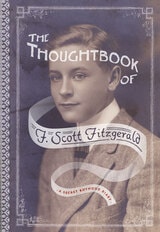
The Thoughtbook of F. Scott Fitzgerald
A Secret Boyhood DiaryF. Scott Fitzgerald
University of Minnesota Press, 2013
When F. Scott Fitzgerald was fourteen and living in the Crocus Hill neighborhood of St. Paul, he began keeping a short diary of his exploits among his friends, friendly rivals, and crushes. He gave the journal a title page—Thoughtbook of Francis Scott Key Fitzgerald of St. Paul Minn. U.S.A.—and kept it securely locked in a box under his bed. He would later use The Thoughtbook as the basis for “The Book of Scandal” in his Basil Lee Duke stories, and brief sections were copied over the years for use by scholars and even published in Life magazine.“Are you going to the Ordways’? the Herseys’? the Schultzes’?” Here, for the first time, is a complete transcription of this charming, twenty-seven-page diary highlighting Fitzgerald’s escapades among the children of some of St. Paul’s most influential families—models for the families described in The Great Gatsby. Presented in a simple format for both scholars and general readers alike, The Thoughtbook of F. Scott Fitzgerald includes a new introduction by Dave Page that covers the history and provenance of the diary, its place and meaning in Fitzgerald’s literary development, and its revelations about his life and writing process.
One of the earliest known works by F. Scott Fitzgerald, The Thoughtbook provides a unique glimpse of Fitzgerald as a young boy and his social circle as they played among the grand homes of Summit Avenue, making up games, starting secret societies, competing with rivals, and (at all times) staying up-to-date on who exactly is vying for whose attention.