Results by title
2 books match the query 'Fārābī'
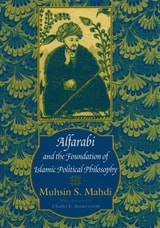
Alfarabi and the Foundation of Islamic Political Philosophy
Muhsin S. Mahdi
University of Chicago Press, 2001
Beginning with a survey of Islamic philosophy and a discussion of its historical background, Mahdi considers the interrelated spheres of philosophy, political thought, theology, and jurisprudence of the time. He then turns to Alfarabi's concept of "the virtuous city," and concludes with an in-depth analysis of the trilogy, Philosophy of Plato and Aristotle.
This philosophical engagement with the writings of and about Alfarabi will be essential reading for anyone interested in medieval political philosophy.
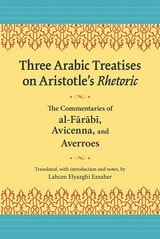
Three Arabic Treatises on Aristotle’s Rhetoric
The Commentaries of al-Farabi, Avicenna, and AverroesTranslated, with introduction and notes, by Lahcen Elyazghi Ezzaher
Southern Illinois University Press, 2015
Winner, 2018 MLA Aldo and Jeanne Scaglione Prize for a Translation of a Scholarly Study of Literature
It is increasingly well documented that western rhetoric’s journey from pagan Athens to the medieval academies of Christian Europe was significantly influenced by the intellectual thought of the Muslim Near East. Lahcen Elyazghi Ezzaher contributes to the contemporary chronicling of this influence in Three Arabic Treatises on Aristotle’s Rhetoric: The Commentaries of al-Farabi, Avicenna, and Averroes, offering English translations of three landmark medieval Arabic commentaries on Aristotle's famous rhetorical treatise together in one volume for the first time. Elegant and practical, Elyazghi Ezzaher’s translations give English-speaking scholars and students of rhetoric access to key medieval Arabic rhetorical texts while elucidating the unique and important contribution of those texts to the revival of European interest in the rhetoric and logic of Aristotle, which in turn influenced the rise of universities and the shaping of Western intellectual life.
With a focus on Book I of Aristotle’s Rhetoric, the commentaries ofal-Farabi, Avicenna, and Averroes translated by Elyazghi Ezzaher are paramount examples of an extensive Arabic-Muslim tradition of textual commentary while also serving as rich corollaries to the medieval Greek and Latin rhetorical commentaries produced in Europe. Elyazghi Ezzaher’s translations are each accompanied by insightful scholarly introductions and notes that contextualize—both historically and culturally—these immensely significant works while highlighting a comparative, multidisciplinary approach to rhetorical scholarship that offers new perspectives on one of the field’s foundational texts.
A remarkable addition to rhetorical studies, Three Arabic Treatises on Aristotle’s Rhetoric: The Commentaries of al-Farabi, Avicenna, and Averroes not only provides vibrant English translations of essential medieval Arabic rhetorical texts but also challenges scholars and students of rhetoric to consider their own historical, cultural, and linguistic relationships to the texts and objects they study.