Results by title
8 books match the query 'Fabric'

Cotton
Companies, Fashion and the Fabric of Our LivesEdited by Joseph H. II Hancock, Nioka Wyatt, and Tasha L. Lewis
Intellect Books, 2016

Guide to Implementing Electrified Heat in Domestic Properties
Electrical, fabric, and plumbing considerations for heat pumps and other low-carbon heatingThe Institution of Engineering and Technology
The Institution of Engineering and Technology, 2022
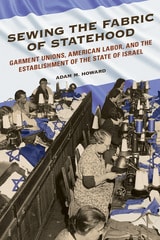
Sewing the Fabric of Statehood
Garment Unions, American Labor, and the Establishment of the State of IsraelAdam Howard
University of Illinois Press, 2017
The Fabric of Classical Islamic Culture
A Cognitivist ApproachHouari Touati
University of Chicago Press, 2027
A sweeping account of the evolution of early Islamic culture.
This book argues that early Islamic literature was influenced less by the Qur’an and more by the bureaucratic culture of the Diwan, the secular political system in place long before a written religious culture emerged. As Houari Touati explains, this secular Arab culture quickly outstripped written religious erudition: first, because of the diverse communities who participated in the scholarly networks of the empire; and second, because of the universalizing influence of the period’s Greco-Arabic translation movement. This process of cross-cultural fertilization, Touati recounts, flourished within Islam until the canonization of the Hadith (the official sayings, actions, and sanctions of Muhammad) began to disrupt this dynamic of interchange after the tenth century, without, however, managing to put a definitive end to it. The Fabric of Classical Islamic Culture is a wide-ranging, comparative account of the parallel development of secular and sacred culture that produced the modern Arabic world.
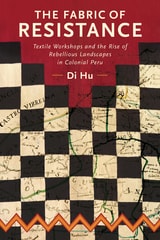
The Fabric of Resistance
Textile Workshops and the Rise of Rebellious Landscapes in Colonial PeruDi Hu
University of Alabama Press, 2022
Textiles as sites of power, production, and rebellion in the early modern Andes.
The Fabric of Resistance: Textile Workshops and the Rise of Rebellious Landscapes in Colonial Peru documents the impact of Spanish colonial institutions of labor on identity and social cohesion in Peru. Through archaeological and historical lines of evidence, Di Hu examines the long-term social conditions that enabled the large-scale rebellions in the late Spanish colonial period in Peru. Hu argues that ordinary people from different backgrounds pushed back against the top-down identity categories imposed by the Spanish colonial government and in the process created a cosmopolitan social landscape that later facilitated broader rebellion.
Hu’s case study is Pomacocha, the site of an important Spanish colonial hacienda (agricultural estate) and obraje (textile workshop). At its height, the latter had more than one hundred working families and sold textiles all over the Andes. Through analysis of this site, Hu explores three main long-term causes of rebellions against Spanish oppression. First, the Spanish colonial economy provided motivation and the social spaces for intercaste (indigenous, African, and mestizo) mixing at textile workshops. Second, new hybrid cultural practices and political solidarity arose there that facilitated the creation of new rebellious identities. Third, the maturation in the eighteenth century of popular folklore that reflected the harsh nature of Spanish labor institutions helped workers from diverse backgrounds gain a systemic understanding of exploitation.
This study provides a fresh archaeological and historical perspectives on the largest and most cosmopolitan indigenous-led rebellions of the Americas. Hu interweaves analyses of society at multiple scales including fine-grained perspectives of social networks, demography, and intimate details of material life in the textile workshop. She examines a wide range of data sources including artifacts, food remains, architectural plans, account books, censuses, court documents, contracts, maps, and land title disputes.
The Fabric of the Heavens
The Development of Astronomy and DynamicsStephen Toulmin and June Goodfield
University of Chicago Press, 1999
Praise for The Fabric of the Heavens:
"I cannot remember when I last went through a book, any book, with such all-devouring zest. What is more, even the most complex technicalities are reduced to a positively crystalline clarity: If I can understand them, anyone can. The Fabric of the Heavens is, in every sense of the word, an eye-opener."—Peter Green, The Yorkshire Post
"Not until the last chapter of the book is [the reader] allowed to think again wholly as a modern man has become accustomed, by common sense, to think. The discipline is admirably suited to the authors' task, and cunningly devised for the reader's edification—and, indeed, for his delight."—Physics Today
Praise for The Architecture of Matter:
"The Architecture of Matter is to be warmly recommended. It is that rare achievement, a lively book which at the same time takes the fullest possible advantage of scholarly knowledge."—Charles C. Gillespie, New York Times Book Review
"One is impressed by the felicity of the examples and by the lively clarity with which significant experiments and ideas are explained. . . . No other history of science is so consistently challenging."—Scientific American
Praise for The Discovery of Time:
"A subject of absorbing interest . . . is presented not as a history of science, but as a chapter in the history of ideas from the ancient Greeks to our own time."—Times Literary Supplement

The Thin Tear In The Fabric Of Space
Douglas Trevor
University of Iowa Press, 2005
The Thin Tear in the Fabric of Space gathers stories about coping with grief, trying to love people who have died, and—more broadly—leaving old versions of the self behind, sometimes by choice and sometimes out of necessity. In each of the nine stories, Douglas Trevor’s characters are forced to face uncomfortable realities. For Elena Gavrushnekov in the title story, that means admitting after the death of her beloved that she still longs for contact with other human bodies. For Peter in “Central Square,” it is realizing that, like his deceased father before him, he is drinking himself to death. Unable to confront his incapacitated mother and the memory of the plane crash that killed his father, Edwin Morris in “Saint Francis in Flint” is compelled to acknowledge that his saintly aspirations are not what they appear to be, while Sharon Mackaney in “The Surprising Weight of the Body's Organs” struggles with uncontrollable outbursts of rage in the wake of her young son’s death.
In moments of great pain and loss, when self-expression seems impossible and terribly useless, the characters in these stories nonetheless discover the tenderness of others. In “The River,” the narrator finds that the friendship he has forged with a French girl with whom he can only just communicate has bred intense, almost intuitive compassion, while in “Fellowship of the Bereaved,” the disconsolate brother of the deceased sister who occupies the empty center of the story uncovers not only anger in his parents but also empathy and humor. As these characters persevere in their own lives, they do so mindful of, and humanized by, the experiences of having seen people they know and love slip unexpectedly into the thin tear in the fabric of space: that quiet chasm that so resolutely separates the living from the dead.
Weaving a Fabric of Unity
Conversations on Education and DevelopmentHaleh Arbab
West Virginia University Press, 2024