Results by title
6 books match the query 'Factories'

Living Rooms as Factories
Class, Gender, and the Satelite Factory System in TaiwanPing-Chun Hsiung
Temple University Press, 1996
In Taiwan, small-scale subcontracting factories of thirty employees or less make items for export, like the wooden jewelry boxes that Ping-Chun Hsiung made when she worked in six such factories. These factories are found in rice fields and urban areas, front yards and living rooms, mostly employing married women in line with the government slogan that promotes work in the home—"Living Rooms as Factories."
Hsiung studies the experiences of the married women who work in this satellite system of factories, and how their work and family lives have contributed to Taiwan's 9.1 percent GNP growth over the last three decades, the "economic miracle." This vivid portrayal of the dual lives of these women as wives, mothers, daughters-in-law and as manufacturing workers also provides sophisticated analyses of the links between class and gender stratification, family dynamics, state policy, and global restructuring within the process of industrialization.
Hsiung uses ethnographic data to illustrate how, in this system of intersecting capitalist logic and patriarchal practices, some Taiwanese women experience upward mobility by marrying into the owners' family, while others remain home and wage workers. Although women in both groups acknowledge gender inequality, this commonality does not bridge divergent class affiliations. Along with a detailed account of the oppressive labor practices, this book reveals how workers employ clandestine tactics to defy the owners' claims on their labor.
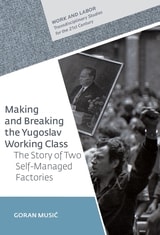
Making and Breaking the Yugoslav Working Class
The Story of Two Self-Managed FactoriesGoran Music
Central European University Press, 2021
Workers' self-management was one of the unique features of communist Yugoslavia. Goran Musić has investigated the changing ways in which blue-collar workers perceived the recurring crises of the regime. Two self-managed metal enterprises, one in Serbia another in Slovenia, provide the frame of the analysis in the time span between 1945 and 1989. These two factories became famous for strikes in 1988 that evoked echoes in popular discourses in former Yugoslavia. Drawing on interviews, factory publications and other media, local archives, and secondary literature, Musić analyzes the two cases, going beyond the clichés of political manipulation from the top and workers' intrinsic attraction to nationalism.
The author explains how, in the later phase of communist Yugoslavia, growing social inequalities among the workers and undemocratic practices inside the self-managed enterprises facilitated the spread of a nationalist and pro-market ideology on the shop floors. Yet rather than being a mass taken advantage of by populist leaders, the working class Musić presents is one with agency and voice, a force that played an important role in shaping the fate of the country. The book thus seeks to open a debate on the social processes leading up to the dissolution of Yugoslavia.

Poletown
COMMUNITY BETRAYEDJeanie Wylie
University of Illinois Press, 1989
"This book is about the ramifications of raw corporate power going unchecked." -- John Conyers, Michigan congressman
"Racial class is a fundamental problem in America. But Poletown demonstrates that economic class is even more fundamental." -- Rev. Jesse Jackson

Robots and Automated Manufacture
J. Billingsley
The Institution of Engineering and Technology, 1985
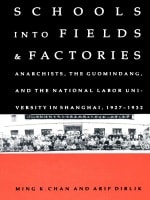
Schools into Fields and Factories
Anarchists, the Guomindang, and the National Labor University in Shanghai, 1927–1932Ming K. Chan and Arif Dirlik
Duke University Press, 1991
During its five years of existence, Labor University was the most impressive institutional embodiment in twentieth-century China of the labor-learning ideal, which was introduced by anarchists in the first decade of the century and came to be shared by a diverse group of revolutionaries in the 1920s. This detailed study places Labor University within the broad context of anarchist social ideals and educational experiments that inspired it directly, as well as comparable socialist experiments within labor education in Europe that Labor University’s founders used as models. The authors bring to bear the perspectives of institutional and intellectual history on their examination of the structure and operation of the University, presenting new material on its faculty, curriculum, physical plant, and history.
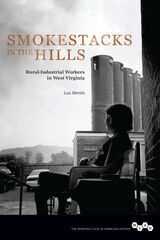
Smokestacks in the Hills
Rural-Industrial Workers in West VirginiaLouis Martin
University of Illinois Press, 2015
As Martin shows, access to land in and around steel and pottery towns allowed residents to preserve rural habits and culture. Workers in these places valued place and local community. Because of their belief in localism, an individualistic ethic of "making do," and company loyalty, they often worked to place limits on union influence. At the same time, this localism allowed workers to adapt to the dictates of industrial capitalism and a continually changing world on their own terms--and retain rural ways to a degree unknown among their urbanized peers. Throughout, Martin ties these themes to illuminating discussions of capital mobility, the ways in which changing work experiences defined gender roles, and the persistent myth that modernizing forces bulldozed docile local cultures.
Revealing and incisive, Smokestacks in the Hills reappraises an overlooked stratum of American labor history and contributes to the ongoing dialogue on shifts in national politics in the postwar era.