Results by title
7 books match the query 'Fake news'

A Matter of Facts
The Value of Evidence in an Information AgeLaura A. Millar
American Library Association, 2019
The safeguarding of authentic facts is essential, especially in this disruptive Orwellian age, where digital technologies have opened the door to a post-truth world in which “alternative facts” can be so easily accepted as valid. And because facts matter, evidence matters. In this urgent manifesto, archives luminary Millar makes the case that authentic and accurate records, archives, data, and other sources of documentary proof are crucial in supporting and fostering a society that is respectful, democratic, and self-aware. An eye-opening treatise for the general public, an invaluable resource for archives students, and a provocative call-to-arms for information and records professionals, Millar’s book
- explains the concept of evidence and discusses the ways in which records, archives, and data are not just useful tools for our daily existence but also essential sources of evidence both today and in the future;
- includes plentiful examples that illustrate the critical role evidence plays in upholding rights, enforcing responsibilities, tracing family or community stories, and capturing and sharing memories; and
- examines the impact of digital technologies on how records and information are created and used.
With documentary examples ranging from Mesopotamian clay tablets to World War II photographs to today’s Twitter messages and Facebook posts, Millar’s stirring book will encourage readers to understand more fully the importance of their own records and archives, for themselves and for future generations.
Bad News for Labour
Antisemitism, the Party and Public BeliefGreg Philo
Pluto Press, 2019
Creating Chaos Online
Disinformation and Subverted Post-PublicsAsta Zelenkauskaite
University of Michigan Press, 2022
With the prevalence of disinformation geared to instill doubt rather than clarity, Creating Chaos Online unmasks disinformation when it attempts to pass as deliberation in the public sphere and distorts the democratic processes. Asta Zelenkauskaitė finds that repeated tropes justifying Russian trolling were found to circulate across not only all analyzed media platforms’ comments but also across two analyzed sociopolitical contexts suggesting the orchestrated efforts behind messaging. Through a dystopian vision of publics that are expected to navigate in the sea of uncertain both authentic and orchestrated content, pushed by human and nonhuman actors, Creating Chaos Online offers a concept of post-publics. The idea of post-publics is reflected within the continuum of treatment of public, counter public, and anti-public. This book argues that affect-instilled arguments used in public deliberation in times of uncertainty, along with whataboutism constitute a playbook for chaos online.
Fake News and Alternative Facts
Information Literacy in a Post-Truth EraNicole A. Cooke
American Library Association, 2018
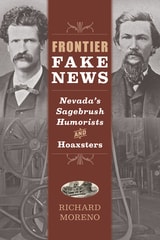
Frontier Fake News
Nevada's Sagebrush Humorists and HoaxstersRichard Moreno
University of Nevada Press, 2023
When readers see the names Mark Twain and Dan De Quille, fake news may not be the first thing that comes to mind. But these legendary journalists were some of the original, and most prolific, fake news writers in the early years of Nevada’s history. Frontier Fake News puts a spotlight on the hoaxes, feuds, pranks, outright lies, witty writing, and other literary devices utilized by a number of the Silver State’s frontier newsmen from the mid-nineteenth through the early twentieth centuries. Often known collectively as the Sagebrush School, these journalists were opinionated, talented, and individualistic.
While Mark Twain (Samuel Clemens), who got his start at Virginia City’s Territorial Enterprise, and Dan De Quille (William Wright), who some felt was a better writer than Twain, are the most well-known members of the Sagebrush School, author Richard Moreno includes others such as Fred Hart, who concocted a fake social club and reported on its gatherings for Austin’s Reese River Reveille, and William Forbes, who enjoyed sprinkling clever puns with political undertones in his newspaper articles.
Moreno traces the beginnings of genuine fake news from founding father Benjamin Franklin’s “Supplement to the Boston Independent Chronicle, Number 705, March 1782,” a fake newspaper aimed at swaying British public opinion, to the fake news articles of New York and Baltimore papers in the early 1800s. But these examples are only a prelude to the amazing accounts of petrified men, freeze-inducing solar armor, magically magnetic rocks, blood-curdling massacres, and other nonsense stories that appeared in Nevada’s frontier newspapers and beyond.
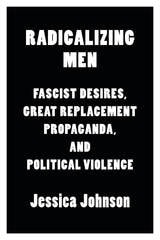
Radicalizing Men
Fascist Desires, Great Replacement Propaganda, and Political ViolenceJessica Johnson
Duke University Press, 2026
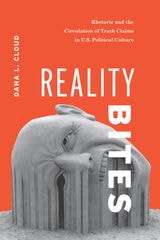
Reality Bites
Rhetoric and the Circulation of Truth Claims in U.S. Political CultureDana L. Cloud
The Ohio State University Press, 2018