Results by title
3 books match the query 'False Dawn'
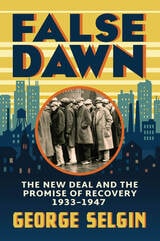
False Dawn
The New Deal and the Promise of Recovery, 1933–1947George Selgin
University of Chicago Press, 2025
CHOSEN AS ONE OF THE WALL STREET JOURNAL’S 10 BEST BOOKS OF 2025
A definitive history of the United States’ recovery from the Great Depression—and the New Deal's true part in it.
FDR’s New Deal has long enjoyed a special place in American history and policy—both because it redefined the government’s fundamental responsibilities and because Roosevelt’s “bold experimentation” represented a type of policymaking many would like to see repeated.
But “the thing about bold experiments,” economist George Selgin reminds us, “is that they often fail.” In False Dawn Selgin draws on both contemporary sources and numerous studies by economic historians to show that, although steps taken during the Roosevelt administration’s first days raised hopes of a speedy recovery from the Great Depression, instead of fulfilling those hopes, subsequent New Deal policies proved so counterproductive that over seventeen percent of American workers—more than the peak unemployment rate during the COVID-19 crisis—were still either unemployed or on work relief six years later.
By distinguishing the New Deal’s successes from its failures, and explaining how the U.S. finally managed to lay the specter of mass unemployment to rest, Selgin draws salient lessons for dealing with future recessions.
False Dawn
The Rise and Decline of Public Health NursingKaren Buhler-Wilkerson
Rutgers University Press, 2021

The False Dawn
European Imperialism in the Nineteenth CenturyRaymond F. Betts
University of Minnesota Press, 1978
The False Dawn was first published in 1975. Minnesota Archive Editions uses digital technology to make long-unavailable books once again accessible, and are published unaltered from the original University of Minnesota Press editions.
As the author explains, the false dawn that greeted and disappointed the visitors in E. M. Forster's A Passage to India is a literary image that might serve as a value judgment of modern overseas empire in general. Commenting that the term "empire" is now badly tarnished, Professor Betts points out that no bright dawn of understanding has yet appeared on the academic horizon. With this perceptive viewpoint, he traces the course of European imperialism beginning with the Treaty of Paris in 1763 and ending with a final glance toward the Western Front in August, 1914.
Reviewing the book in the Historian, Lawrence J. Baack calls it "a clear and concise essay on the nature of European imperialism." In its review Choice says: "Undergraduates and graduate students alike will welcome this book as a readable general introduction to more technical works."