Results by title
3 books match the query 'Family-owned business enterprises'
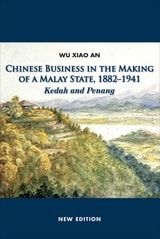
Chinese Business in the Making of a Malay State, 1882-1941
Kedah and PenangWu Xiao An
National University of Singapore Press, 2010
The Chinese in colonial Malaya were noted for their involvement in revenue farming, the rice trade, mining and estates, and pawnbroking. However, the Chinese presence was also significant in broader economic and social spheres, and the wealth and power of the Chinese community helped fuel the emerging colonial state and the modern transformation of Southeast Asia. In Chinese Business in the Making of a Malay State, Wu Xiao An argues persuasively that Chinese ventures owed much of their success to the flexibility and dynamism of Chinese family and economic networks, and the moral imperatives that governed relationships within the Chinese community.
Using Penang and Kedah as a case study, Wu draws on archival sources, family histories and an examination of legal arrangements and the press to show that personal business and business networks were not bound by the territorial borders of traditional or modern states, but extended across much of Southeast Asia and into China. His demonstration of the complexity of interactions involving new migrants, sojourners and settlers, both Chinese and non-Chinese, challenges understandings of state formation and economic growth in colonial Malaya based on ethnic stereotypes and accounts of events limited by fixed political boundaries.
Using Penang and Kedah as a case study, Wu draws on archival sources, family histories and an examination of legal arrangements and the press to show that personal business and business networks were not bound by the territorial borders of traditional or modern states, but extended across much of Southeast Asia and into China. His demonstration of the complexity of interactions involving new migrants, sojourners and settlers, both Chinese and non-Chinese, challenges understandings of state formation and economic growth in colonial Malaya based on ethnic stereotypes and accounts of events limited by fixed political boundaries.
[more]

For Love and Money
Portraits of Wisconsin Family BusinessesCarl Corey
Wisconsin Historical Society Press, 2014
In his follow-up to Tavern League: Portraits of Wisconsin Bars, Carl Corey turns his camera on Wisconsin family-owned businesses in existence fifty years or longer. The businesses portrayed here—bakeries and barbecue joints, funeral homes and furniture builders, cheesemakers, fishermen, ferry boat drivers—have survived against all the odds, weathering tough economic times and big-business competition. The owners are loyal to their employees, their families, and themselves. And they are integral to their local economies and social fabric. The services and goods they provide are usually for neighbors and friends. Generations serve generations, creating lasting relationships and strong, vibrant neighborhoods and rural communities. In For Love and Money, Carl Corey provides indelible glimpses of an increasingly endangered way of life. The Museum of Wisconsin Art’s Graham Reid has said, “As current and future generations come and go, these pictures will survive in the hands of the subjects, collectors, museums, and galleries. Will the businesses featured enjoy a similar longevity? Only time will tell, and we can only watch and hope, but Carl Corey has ensured that they will not be forgotten.”
[more]
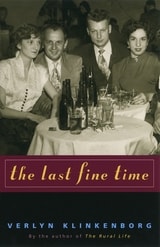
The Last Fine Time
Verlyn Klinkenborg
University of Chicago Press, 2004
By turns, an elegy, a celebration, and a social history, The Last Fine Time is a tour de force of lyrical style. Verlyn Klinkenborg chronicles the life of a family-owned restaurant in Buffalo, New York, from its days as a prewar Polish tavern to its reincarnation as George & Eddie's, a swank nightspot serving highballs and French-fried shrimp to a generation of optimistic and prosperous Americans. In the inevitable dimming of the neon sign outside the restaurant, we see both the passing of an old world way of life and the end to the postwar exuberance that was Eddie Wenzek's "last fine time."
[more]