Results by title
5 books match the query 'Famine, 1845-1852'

A Death-Dealing Famine
The Great Hunger in IrelandChristine Kinealy
Pluto Press, 1997
[more]
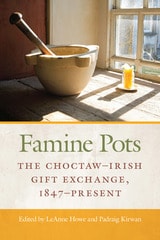
Famine Pots
The Choctaw–Irish Gift Exchange, 1847–PresentLeAnne Howe
Michigan State University Press, 2020
The remarkable story of the money sent by the Choctaw to the Irish in 1847 is one that is often told and remembered by people in both nations. This gift was sent to the Irish from the Choctaw at the height of the potato famine in Ireland, just sixteen years after the Choctaw began their march on the Trail of Tears toward the areas west of the Mississippi River. Famine Pots honors that extraordinary gift and provides further context about and consideration of this powerful symbol of cross-cultural synergy through a collection of essays and poems that speak volumes of the empathy and connectivity between the two communities. As well as signaling patterns of movement and exchange, this study of the gift exchange invites reflection on processes of cultural formation within Choctaw and Irish society alike, and sheds light on longtime concerns surrounding spiritual and social identities. This volume aims to facilitate a fuller understanding of the historical complexities that surrounded migration and movement in the colonial world, which in turn will help lead to a more constructive consideration of the ways in which Irish and Native American Studies might be drawn together today.
[more]

The Feminization of Famine
Expressions of the Inexpressible?Margaret Kelleher
Duke University Press, 1997
Contemporary depictions of famine and disaster are dominated by female images. The Feminization of Famine examines these representations, exploring, in particular, the literature arising from the Irish "Great Famine" of the 1840s and the Bengali famine of the 1940s. Kelleher illuminates recurring motifs: the prevalence of mother and child images, the scrutiny of women’s starved bodies, and the reliance on the female figure to express the largely "inexpressible" reality of famine. Questioning what gives these particularly feminine images their affective power and analyzing the responses they generate, this historical critique reveals striking parallels between these two "great" famines and current representations of similar natural disasters and catastrophes.
Kelleher begins with a critical reading of the novels and short stories written about the Irish famine over the last 150 years, from the novels of William Carleton and Anthony Trollope to the writings of Liam O’Flaherty and John Banville. She then moves on to unveil a lesser-known body of literature—works written by women. This literature is read in the context of a rich variety of other sources, including eye-witness accounts, memoirs, journalistic accounts, and famine historiography. Concluding with a reading of the twentieth-century accounts of the famine in Bengal, this book reveals how gendered representations have played a crucial role in defining notions of famine.
Kelleher begins with a critical reading of the novels and short stories written about the Irish famine over the last 150 years, from the novels of William Carleton and Anthony Trollope to the writings of Liam O’Flaherty and John Banville. She then moves on to unveil a lesser-known body of literature—works written by women. This literature is read in the context of a rich variety of other sources, including eye-witness accounts, memoirs, journalistic accounts, and famine historiography. Concluding with a reading of the twentieth-century accounts of the famine in Bengal, this book reveals how gendered representations have played a crucial role in defining notions of famine.
[more]
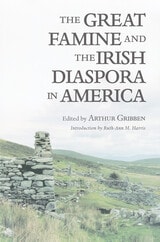
The Great Famine and the Irish Diaspora in America
Arthur Gribben
University of Massachusetts Press, 1999
Between 1845 and 1855, nearly 1.5 million Irish women, men, and children sailed to America to escape the Great Famine, triggered by successive years of potato blight. The famine and resulting emigration had a profound impact not only on the history of Ireland, but on that of England and North America as well. This volume of original essays commemorates the 150th anniversary of these epochal events and sheds new light on both the consequences of the famine and experience of the Irish in America.
[more]
The Hidden Famine
Hunger, Poverty and Sectarianism in Belfast 1840-50Christine Kinealy and Gerard Mac Atasney
Pluto Press, 2000
[more]