Results by title
14 books match the query 'Famines'

A Death-Dealing Famine
The Great Hunger in IrelandChristine Kinealy
Pluto Press, 1997

After the Digging
Alan Shapiro
University of Chicago Press, 1998
"Powerful. . . . That a young poet can handle this subject so well in a first book is . . . a pleasure in itself."—Robert von Hallberg, Contemporary Literature, 1981
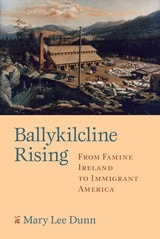
Ballykilcline Rising
From Famine Ireland to Immigrant AmericaMary Lee Dunn Maguire
University of Massachusetts Press, 2008
In 1847, in the third year of Ireland's Great Famine and the thirteenth year of their rent strike against the Crown, hundreds of tenant farmers in Ballykilcline, County Roscommon, were evicted by the Queen's agents and shipped to New York. Mary Lee Dunn tells their story in this meticulously researched book. Using numerous Irish and U.S. sources and with descendants' help, she traces dozens of the evictees to Rutland, Vermont, as railroads and marble quarries transformed the local economy. She follows the immigrants up to 1870 and learns not only what happened to them but also what light American experience and records cast on their Irish “rebellion.”
Dunn begins with Ireland's pre-Famine social and political landscape as context for the Ballykilcline strike. The tenants had rented earlier from the Mahons of Strokestown, whose former property now houses Ireland's Famine Museum. In 1847, landlord Denis Mahon evicted and sent nearly a thousand tenants to Quebec, where half died before or just after reaching the Grosse Ile quarantine station. Mahon was gunned down months later. His murder provoked an international controversy involving the Vatican. An early suspect in the case was a man from Ballykilcline.
In the United States, many of the immigrants resettled in clusters in several locations, including Vermont, Illinois, Iowa, Maryland, and New York. In Vermont they found jobs in the marble quarries, but some of them lost their homes again in quarry labor actions after 1859. Others prospered in their new lives. A number of Ballykilcline families who stopped in Rutland later moved west; one had a son kidnapped by Indians in Minnesota. Readers who have Irish Famine roots will gain a sense of their own “back story” from this account of Ireland and the native Irish, and scholars in the field of immigration studies will find it particularly useful.
Famine Foods
Plants We Eat to SurvivePaul E. Minnis
University of Arizona Press, 2021
How people eat today is a record of food use through the ages—and not just the decadent, delicious foods but the less glamorous and often life-saving foods from periods of famine as well. In Famine Foods, Paul E. Minnis focuses on the myriad plants that have sustained human populations throughout the course of history, unveiling the those that people have consumed, and often still consume, to avoid starvation. For the first time, this book offers a fascinating overview of famine foods—how they are used, who uses them, and, perhaps most importantly, why they may be critical to sustain human life in the future.
In addition to a broader discussion of famine foods, Minnis includes fourteen short case studies that examine the use of alternative foods in human societies throughout the world, from hunter-gatherers to major nations. When environmental catastrophes, war, corrupt governments, annual hunger seasons, and radical agricultural policies have threatened to starve populations, cultural knowledge and memories of food shortages have been crucial to the survival of millions of people.Famine Foods dives deeply into the cultural contexts of famine food use, showing the curious, strange, and often unpleasant foods people have turned to in order to get by. There is not a single society or area of the world that is immune to severe food shortages, and gaining a deeper knowledge of famine foods will be relevant for the foreseeable future of humanity.
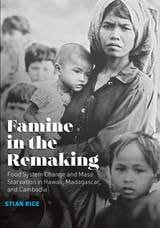
Famine in the Remaking
Food System Change and Mass Starvation in Hawaii, Madagascar, and CambodiaStian Rice
West Virginia University Press, 2020
Famine in the Remaking examines the relationship between the reorganization of food systems and large-scale food crises through a comparative historical analysis of three famines: Hawaii in the 1820s, Madagascar in the 1920s, and Cambodia in the 1970s. This examination identifies the structural transformations—that is, changes to the relationships between producers and consumers—that make food systems more vulnerable to failure. Moving beyond the economic and political explanations for food crisis that have dominated the literature, Stian Rice emphasizes important socioecological interactions, developing a framework for crisis evolution that identifies two distinct temporal phases and five different types of causal mechanisms involved in food system failure. His framework contributes to current work in famine prevention and, animated by a commitment to social justice, offers the potential for early intervention in emerging food crises.
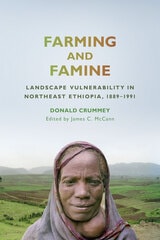
Farming and Famine
Landscape Vulnerability in Northeast Ethiopia, 1889–1991Donald E. Crummey; Edited by James C. McCann
University of Wisconsin Press, 2018
Crummey draws on photographs comparing identical landscapes in 1937 and 1997 as well as interviews with local farmers, among other sources. He reveals that forestation actually increased due to farmers' tree-planting initiatives. More broadly, he shows that, in the face of growing environmental stress, Ethiopian farmers have innovated and adapted. Yet the threat of famine remains because of constricted access to resources and erratic rainfall. To avoid future famines, Crummey suggests, Ethiopia's farmers must transform agricultural productivity, but they cannot achieve that on their own.
Hunger
The Biology and Politics of StarvationJohn R. Butterly and Jack Shepherd
Dartmouth College Press, 2010

Imagining Ethiopia
Struggles for History and Identity in the Horn of AfricaJohn Sorenson
Rutgers University Press, 1993
Plants for Desperate Times
The Diversity of Life-Saving Famine FoodsPaul E. Minnis and Robert L. Freedman
University of Arizona Press, 2024
Plants for Desperate Times is an introduction to the diversity of plant foods that have saved millions of lives during lethal food shortages. While not a field guide, it addresses questions about what famine foods are and why they are important. The work highlights one hundred plants. Each entry includes the common and scientific names, botanical family, distribution, use as a famine food and other uses, and nutritional information. The species come from across the botanical kingdom, demonstrating the diversity of life-saving plants and the human ingenuity of making what might seem to be inedible plants edible. Unexpectedly, important famine foods include alternative uses of important crops as well as native plants.
Beyond a study of famine foods, the authors share why keeping an inventory of plant foods of last resort is so important. They help to build an understanding of little-known and underappreciated foods that may have a greater role in provisioning humanity in the future. As much as we may hope that severe food scarcity will never occur again, history suggests otherwise, and Plants for Desperate Times provides invaluable documentation of these vital foods.
Seasons of Hunger
Fighting Cycles of Starvation Among the World's Rural PoorStephen Devereux, Samuel Hauenstein Swan, and Bapu Vaitla
Pluto Press, 2008
Every year, millions of the rural poor suffer from predictable and preventable seasonal hunger. This hunger is less dramatic but no less damaging than the starvation associated with famines, wars and natural disasters. Seasons of Hunger explores why the world does not react to a crisis that we know will continue year after year.
Seasonal hunger is caused by annual cycles of shrinking food stocks, rising prices, and lack of income. This hidden hunger pushes millions of children to the brink of starvation every year, permanently stunting their physical and cognitive development, weakening their immune systems and opening the door for killer diseases. Action Against Hunger argue that ending seasonal hunger could save millions of young lives and is key to achieving the Millennium Development Goals. This book documents seasonal hunger in four countries - India, Malawi, Mali and Myanmar - including personal stories and country-wide data which shows the magnitude of the problem.
The authors also find encouraging examples of interventions designed to address seasonality - initiatives led by governments, donors and NGOs, and poor people themselves - and propose a package of advocacy messages that could contribute to the global eradication of seasonal hunger. This book will be a valuable resource for journalists, policy makers, NGO members and students of development studies.

The Feminization of Famine
Expressions of the Inexpressible?Margaret Kelleher
Duke University Press, 1997
Kelleher begins with a critical reading of the novels and short stories written about the Irish famine over the last 150 years, from the novels of William Carleton and Anthony Trollope to the writings of Liam O’Flaherty and John Banville. She then moves on to unveil a lesser-known body of literature—works written by women. This literature is read in the context of a rich variety of other sources, including eye-witness accounts, memoirs, journalistic accounts, and famine historiography. Concluding with a reading of the twentieth-century accounts of the famine in Bengal, this book reveals how gendered representations have played a crucial role in defining notions of famine.
The Great Famine and the Irish Diaspora in America
Arthur Gribben
University of Massachusetts Press, 1999
The Hidden Famine
Hunger, Poverty and Sectarianism in Belfast 1840-50Christine Kinealy and Gerard Mac Atasney
Pluto Press, 2000

The Prendergast Letters
Correspondence from Famine-Era Ireland, 1840–1850Shelley Barber
University of Massachusetts Press, 2006
Most important, the letters offer a rare contemporary, firsthand account of Ireland's an Gorta Mor, the Great Famine that began with the failure of the potato crop in 1845. Letters written in the months and years following the announcement of the first crop failure provide insight into not only the sufferings of one family but also the response of the community and nation as this crisis transformed Ireland.
James and Elizabeth Prendergast were the parents of six children. Their letters from Milltown, County Kerry, dictated to a scrivener, were posted to sons Thomas and Jeffrey and daughter Julia Riordan and her husband Cornelius, all of whom had emigrated in search of employment to Boston, Massachusetts—a city that would itself be transformed by the famine-era influx of Irish immigrants.
In addition to transcriptions of the forty-eight letters in the collection, this volume includes contextual essays by historian Ruth-Ann Harris and genealogist Marie Daly. The evidence of the letters themselves, along with the contributions of Harris and Daly, demonstrate the ways in which the family of James Prendergast was at once exceptional and typical.