Results by title
4 books match the query 'Fantasy in children'
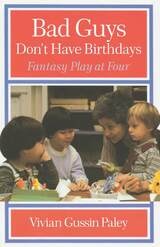
Bad Guys Don't Have Birthdays
Fantasy Play at FourVivian Gussin Paley
University of Chicago Press, 1991
Their play is filled with warnings. They invent chaos in order to show that everything is under control. They portray fear to prove that it can be conquered. No theme is too large or too small for their intense scrutiny. Fantasy play is their ever dependable pathway to knowledge and certainty.
" It . . . takes a special teacher to value the young child's communications sufficiently, enter into a meaningful dialogue with the youngster, and thereby stimulate more productivity without overwhelming the child with her own ideas. Vivian Paley is such a teacher."—Maria W. Piers, in the American Journal of Education
"[Mrs. Paley's books] should be required reading wherever children are growing. Mrs. Paley does not presume to understand preschool children, or to theorize. Her strength lies equally in knowing that she does not know and in trying to learn. When she cannot help children—because she can neither anticipate nor follow their thinking—she strives not to hinder them. She avoids the arrogance of adult to small child; of teacher to student; or writer to reader."—Penelope Leach, author of Your Baby & Child in the New York Times Book Review
"[Paley's] stories and interpretation argue for a new type of early childhood education . . . a form of teaching that builds upon the considerable knowledge children already have and grapple with daily in fantasy play."—Alex Raskin, Los Angeles Times Book Review
"Through the 'intuitive language' of fantasy play, Paley believes, children express their deepest concerns. They act out different roles and invent imaginative scenarios to better understand the real world. Fantasy play helps them cope with uncomfortable feelings. . . . In fantasy, any device may be used to draw safe boundaries."—Ruth J. Moss, Psychology Today
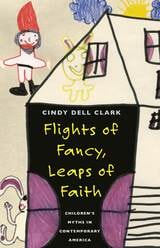
Flights of Fancy, Leaps of Faith
Children's Myths in Contemporary AmericaCindy Dell Clark
University of Chicago Press, 1995
"A very enjoyable read, this book is a seriously researched record of children's myths, written with the observant accuracy of an anthropologist."—Nadja Reissland, Common Knowledge
"Clark posits some novel interpretations as well as intriguing glimpses for parents, teachers, and psychologists into the ways children shape our culture rather than merely being passive inheritors of it."—Booklist
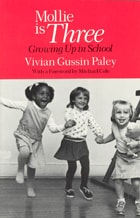
Mollie Is Three
Growing Up in SchoolVivian Gussin Paley
University of Chicago Press, 1986
Mollie Is Three describes a year in the life of a little girl and her preschool classmates in a nursery school classroom run by Vivian Gussin Paley, whose groundbreaking ideas about the best way to teach young children continue to be influential today. We first encounter Mollie on the first day of school, just before her third birthday, and we follow her and her classmates for the next year. Alongside her, we go from confusion and uncertainty in new surroundings to growing understanding and confidence, as patterns emerge and Mollie begins to grasp their significance--and her teacher begins to understand how to track her growth and development.
Rather than offer an account of an idealized, all but imaginary child, Paley presents us with one actual kid, in all their complexity and confusion. The result is a landmark contribution to our understanding of child development and the role early education can play in fostering it.
The Classrooms All Young Children Need
Lessons in Teaching from Vivian PaleyPatricia M. Cooper
University of Chicago Press, 2009
Teacher and author Vivian Paley is highly regarded by parents, educators, and other professionals for her original insights into such seemingly everyday issues as play, story, gender, and how young children think. In The Classrooms All Young Children Need, Patricia M. Cooper takes a synoptic view of Paley’s many books and articles, charting the evolution of Paley’s thinking while revealing the seminal characteristics of her teaching philosophy. This careful analysis leads Cooper to identify a pedagogical model organized around two complementary principles: a curriculum that promotes play and imagination, and the idea of classrooms as fair places where young children of every color, ability, and disposition are welcome.
With timely attention paid to debates about the reduction in time for play in the early childhood classroom, the role of race in education, and No Child Left Behind, The Classrooms All Young Children Need will be embraced by anyone tasked with teaching our youngest pupils.