Results by title
2 books match the query 'Far East'
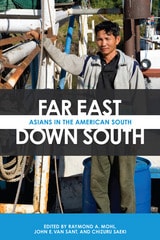
Far East, Down South
Asians in the American SouthEdited by Raymond A. Mohl, John E. Van Sant, and Chizuru Saeki
University of Alabama Press, 2016
Uncovering the overlooked histories of Asians in the American South.
In sharp contrast to the “melting pot” reputation of the United States, the American South—with its history of slavery, Jim Crow, and the civil rights movement—has been perceived in stark and simplistic demographic terms. In Far East, Down South, editors Raymond A. Mohl, John E. Van Sant, and Chizuru Saeki provide a collection of essential essays that restores and explores an overlooked part of the South’s story—that of Asian immigration to the region.
These essays form a comprehensive overview of key episodes and issues in the history of Asian immigrants to the South. During Reconstruction, southern entrepreneurs experimented with the replacement of slave labor with Chinese workers. As in the West, Chinese laborers played a role in the development of railroads. Japanese farmers also played a more widespread role than is usually believed. Filipino sailors recruited by the US Navy in the early decades of the twentieth century often settled with their families in the vicinity of naval ports such as Corpus Christi, Biloxi, and Pensacola. Internment camps brought Japanese Americans to Arkansas. Marriages between American servicemen and Japanese, Korean, Filipina, Vietnamese, and nationals in other theaters of war created many thousands of blended families in the South. In recent decades, the South is the destination of internal immigration as Asian Americans spread out from immigrant enclaves in West Coast and Northeast urban areas.
Taken together, the book’s essays document numerous fascinating themes: the historic presence of Asians in the South dating back to the mid-nineteenth century; the sources of numerous waves of contemporary Asian immigration to the South; and the steady spread of Asians out from the coastal port cities. Far East, Down South adds a vital new dimension to popular understanding of southern history.
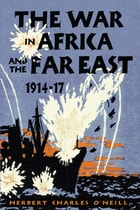
The War in Africa and the Far East, 1914-17
Herbert Charles O'Neill
Westholme Publishing, 2012
"This account will be welcome to a large circle of readers. . . . The arduous nature of these campaigns deserves to be far more widely known, and this is just the book for the purpose--short, clear, and easy to read."--Journal of the African Society
The largest battles of World War I were fought in Europe, and it is there where most critical studies focus. The fate of the far-flung colonies of Germany, however, are what gave the war its global scope, with campaigns reaching from China to New Guinea and East to West Africa. While there are detailed accounts of most of these campaigns, The War in Africa and the Far East, 1914-17 is unique in providing a concise history of the entire series of military events in Africa and Asia, giving the reader a better idea of the relationship and chronology of these wide-ranging events. While Germany was stripped of all its overseas colonies, the change in power had unintended consequences, most importantly the rise of Japan in the Pacific, where former German colonies now stood at the territorial boundary between Japan and the United States.
Waged by Allied troops from Britain, Kenya, Zambia, Portugal, Japan, India, Netherlands, and other countries and led by such personalities as General Jan Christian Smuts, the theater of operations crossed modern-day Tanzania, Rwanda, Burundi, Togo, Cameroon, Namibia, New Guinea, Qingdau, the Bismarck Archipelago, and other Pacific Island chains. Originally published in 1918 using official dispatches and other sources, and presented here for the first time in paperback, completely retypeset and with the original maps and additional photographs, The War in Africa and the Far East is a compact overview of an important aspect of the First World War.