Results by title
2 books match the query 'Fass, Paula S.'
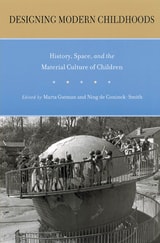
Designing Modern Childhoods
History, Space, and the Material Culture of ChildrenGutman, Marta
Rutgers University Press, 2008
With the advent of urbanization in the early modern period, the material worlds of children were vastly altered. In industrialized democracies, a broad consensus developed that children should not work, but rather learn and play in settings designed and built with these specific purposes in mind. Unregulated public spaces for children were no longer acceptable; and the cultural landscapes of children's private lives were changed, with modifications in architecture and the objects of daily life.
In Designing Modern Childhoods, architectural historians, social historians, social scientists, and architects examine the history and design of places and objects such as schools, hospitals, playgrounds, houses, cell phones, snowboards, and even the McDonald's Happy Meal. Special attention is given to how children use and interpret the spaces, buildings, and objects that are part of their lives, becoming themselves creators and carriers of culture. The authors extract common threads in children's understandings of their material worlds, but they also show how the experience of modernity varies for young people across time, through space, and according to age, gender, social class, race, and culture.
In Designing Modern Childhoods, architectural historians, social historians, social scientists, and architects examine the history and design of places and objects such as schools, hospitals, playgrounds, houses, cell phones, snowboards, and even the McDonald's Happy Meal. Special attention is given to how children use and interpret the spaces, buildings, and objects that are part of their lives, becoming themselves creators and carriers of culture. The authors extract common threads in children's understandings of their material worlds, but they also show how the experience of modernity varies for young people across time, through space, and according to age, gender, social class, race, and culture.
[more]
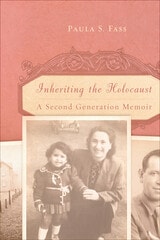
Inheriting the Holocaust
A Second-Generation MemoirPaula S. Fass
Rutgers University Press, 2011
In Inheriting the Holocaust, Paula S. Fass explores her own past as the daughter of Holocaust survivors to reflect on the nature of history and memory. Through her parents' experiences and the stories they recounted, Fass defined her engagement as a historian and used these skills to better understand her parents' lives.
Fass begins her journey through time and relationships when she travels to Poland and locates birth certificates of the murdered siblings she never knew. That journey to recover her family's story provides her with ever more evidence for the perplexing reliability of memory and its winding path toward historical reconstruction. In the end, Fass recovers parts of her family's history only to discover that Poland is rapidly re-imagining the role Jews played in the nation's past.
[more]