Results by title
10 books match the query 'Father and child'
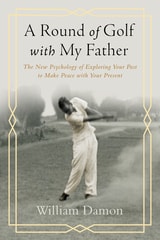
A Round of Golf with My Father
The New Psychology of Exploring Your Past to Make Peace with Your PresentDamon, William
Templeton Press, 2021
Viewing our past through the eyes of maturity can reveal insights that our younger selves could not see. Lessons that eluded us become apparent. Encounters that once felt like misfortunes now become understood as valued parts of who we are. We realize what we’ve learned and what we have to teach. And we’re encouraged to chart a future that is rich with purpose.
In A Round of Golf with My Father, William Damon introduces us to the “life review.” This is a process of looking with clarity and curiosity at the paths we’ve traveled, examining our pasts in a frank yet positive manner, and using what we’ve learned to write purposeful next chapters for our lives.
For Damon, that process began by uncovering the mysterious life of his father, whom he never met and never gave much thought to. What he discovered surprised him so greatly that he was moved to reassess the events of his own life, including the choices he made, the relationships he forged, and the career he pursued.
Early in his life, Damon was led to believe that his father had been killed in World War II. But the man survived and went on to live a second life abroad. He married a French ballerina, started a new family, and forged a significant Foreign Service career. He also was an excellent golfer, a bittersweet revelation for Damon, who wishes that his father had been around to teach him the game.
We follow Damon as he struggles to make sense of his father’s contradictions and how his father, even though living a world apart, influenced Damon’s own development in crucial ways. In his life review, Damon uses what he learned about his father to enhance his own newly emerging self-knowledge.
Readers of this book may come away inspired to conduct informal life reviews for themselves. By uncovering and assembling the often overlooked puzzle pieces of their pasts, readers can seek present-day contentment and look with growing optimism to the years ahead.
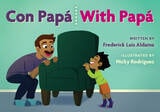
Con Papá / With Papá
Written by Frederick Luis Aldama Illustrated by Nicky Rodriguez
The Ohio State University Press, 2022
With Papá, anything is possible! With playful illustrations and rich imagery, this gentle bilingual story for ages 3–8 celebrates fathers, children, and Latinx identity as it takes readers on a childhood journey of growth and discovery. From delivery from the serpent god’s wings to Papá’s safe arms to witnessing the magical tapestry of stars, Con Papá / With Papá shows us the world through a child’s eyes, hand in hand with Papá, until they are ready to set off on their own adventures.
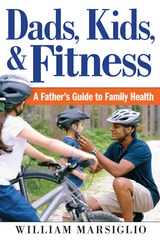
Dads, Kids, and Fitness
A Father's Guide to Family HealthMarsiglio, William
Rutgers University Press, 2016
Now more than ever, American dads act as hands-on caregivers who are devoted to keeping themselves and their families healthy. Yet, men are also disproportionately likely to neglect their own health care, diets, and exercise routines—bad habits that they risk passing on to their children.
In Dads, Kids, and Fitness, William Marsiglio challenges dads to become more health-conscious in how they live and raise their children. His conclusions are drawn not only from his revealing interviews with a diverse sample of dads and pediatric healthcare professionals, but also from his own unique personal experiences—as a teenage father who, thirty-one years later, became a later-life dad to a second son. Marsiglio’s research highlights the value of treating dads as central players in what he calls the social health matrix, which can serve both healthy children and those with special needs. He also outlines how schools, healthcare facilities, religious groups, and other organizations can help dads make a positive imprint on their families’ health, fitness, and well-being.
Anchored in compelling life stories of joy, tragedy, and resilience, Dads, Kids, and Fitness extends and deepens public conversation about health at a pivotal historical moment. Its progressive message breathes new life into discussions about fathering, manhood, and health.

Father Nature
Fathers as Guides to the Natural WorldPaul S. & Stan Piper & Tag
University of Iowa Press, 2003
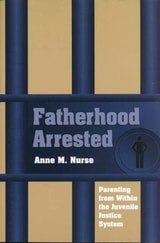
Fatherhood Arrested
Parenting from Within the Juvenile Justice SystemAnne M. Nurse
Vanderbilt University Press, 2002
By taking us inside the prison system, Nurse shows how its structure actively shapes an inmate's relationship with his children. For example, visitation is sometimes restricted to blood relatives and wives. Because relationships between unmarried men and the mothers of their children are often strained, some mothers are unwilling to allow their children to go to the prison with the inmate's family. Or the father may be allowed to receive visits from only one "girlfriend," which forces a man with multiple relationships, or with children by different women, to make impossible choices. Special attention is paid to the gendered nature of prison, its patriarchal and punitive structure, and its high-stress environment. The book then follows newly paroled men as they are released and return to their children.
The author spent four years doing research at the California Youth Authority, during which time she surveyed 258 paroled fathers. The group included young white, black, and Latino men, ages sixteen to twenty-five. She conducted in-depth interviews with men selected from this group, participated in forty parenting class sessions, and observed visiting hours at three different institutions. The data provide fascinating information about the characteristics of the men, their attitudes toward fatherhood, and the ways they are involved with their children. The diversity of the fathers allows for an analysis of racial and ethnic variation in their attitudes and involvement. The study concludes with a series of policy suggestions, especially important in light of the large number of fathers now living under the care and control of the juvenile justice system.
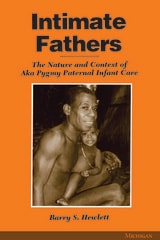
Intimate Fathers
The Nature and Context of Aka Pygmy Paternal Infant CareBarry S. Hewlett
University of Michigan Press, 1991
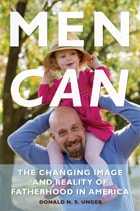
Men Can
The Changing Image and Reality of Fatherhood in AmericaDonald N.S. Unger
Temple University Press, 2010
Fatherhood is evolving in America. Stay at home dads are becoming more commonplace; men are becoming more visible in domestic, caregiving activities. In Men Can, writer, teacher, and father Donald Unger uses his personal experiences, stories of real-life families, as well as representations of fathers in film, on television, and in advertising, to illuminate the role of men in the increasingly fluid domestic sphere.
In thoughtful interviews, Don Unger tells the stories of a half dozen families—of varied ethnicities, geographical locations, and philosophical orientations—in which fathers are either primary or equally sharing parents, personalizing what is changing in how Americans care for their children. These stories are complemented by a discussion of how the language of parenting has evolved and how media representations of fathers have shifted over several decades.
Men Can shows how real change can take place when families divide up domestic labor on a gender-neutral basis. The families whose stories he tells offer insights into the struggles of—and opportunities for—men caring for children. When it comes to taking up the responsibility of parenting, his argument, ultimately, is in favor of respecting personal choices and individual differences, crediting and supporting functional families, rather than trying to force every household into a one-size-fits-all mold.
Nurturing Dads
Fatherhood Initiatives Beyond the WalletWilliam Marsiglio
Russell Sage Foundation, 2012
Papa, PhD
Essays on Fatherhood by Men in the AcademyMarotte, Mary Ruth
Rutgers University Press, 2010
In Papa, PhD, Mary Ruth Marotte, Paige Martin Reynolds, and Ralph James Savarese bring together a group contributors from a variety of backgrounds and disciplines. They are white, black, South Asian, Asian, and Arab. They are gay and straight, married and divorced. They are tenured and untenured, at research-one universities and at community colleges. Some write at the beginning of their careers, others at the end. But, perhaps most important they do not look back-they look forward to new parental and professional synergies as they reflect on what it means to be a father in the academy.
The fathers writing in Papa, PhD seek to expand their children's horizons, giving them the gifts of better topic sentences and a cosmopolitan sensibility. They seriously consider the implications of gender theory and queer theory-even Marxist theory-and make relevant theoretical connections between their work and the less abstract, more pragmatic, world of fathering. What resonates is the astonishing range of forms that fatherhood can take as these dads challenge traditional norms by actively questioning the status quo.
Thinking about the Baby
Gender and Transitions into ParenthoodSusan Walzer
Temple University Press, 1998
How do new mothers and fathers think about babies, and what is the influence of parental consciousness in reproducing motherhood and fatherhood as different experiences? The reports of new parents in this book illustrate the power of gendered cultural imagery in how women and men think about their roles and negotiate their parenting arrangement.
New parents talk about what it means to them to be a "good" mother or father and how this plays out in their working arrangements and their everyday interactions over child care. The author carefully unravels the effects of social norms, personal relationships, and social institutions in channeling parents toward gender-differentiated approaches to parenting.