Results by title

11 books match the query 'Fathers of the church'
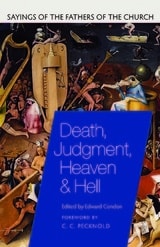
cover of Death, Judgement, Heaven, and Hell

Death, Judgement, Heaven, and Hell

Edward Condon

Catholic University of America Press, 2019
In this volume, canon lawyer and writer Edward Condon compiles a book full of wisdom and compelling insights. More than anything, the Fathers warn us that our life is short, and the reckoning for how we have lived it eternal. The urgency of the Church’s message, brought to life in the sayings of the Fathers, comes to remind us of our true calling and inheritance in baptism, and of the richness of the heavenly reward, which is not so much the fruit of our efforts on Earth but the fulfillment of God’s promise of love to us. The terror of hell is not the threat of the dictator, but a dire warning of the true scope of our freedom as children of God.
[more]
cover of God, the Flesh, and the Other: From Irenaeus to Duns Scotus

God, the Flesh, and the Other

From Irenaeus to Duns Scotus

Emmanuel Falque Translated from the French by William Christian Hackett

Northwestern University Press, 2015

In God, the Flesh, and the Other, the philosopher Emmanuel Falque joins the ongoing debate about the role of theology in phenomenology. An important voice in the second generation of French philosophy’s “theological turn,” Falque examines philosophically the fathers of the Church and the medieval theologians on the nature of theology and the objects comprising it. Falque works phenomenology itself into the corpus of theology. Theological concepts thus translate into philosophical terms that phenomenology should legitimately question: concepts from contemporary phenomenology such as onto-theology, appearance, reduction, body/flesh, inter-corporeity, the genesis of community, intersubjectivity, and the singularity of the other find penetrating analogues in patristic and medieval thought forged through millennia of Christological and Trinitarian debate, mystical discourses, and speculative reflection. Through Falque’s wide-ranging interpretive path, phenomenology finds itself interrogated—and renewed.
[more]
cover of Growing into God: The Fathers of the Church on Christian Maturity

Growing into God

The Fathers of the Church on Christian Maturity

John Gavin

Catholic University of America Press, 2025
Many studies of spiritual development exist under the heading of “Christian Perfection.” However, John Gavin revisits such topics as asceticism, prayer, sacraments, virtues, and spiritual combat through scriptural and patristic texts that present the Christian life as one of growth from spiritual infancy to a particular fulfillment or end (telos): divinized humanity as formed and revealed in Jesus Christ. Thus, though Christian maturity does incorporate such things as physical and cognitive development, its true distinction lies in its gifted, supernatural end that does not exclude human freedom. Part One establishes the pillars of Christian maturity – form and finality; virtue and character; vocation and mission – and explores the opposition to maturation in the form of demonic infantilism. Part Two examines the means of maturity given to us in the life of the Church: the Scriptures, the Mysteries (Sacraments), and asceticism. Finally, Part Three reviews four figures of Christian adulthood: the Witness, the Teacher, the Servant, and the Fool. A concluding chapter applies the insights from the previous chapters to our modern world to see in what ways our times need to “grow up.” Growing into God includes a variety of early Christian voices: Irenaeus of Lyons, Origen of Alexandria, Gregory of Nazianzus, Gregory of Nyssa, Basil of Caeserea, Augustine of Hippo, Ambrose of Milan, John Cassian, Dionysius the Areopagite, Mark the Monk, John Moschos, Maximus the Confessor, Symeon the Holy Fool, and others. Their collective insights, all the fruits of great learning and the contemplation of God’s Word, describe a wondrous figure: the mature saint transformed by union with the Father, Son, and Spirit.
[more]
cover of On Illustrious Men

On Illustrious Men

Saint Jerome

Catholic University of America Press, 1999
Often cited as a source of biographical information on ancient Christian authors, On Illustrious Men provides St. Jerome's personal evaluations of his forebears and contemporaries, as well as catalogs of patristic writings known to him
[more]
cover of Patristic Exegesis in Context: Exploring the Genres of Early Christian Biblical Interpretation

Patristic Exegesis in Context

Exploring the Genres of Early Christian Biblical Interpretation

Miriam De Cock

Catholic University of America Press, 2023
The essays of Patristic Exegesis in Context examine the biblical exegesis of early Christians beyond the formal genre of biblical commentary. The past couple of decades have seen a broadening of perspective on the study of patristic exegesis; the phenomenon is increasingly situated within its various literary contexts and genres, and the definition of what counts as patristic exegesis is therefore widened. This volume thus situates itself within this emerging scholarly tradition, which aims not to give an account of exegetical strategies and methodologies as found primarily in exegetical commentaries and homilies, but to demonstrate the highly sophisticated nature of biblical exegesis in other genres, and the manifold uses to which this exegesis was put. Ancient Christian authors lived and breathed scripture; it served as their primary source of theological and liturgical vocabulary, their way of processing the world, their social ethic, and their mode of constructing self and communal identity. Scripture therefore permeates all ancient Christian literature, regardless of genre, and the various contexts in which interpretation of scripture took place resulted in a wide variety of uses of the church’s authoritative texts. The essays in this volume demonstrate the interpretive skill, creativity, and sophistication of early Christian authors in a myriad of other early Christian genres, such as poetry, paraphrase, hymns, martyr accounts, homilies, prophetic vision accounts, monastic writings, argumentative treatises, encomia, apocalypses, and catenae. Accordingly, the volume aims to help the modern person, who is used to hearing the Bible explained in explicitly expository situations (for example, in academic commentaries or religious sermons) to become more habituated to ancient ways of interacting with and expounding the biblical text. These essays attempt to contextualize various types of patristic exegesis, in order for us to glimpse the complex and diverse uses of the Bible in this period.
[more]
cover of Reading Patristic Texts on Social Ethics: Issues and Challenges for the Twenty-First Century

Reading Patristic Texts on Social Ethics

Issues and Challenges for the Twenty-First Century

Johan Leemans

Catholic University of America Press, 2011
Can writings of the church fathers related to the field of social ethics be of value to contemporary discussions on the topic? In addressing this question, the authors of this book discuss the exciting challenges that scholars of both early Christianity and contemporary Catholic social thought face regarding the interaction of historical sources and present issues.
[more]
cover of The Fathers of the Church in Christian Theology

The Fathers of the Church in Christian Theology

Catholic University of America Press, 2019
The main purpose of The Fathers of the Church in Christian Theology is to argue that Patristic studies still has much to contribute to theological reflections in our time. Throughout history, the reading of the Fathers of the Church has made major contributions to Christian thinking. This fecundity was notably verified in the 20th century through the work of theologians like Henri de Lubac and Hans Urs von Balthasar. It was as well manifested broadly in the life of the church that, with the Vatican II council, drew from the patristic tradition a source of inspiration for its own renewal. However, even though the research and work on early Christianity has experienced considerable growth for several decades, Christian theology is today confronted with new questions. Thus, what status to recognize in the exegesis of the Fathers? Has not the distance from the heritage of patristic thinking been widened? More radically, do not the demands of contextual theologies on diverse continents compel a distancing away from some traditions that formerly were principally limited to Mediterranean and European regions? If these questions must be taken into account, they, nevertheless, cannot dispense with Christian theology being, today as yesterday, inspired and made fecund by the writings of the Fathers. Michel Fédou attempts to shed light on what, in our own era, justifies the necessity of a patristic theology. He shows how the reading of the Fathers contributes to the understanding of the faith in the different fields of Christian thinking. It highlights the importance of their writings for the spiritual life and the valuable nourishment that they thus offer to our times.
[more]
cover of The Holy Mass

The Holy Mass

Mike Aquilia

Catholic University of America Press, 2021
The Catholic University of America Press is proud to present the third volume in its Sayings of the Fathers of the Church series. Featuring esteemed scholars and writers compiling material from our acclaimed Fathers of the Church volumes, each title is devoted to select areas of theology. The inaugural volumes covered the Seven Deadly Sins and the Four Last Things, and now we turn to The Holy Mass. The documents of early Christianity are rich in mentions of the Mass and its component parts. Sometimes they’re detailed descriptions, sometimes quick allusions. In this volume Mike Aquilina, a popular author on early Christianity, takes readers step by step through the Mass, from the Sign of the Cross through the Dismissal, illuminating the way with the words of the Fathers. Along the way readers encounter familiar rites, words, and gestures, but also familiar complaints — about long homilies, bad singing, liturgical abuses, and distracted congregations. The Holy Mass is divided into chapters based on the parts of the Mass known to modern Catholics of the Roman Rite. The Mass did not follow this sequence through the entirety of the era of the Fathers. Gregory the Great moved the position of the Lord’s Prayer. There were geographic variants for the placement of the Sign of Peace. Some ancient liturgies lacked a specific penitential rite — though all the liturgies had a penitential dimension to their prayers. Mike Aquilina’s introduction provides historical context and describes the rich development of the liturgy through the Church’s first few centuries. A foreword by Thomas Weinandy, a member of the Vatican’s International Theological Commission, speaks of the relevance of this material for worshipers today.
[more]
cover of The Seven Deadly Sins: Sayings of the Fathers of the Church

The Seven Deadly Sins

Sayings of the Fathers of the Church

Kevin M. Clarke

Catholic University of America Press, 2018

The Seven Deadly Sins: Sayings of the Fathers of the Church is the inaugural volume in a new series from the Catholic University of America Press. This series will feature a wide range of scholars compiling material from the Fathers of the Church series to focus on a specific area of theology. Forthcoming titles will focus on Death, Judgement, Heaven and Hell, and Angels and Demons, with others to be announced shortly.

Sacred Scripture did not neatly list the seven deadly sins, so where did this tradition come from? Unsurprisingly, it can be traced back to the Church Fathers. But were there eight or seven? In a sense, the answer is “both.” The tradition of the capital sins has a rich development in the patristic era, not only in the presentation of the list of vices but in the preaching and teaching of the early shepherds of the Church. So how do the capital sins spawn other vices in the soul? How does one cultivate the virtues that heal the soul from those vices? How are gluttony and lust related? Is sadness really a vice? How is vainglory different from pride? What role does almsgiving have in soothing the passion of anger? The Fathers of the Church answer these questions and more in this volume.

The capital vices are the gateway drugs to countless sins. The path of the book descends through the vices, culminating with their queen ruler, pride. The words of the Fathers will assist the reader in being more realistic about the attacks upon the soul. The text should also be edifying and medicinal. Since each chapter begins with vice and ends with virtue, one’s path through the chapters represents a sort of ascent out of vice and into the freedom of the virtues. The text gives special attention throughout to the thought of Augustine of Hippo, Evagrius of Pontus, John Cassian, Gregory the Great, and Maximus the Confessor.
[more]
cover of Thomas Aquinas and His Predecessors: The Philosophers and the Church Fathers

Thomas Aquinas and His Predecessors

The Philosophers and the Church Fathers

Leo J. Elders

Catholic University of America Press, 2018
Thomas Aquinas and His Predecessors takes us on a voyage through the history of philosophical thought as present in the works of Thomas Aquinas. It is a synthetic presentation of the works and thought of the great predecessors of Aquinas, as he kne
[more]
cover of Treatises on Noah and David

Treatises on Noah and David

Brian P. St. Ambrose

Catholic University of America Press, 2020

These sermons by Ambrose of Milan (340–397 AD) provide a window into the preaching and scriptural exegesis of the legendary bishop, whose exposition of the Old Testament was instrumental in the conversion of Augustine of Hippo and in the development of Latin theology. In his treatise On Noah and his two Defenses for David, Ambrose borrows from influential Greek theologians, including Philo of Alexandria, Origen, and Didymus the Blind, while developing his own commentary on the exemplary patriarchs. Ambrose’s exegesis typifies both his attention to the letter of Scripture as well as his spiritual and allegorical reading of the holy figures or “saints” who lived before Christ.

The first treatise presents Noah as a model just man, as Ambrose pairs the literal and the higher or spiritual meaning of the Genesis flood narrative to address topics ranging from the Genesis narrative to Stoic ethics to the Incarnation. In his defense of David to the emperor Theodosius, Ambrose ties David’s sin and repentance to his own close reading of Psalm 51(50), David’s plea for himself in his famous “Miserere.” While the authenticity of the third treatise included in the volume, the Second Apology of David, has long been challenged, recent scholarship suggests that it transmits Ambrose’s own preaching, which applies the lessons of David’s life to the situation of gentile unbelievers, Jews, and the church; even if it is the work of a later imitator, the Second Apology is a compelling and systematic treatment of the David’s sin and repentance as relevant to Christian morality and doctrine.

The three treatises, previously unavailable in English translation, broaden our understanding of exegesis in the Latin West and our interpretation of Ambrose as preacher and exegete.
[more]