Results by title
2 books match the query 'Fawcett, Julia H.'
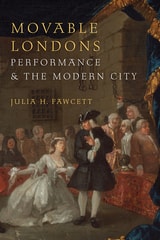
Movable Londons
Performance and the Modern CityJulia H Fawcett
University of Michigan Press, 2025
In September 1666, a fire sparked in a bakery on Pudding Lane grew until it had destroyed four-fifths of central London. The rebuilding efforts that followed not only launched the careers of some of London’s most famous architects, but also transformed Londoners’ relationship to their city by underscoring the ways that people could shape a city’s spaces—and the ways that a city’s spaces could shape its people. Movable Londons looks to the Restoration theater to understand how the dispossessed made London into a modern city after the Great Fire of 1666 and how the introduction of changeable scenery in theaters altered how Londoners conceptualized the city. Fawcett makes a claim for the centrality of unplanned spaces and the role of the Restoration theater in articulating those spaces as the modern city emerged and argues that movable scenery revolutionized London’s public theaters, inviting audiences to observe how the performers—many of them hailing from the same communities as their characters—navigated the stage.
[more]

Spectacular Disappearances
Celebrity and Privacy, 1696-1801Julia H. Fawcett
University of Michigan Press, 2016
How can people in the spotlight control their self-representations when the whole world seems to be watching? The question is familiar, but not new. Julia Fawcett examines the stages, pages, and streets of eighteenth-century London as England's first modern celebrities performed their own strange and spectacular self-representations. They include the enormous wig that actor Colley Cibber donned in his comic role as Lord Foppington--and that later reappeared on the head of Cibber's cross-dressing daughter, Charlotte Charke. They include the black page of Tristram Shandy, a memorial to the parson Yorick (and author Laurence Sterne), a page so full of ink that it cannot be read. And they include the puffs and prologues that David Garrick used to heighten his publicity while protecting his privacy; the epistolary autobiography, modeled on the sentimental novel, of Garrick's protégée George Anne Bellamy; and the elliptical poems and portraits of the poet, actress, and royal courtesan Mary Robinson, a.k.a. Perdita.
Linking all of these representations is a quality that Fawcett terms "over-expression," the unique quality that allows celebrities to meet their spectators' demands for disclosure without giving themselves away. Like a spotlight so brilliant it is blinding, these exaggerated but illegible self-representations suggest a new way of understanding some of the key aspects of celebrity culture, both in the eighteenth century and today. They also challenge divides between theatrical character and novelistic character in eighteenth-century studies, or between performance studies and literary studies today. The book provides an indispensable history for scholars and students in celebrity studies, performance studies, and autobiography—and for anyone curious about the origins of the eighteenth-century self.
[more]