Results by title
4 books match the query 'Feathers'
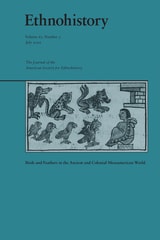
Birds and Feathers in the Ancient and Colonial Mesoamerican World
Allison Caplan and Lisa Sousa, special issue editors
Duke University Press, 0
This issue reconstructs the integrated roles of real and symbolic birds and their feathers in ancient and colonial Mesoamerican and trans-Atlantic societies. The contributors—who include biologists, historians, and art historians—combine ethnohistoric methodologies with the physical sciences to analyze pictorial and native-language sources, archival documents, chronicles, feather artworks, and specimens in natural history collections. Contributors explore the semiotics of feathers, highly valued as part of local and imperial economies, in ritual regalia and featherworks. The issue also sheds light on how the shipment of indigenous featherworks and actual birds—both living and stuffed—brought American birds and indigenous knowledge of them into contact with Europe. By foregrounding indigenous knowledge and value systems, the contributors reexamine the significance of birds and feathers in constructions of the natural world, philosophy and religion, society and economics, and artistic practice.
Contributors: Allison Caplan, Martha Few, León García Garagarza, James Maley, John McCormack, Iris Montero Sobrevilla, Lisa Sousa
Contributors: Allison Caplan, Martha Few, León García Garagarza, James Maley, John McCormack, Iris Montero Sobrevilla, Lisa Sousa
[more]
Feathers
Haim Be’er
Brandeis University Press, 2006
When first published in 1979, Haim Be’er’s Feathers was a critical and commercial success, ushering in a period of great productivity and expansiveness in modern Hebrew literature. Now considered a classic in Israeli fiction the book is finally available to English readers worldwide. In this, his first novel, Be’er portrays the world of a deeply religious community in Jerusalem during the author’s childhood and adolescence in the 1950s and 60s. The novel is filled with vivid portraits of eccentric Jerusalem characters, chief among them the book’s main character, Mordecai Leder, who dreams of founding a utopian colony based on the theories of the nineteenth-century Viennese Jewish thinker Karl Popper-Lynkeus. Similar high-flying dreams inspire the family of the narrator, strict Orthodox Jews with impractical minds and adventurous souls—men such as the narrator’s father, who periodically disappears from home on botanical expeditions meant to prove that the willow tree of Scripture is in fact the Australian eucalyptus. Experimental in structure and mood, Feathers features kaleidoscopic jumps in time, back and forth in the narrator’s memories from boyhood to adulthood. Its moods swing wildly from hilarity to the macabre, from familial warmth to the loneliness of adolescence. Jerusalem and its inhabitants, as well as the emotional life of the narrator, are splintered and reconstituted, shattered and patched. This fragmentation, combined with a preoccupation with death and physical dissolution and dreamlike flights of imagination, evokes an Israeli magical realism. Feathers was chosen one of the 100 Greatest Works of Modern Jewish Literature by the National Yiddish Book Center.
[more]
Millions of Gifts for the Gods
The Feather Distribution ProjectJonathan Reyman
University Press of Colorado, 2025
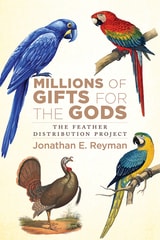
In Millions of Gifts for the Gods, Jonathan E. Reyman chronicles a remarkable thirty-four-year applied anthropology initiative that bridged ancient traditions with contemporary conservation challenges. From 1982 to 2015 the Feather Distribution Project addressed the critical need for macaw, parrot, and wild turkey feathers essential to Pueblo religious practices, directly supporting their constitutional right to freedom of religion.
Grounded in Sol Tax’s concept of “action anthropology,” the project facilitated community-driven decision-making rather than imposing external solutions. This collaborative approach enabled Indigenous communities to maintain cultural practices that have persisted for over a millennium, dating back to the Ancestral Pueblo people and the Mogollon and Sinagua tribes, who viewed birds as sacred beings that helped humans emerge from the underworld. Yet the project’s impact extended far beyond cultural preservation. Over three decades, it distributed approximately 14.5 million feathers, valued at $20 million, to the Southwest Pueblos and other Indigenous Americans at no cost to them. Through partnerships with turkey hunters, zoos, bird clubs, the National Wild Turkey Federation, and dozens of volunteers, the initiative reduced illegal bird smuggling from Latin America, alleviated pressure on threatened bird populations, and eliminated harmful plucking practices.
Millions of Gifts for the Gods is an extended case study in applied anthropology, demonstrating how sustained collaboration between anthropologists and Indigenous communities can effectively address complex cultural, legal, and environmental challenges while preserving sacred traditions. This unique project is of special interest to anthropologists working in the American Southwest, as well as students and scholars of archaeology, ethnography, and ethnohistory.
[more]
The Sound of Feathers
Attentive Living in a World Beyond OurselvesKathryn Gillespie
Duke University Press, 2026
From the rustle of a crow’s wings to the cool touch of moss on a stone wall, to the quiet determination of a worm crossing a sidewalk, The Sound of Feathers invites readers to notice the small wonders of life all around them. These fleeting details hold surprising truths about humanity’s connection to nature, the complex relationships of care and harm in which we are entangled, our responsibilities to other species, and what it means to be fully present in the world. Through vivid storytelling and deeply personal reflections, Kathryn Gillespie invites us to slow down, pay attention, and think differently about our everyday lives so that we might imagine shared futures of flourishing. She urges us to confront the forces that separate us from the natural world and find more compassionate ways of living in harmony with it. Gillespie reminds us that the quiet, often overlooked moments in life are where the most profound insights and connections begin.
[more]