Results by title
4 books match the query 'February Revolution, 1848'
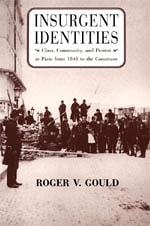
Insurgent Identities
Class, Community, and Protest in Paris from 1848 to the CommuneRoger V. Gould
University of Chicago Press, 1995
The difference was due to Baron Haussmann's massive urban renovation projects between 1852 and 1868, which dispersed workers from Paris's center to newly annexed districts on the outskirts of the city. In these areas, residence rather than occupation structured social relations. Drawing on evidence from trail documents, marriage records, reports of police spies, and the popular press, Gould demonstrates that this fundamental rearrangement in the patterns of social life made possible a neighborhood insurgent movement; whereas the insurgents of 1848 fought and died in defense of their status as workers, those in 1871 did so as members of a besieged urban community.
A valuable resource for historians and scholars of social movements, this work shows that collective identities vary with political circumstances but are nevertheless constrained by social networks. Gould extends this argument to make sense of other protest movements and to offer predictions about the dimensions of future social conflict.

Marx's 'Eighteenth Brumaire'
(Post)Modern InterpretationsEdited by Mark Cowling and James Martin
Pluto Press, 2002
Marx's account of the rise of Louis-Napoleon Bonaparte is one of his most important texts. Written after the defeat of the 1848 revolution in France and Bonaparte's subsequent coup, it is a concrete analysis that raises enduring theoretical questions about the state, class conflict and ideology.
Unlike his earlier analyses, Marx develops a nuanced argument concerning the independence of the state from class interests, the different types of classes, and the determining power of ideas and imagery in politics. In the Eighteenth Brumaire he applies his 'materialist conception of history' to an actual historical event with extraordinary subtlety and an impressive, powerful command of language.
This volume contains the most recent and widely acclaimed translation of the Eighteenth Brumaire by Terrell Carver, together with a series of specially commissioned essays on the importance of the Brumaire in Marx's canon. Contributors discuss its continuing significance and interest, the historical background and its contemporary relevance for political philosophy and history.
Sentimental Education
The Story of a Young ManGustave Flaubert
University of Minnesota Press, 2024
A fresh and vivid translation of Flaubert’s influential bildungsroman
Gustave Flaubert conceived Sentimental Education, his final complete novel, as the history of his own generation, one that failed to fulfill the promise of the Revolution of 1848. Published a few months before the start of the 1870 Franco–Prussian War, it offers both a sweeping panorama of French society over three decades and an intimate bildungsroman of a young man from a small town who arrives in Paris when protests against the monarchy are increasing.
The novel’s protagonist, Frédéric Moreau, alternates between aimlessness and ambition as he searches for a meaningful life through love affairs and republican politics. Flaubert’s narrative includes scenes of high drama, as scattered protests across Paris swell into revolution, and quiet moments of self-aware romanticism, crafting a story that possesses the sweep and scope of a historical novel combined with deep emotion and scandalous intimacy. Suffused with tragedy and the poignancy of lost chances and wasted lives, Sentimental Education is sharpened by satirical observations of what Flaubert condemned as the Second Empire’s endemic hypocrisy and willful blindness.
This vibrant, new translation by Raymond N. MacKenzie includes an extensive critical introduction and annotations to help the modern reader appreciate Flaubert’s achievement. Sentimental Education intertwines the personal, the intimate, and the subjective with the political, social, and cultural, embedding Frédéric’s story in the larger arc of what Flaubert saw as France’s decline into mediocrity and imbecility in its politics and manners.

The Romantic Machine
Utopian Science and Technology after NapoleonJohn Tresch
University of Chicago Press, 2012
In the years immediately following Napoleon’s defeat, French thinkers in all fields set their minds to the problem of how to recover from the long upheavals that had been set into motion by the French Revolution. Many challenged the Enlightenment’s emphasis on mechanics and questioned the rising power of machines, seeking a return to the organic unity of an earlier age and triggering the artistic and philosophical movement of romanticism. Previous scholars have viewed romanticism and industrialization in opposition, but in this groundbreaking volume John Tresch reveals how thoroughly entwined science and the arts were in early nineteenth-century France and how they worked together to unite a fractured society.
Focusing on a set of celebrated technologies, including steam engines, electromagnetic and geophysical instruments, early photography, and mass-scale printing, Tresch looks at how new conceptions of energy, instrumentality, and association fueled such diverse developments as fantastic literature, popular astronomy, grand opera, positivism, utopian socialism, and the Revolution of 1848. He shows that those who attempted to fuse organicism and mechanism in various ways, including Alexander von Humboldt and Auguste Comte, charted a road not taken that resonates today.
Essential reading for historians of science, intellectual and cultural historians of Europe, and literary and art historians, The Romantic Machine is poised to profoundly alter our understanding of the scientific and cultural landscape of the early nineteenth century.