Results by title
5 books match the query 'Federal aid to education'
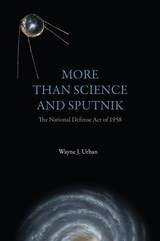
More Than Science and Sputnik
The National Defense Education Act of 1958Wayne J. Urban
University of Alabama Press, 2010
Sparked by dramatic Soviet achievements, particularly in nuclear technology and the development of the Sputnik space orbiter, the United States responded in the late 1950s with an extraordinary federal investment in education. Designed to overcome a perceived national failure to produce enough qualified scientists, engineers, and mathematicians to compete with the Communist bloc, the effort resulted in the National Defense Education Act of 1958 (NDEA). Representative Carl Elliott and Senator Lister Hill both from Alabama, and then Assistant Secretary of Health, Education, and Welfare, Elliot Richardson were the prime movers in shaping of this landmark legislation.
More than Science and Sputnik analyzes primary documents of the three leaders to describe the political process that established the NDEA. The book illustrates what the assumptions of the key players were, and why they believed the act was needed.
No Child Left Behind and the Public Schools
Scott Franklin Abernathy
University of Michigan Press, 2007
“A powerful, detailed, and exceptionally balanced critique of NCLB. It offers some hope for how we might overcome its faults. No legislator or educational expert should be allowed to get away with not reading it—whether to agree or disagree. It’s a must learning experience.”
—Deborah Meier, Senior Scholar and Adjunct Professor, Steinhardt School of Education, New York University, and author of In Schools We Trust
“A concise, highly readable, and balanced account of NCLB, with insightful and realistic suggestions for reform. Teachers, professors, policymakers, and parents—this is the one book about NCLB you ought to read.”
—James E. Ryan, William L. Matheson and Robert M. Morgenthau Distinguished Professor, University of Virginia School of Law
This far-reaching new study looks at the successes and failures of one of the most ambitious and controversial educational initiatives since desegregation—the No Child Left Behind Act of 2001.
NCLB’s opponents criticize it as underfunded and unworkable, while supporters see it as a radical but necessary educational reform that evens the score between advantaged and disadvantaged students. Yet the most basic and important question remains unasked: “Can we ever really know if a child’s education is good?”
Ultimately, Scott Franklin Abernathy argues, policymakers must begin from this question, rather than assuming that any test can accurately measure the elusive thing we call “good” education.
Revitalizing Federal Education Research and Development
Improving the R&D Centers, Regional Educational Laboratories, and the "New" OERIMaris A. Vinovskis
University of Michigan Press, 2001
Maris A. Vinovskis uses the research he has done over the past decade, along with the findings of other policymakers, to argue that the American public school system needs to gain functional reform if research institutions are to conduct more effective studies for policymakers. He examines here both recent reform policies as well as the history behind educational reform.
Vinovskis's vigorous investigation of the process of educational research and development in the United States will be of particular interest to individuals whose careers depend on continued federal funding. This book will also appeal to educators, policymakers, and public policy analysts and will be of unequaled value in understanding the formulation of new educational policies in the twenty-first century.
Maris A. Vinovskis is active on Capitol Hill and lectures throughout the country at such prestigious institutions as the American Academy of Arts and Sciences, the Brookings Institution, and the John F. Kennedy School of Government at Harvard. He is Professor of History, University of Michigan.
The Elusive Ideal
Equal Educational Opportunity and the Federal Role in Boston's Public Schools, 1950-1985Adam R. Nelson
University of Chicago Press, 2005
An ambitious study that spans more than thirty years and covers all facets of educational policy, from legal battles to tax strategies, The Elusive Ideal provides a model from which future inquiries will proceed. A probing and provocative work of urban history with deep relevance for urban public schools today, Nelson's book reveals why equal educational opportunity remains such an elusive ideal.
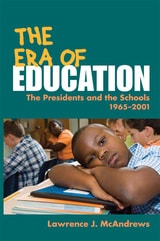
The Era of Education
The Presidents and the Schools, 1965-2001Lawrence J. McAndrews
University of Illinois Press, 2005