Results by title
20 books match the query 'Feldstein, Martin'
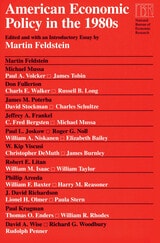
American Economic Policy in the 1980s
Edited by Martin Feldstein
University of Chicago Press, 1994
In his introduction, Martin Feldstein provides compelling analysis of policies with which he was closely involved as chairman of the Council of Economic Advisers during the Reagan administration: monetary and exchange rate policy, tax policy, and budget issues. Other leading economists and policymakers examine a variety of domestic and international issues, including monetary and exchange rate policy, regulation and antitrust, as well as trade, tax, and budget policies.
The contributors to this volume are Alberto Alesina, Phillip Areeda, Elizabeth Bailey, William F. Baxter, C. Fred Bergsten, James Burnley, Geoffrey Carliner, Christopher DeMuth, Douglas W. Elmendorf, Thomas O. Enders, Martin Feldstein, Jeffrey A. Frankel, Don Fullerton, William M. Isaac, Paul L Joskow, Paul Krugman, Robert E. Litan, Russell B. Long, Michael Mussa, William A. Niskanen, Roger G. Noll, Lionel H. Olmer, Rudolph Penner, William Poole, James M. Poterba, Harry M. Reasoner, William R. Rhodes, J. David Richardson, Charles Schultze, Paula Stern, David Stockman, William Taylor, James Tobin, W. Kip Viscusi, Paul A. Volcker, Charles E. Walker, David A. Wise, and Richard G. Woodbury.
Behavioral Simulation Methods in Tax Policy Analysis
Edited by Martin Feldstein
University of Chicago Press, 1983
The principal focus of the project has been on the microsimulation of individual behavior. Thus, this volume includes studies of individual responses to an over reduction in tax rates and to changes in the highest tax rates; a study of alternative tax treatments of the family; and studies of such specific aspects of household behavior as tax treatment of home ownership, charitable contributions, and individual saving behavior. Microsimulation techniques are also used to estimate the effects of alternative policies on the long-run financial status of the social security program and to examine the effects of alternative tax rules on corporate investment and of foreign-source income on overseas investment.
The papers devoted to the development of general equilibrium simulation models to include an examination of the implications of international trade and capital flows, a study of the effects of capital taxation that uses a closed economy equilibrium model, and an examination of the effect of switching to an inflation-indexed tax system. In the volume's final paper, a life-cycle model in which individuals maximize lifetime utility subject to a lifetime budget constraint is used to simulate the effects of tax rules on personal savings.
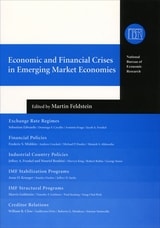
Economic and Financial Crises in Emerging Market Economies
Edited by Martin Feldstein
University of Chicago Press, 2003
This book rises to that challenge, presenting accessible papers and commentaries on the topic not only from leading academic economists, but also from high-ranking government officials (in both industrial and developing nations), senior policymakers at international institutions, and major financial investors. Six non-technical papers, each written by a specialist in the topic, provide essential economic background, introducing sections on exchange rate regimes, financial policies, industrial country policies, IMF stabilization policies, IMF structural programs, and creditor relations. Next, personal statements from the major players give firsthand accounts of what really went on behind the scenes during the crises, giving us a rare glimpse into how international economic policy decisions are actually made. Finally, wide-ranging discussions and debates sparked by these papers and statements are summarized at the end of each section.
The result is an indispensable overview of the key issues at work in these crises, written by the people who move markets and reshape economies, and accessible to not just economists and policymakers, but also to educated general readers.
Contributors:
Montek S. Ahluwalia, Domingo F. Cavallo, William R. Cline, Andrew Crockett, Michael P. Dooley, Sebastian Edwards, Stanley Fischer, Arminio Fraga, Jeffrey Frankel, Jacob Frenkel, Timothy F. Geithner, Morris Goldstein, Paul Keating, Mervyn King, Anne O. Krueger, Roberto Mendoza, Frederic S. Mishkin, Guillermo Ortiz, Yung Chul Park, Nouriel Roubini, Robert Rubin, Jeffrey Sachs, Ammar Siamwalla, George Soros
Empirical Foundations of Household Taxation
Edited by Martin Feldstein and James M. Poterba
University of Chicago Press, 1996
The nine papers in this volume exploit the substantial variation in U.S. tax policy during the last two decades to investigate how taxes affect a range of household behavior, including labor-force participation, saving behavior, choice of health insurance plan, choice of child care arrangements, portfolio choice, and tax evasion. They also present new analytical results on the effects of different types of tax policy. All of this research relies on household-level data—drawn either from public-use tax return files or from large household-level surveys—to explore various aspects of the relationship between taxes and household behavior.
As debates about the effects of proposed tax reforms continue in the 1990s, this volume will be of interest to policy makers and scholars in the field of public finance.
Inflation, Tax Rules, and Capital Formation
Martin Feldstein
University of Chicago Press, 1983
Inflation, Tax Rules, and Capital Formation brings together fourteen papers that show the importance of the interaction between tax rules and monetary policy. Based on theoretical and empirical research, these papers emphasize the importance of including explicit specifications of the tax system in such study.
International Capital Flows
Edited by Martin Feldstein
University of Chicago Press, 1999
But, as was underscored recently by the economic and financial crises in several Asian countries, capital flows can also bring risks. Although there is no simple explanation of the currency crisis in Asia, it is clear that fixed exchange rates and chronic deficits increased the likelihood of a breakdown. Similarly, during the 1970s, the United States and other industrial countries loaned OPEC surpluses to borrowers in Latin America. But when the U.S. Federal Reserve raised interest rates to control soaring inflation, the result was a widespread debt moratorium in Latin America as many countries throughout the region struggled to pay the high interest on their foreign loans.
International Capital Flows contains recent work by eminent scholars and practitioners on the experience of capital flows to Latin America, Asia, and eastern Europe. These papers discuss the role of banks, equity markets, and foreign direct investment in international capital flows, and the risks that investors and others face with these transactions. By focusing on capital flows' productivity and determinants, and the policy issues they raise, this collection is a valuable resource for economists, policymakers, and financial market participants.
International Economic Cooperation
Edited by Martin Feldstein
University of Chicago Press, 1988

Privatizing Social Security
Edited by Martin Feldstein
University of Chicago Press, 1998
Risk Aspects of Investment-Based Social Security Reform
Edited by John Y. Campbell and Martin Feldstein
University of Chicago Press, 2001
Social Security Pension Reform in Europe
Edited by Martin Feldstein and Horst Siebert
University of Chicago Press, 2002
The essays here highlight the problems that the European pension reform process faces and how it differs from that of the United States. This timely volume will significantly enrich the debate on pension reform worldwide.
Taxes and Capital Formation
Edited by Martin Feldstein
University of Chicago Press, 1987
By addressing some of the most critical policy issues of the day with a minimum of economic jargon, Taxes and Capital Formation makes the results of Bureau research available to a wide audience of policy officials and staff as well as to members of the business community. The volume should also prove useful for courses in public policy, business, and law. In keeping with Bureau tradition, the papers do not contain policy recommendations; instead, they promote a better understanding of how the economy works and the effects of specific policies on particular aspects of the economy.
Taxing Multinational Corporations
Edited by Martin Feldstein, James R. Hines Jr., and R. Glenn Hubbard
University of Chicago Press, 1995
In ten succinct chapters, the book documents the channels through which tax policy in the United States and abroad affects plant and equipment investments, spending on research and development, the cost of debt and equity finance, and dividend repatriations by United States subsidiaries. It also discusses the impact of U.S. firms' outbound foreign investment on domestic and foreign economies. Especially useful to nonspecialists is an appendix that summarizes current United States rules for taxing international income.
The American Economy in Transition
Edited by Martin Feldstein
University of Chicago Press, 1980
This unusual volume marks the sixtieth anniversary of the National Bureau of Economic Research. In contrast to the technical and specialized character of most NBER studies, the current book is designed to provide the general reader with a broad and critical overview of the American economy. The result is a volume of essays that range from monetary policy to productivity development, from population change to international trade.
The Costs and Benefits of Price Stability
Edited by Martin Feldstein
University of Chicago Press, 1999
In a seminal article published in 1997, Martin Feldstein developed a framework for calculating the gains in economic welfare that might result from a move from a low level of inflation to full price stability. The present volume extends that analysis, focusing on the likely costs and benefits of achieving price stability not only in the United States, but in Germany, Spain, and the United Kingdom as well. The results show that even small changes in already low inflation rates can have a substantial impact on the economic performance of different countries, and that variations in national tax rules can affect the level of gain from disinflation.

The Distributional Aspects of Social Security and Social Security Reform
Edited by Martin Feldstein and Jeffrey B. Liebman
University of Chicago Press, 2002
As this volume suggests, the distributional consequences of these proposals are substantially different and may disproportionately affect those groups who depend on social security to avoid poverty in old age. Together, these studies persuasively show that appropriately designed investment-based social security reforms can effectively reduce the long-term burden of an aging society on future taxpayers, increase the expected future income of retirees, and mitigate poverty rates among the elderly.
The Economics of Art Museums
Edited and with an Introduction by Martin Feldstein
University of Chicago Press, 1991
This volume brings together nontechnical essays on these issues by economists associated with the NBER and personal statements by leaders of America's major national art museums and related foundations. It can be read not only by economists but also by museum officials and trustees. Museum directors generally come to their responsibilities with a background in art history and curatorial work but without experience in thinking about the management and public policy aspects of museum administration. Trustees who serve on museum boards generally have a background in business or law but have not previously tried to apply their experience to the unusual economic problems of museums. The background papers, the panelists' remarks, and the summary of the discussion will help them to approach their responsibilities with a better understanding of the problems and possibilities of the museum.
The Effects of Taxation on Capital Accumulation
Edited by Martin Feldstein
University of Chicago Press, 1987
The Effects of Taxation on Multinational Corporations
Edited by Martin Feldstein, James R. Hines Jr., and R. Glenn Hubbard
University of Chicago Press, 1995
In an attempt to quantify the effect of tax policy on international investment choices, this volume presents in-depth analyses of the interaction of international tax rules and the investment decisions of multinational enterprises. Ten papers assess the role played by multinational firms and their investment in the U.S. economy and the design of international tax rules for multinational investment; analyze channels through which international tax rules affect the costs of international business activities; and examine ways in which international tax rules affect financing decisions of multinational firms. As a group, the papers demonstrate that international tax rules have significant effects on firms' investment and other financing decisions.
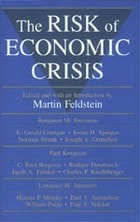
The Risk of Economic Crisis
Edited by Martin Feldstein
University of Chicago Press, 1991
In this accessible and thought-provoking volume, Benjamin M. Friedman investigates the origins of financial crisis in domestic capital markets, Paul Krugman examines the international origins and transmission of financial and economic crises, and Lawrence H. Summers explores the transition from financial crisis to economic collapse. In the introductory essay, Martin Feldstein reviews the major financial problems of the 1980s and discusses lessons to be learned from this experience. The book also contains provocative observations by senior academics and others who have played leading roles in business and government.
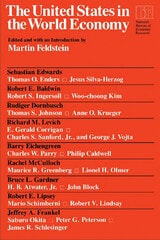
The United States in the World Economy
Edited by Martin Feldstein
University of Chicago Press, 1988