Results by title
527 books match the query 'Feminism & Feminist Theory' and 29 start with a
A Biographical Dictionary of Women's Movements and Feminisms
Central, Eastern, and South Eastern Europe, 19th and 20th CenturiesAnna Loutfi
Central European University Press, 2006

A Decolonial Feminism
Francoise Verges
Pluto Press, 2021

A Feminist Reader in Early Cinema
Jennifer M. Bean and Diane Negra, eds.
Duke University Press, 2002
While fostering new ways of thinking about film history, A Feminist Reader in Early Cinema illuminates the many questions that the concept of "early cinema" itself raises about the relation of gender to modernism, representation, and technologies of the body. The contributors bring a number of disciplinary frameworks to bear, including not only film studies but also postcolonial studies, dance scholarship, literary analysis, philosophies of the body, and theories regarding modernism and postmodernism.
Reflecting the stimulating diversity of early cinematic styles, technologies, and narrative forms, essays address a range of topics—from the dangerous sexuality of the urban flâneuse to the childlike femininity exemplified by Mary Pickford, from the Shanghai film industry to Italian diva films—looking along the way at birth-control sensation films, French crime serials, "war actualities," and the stylistic influence of art deco. Recurring throughout the volume is the protean figure of the New Woman, alternately garbed as childish tomboy, athletic star, enigmatic vamp, languid diva, working girl, kinetic flapper, and primitive exotic.
Contributors. Constance Balides, Jennifer M. Bean, Kristine Butler, Mary Ann Doane, Lucy Fischer, Jane Gaines, Amelie Hastie, Sumiko Higashi, Lori Landay, Anne Morey, Diane Negra, Catherine Russell, Siobhan B. Somerville, Shelley Stamp, Gaylyn Studlar, Angela Dalle Vacche, Radha Vatsal, Kristen Whissel, Patricia White, Zhang Zhen

A Feminist Theory of Violence
A Decolonial PerspectiveFrançoise Vergès
Pluto Press, 2022
***Winner of an English PEN Award 2022***
The mainstream conversation surrounding gender equality is a repertoire of violence: harassment, rape, abuse, femicide. These words suggest a cruel reality. But they also hide another reality: that of gendered violence committed with the complicity of the State.
In this book, Françoise Vergès denounces the carceral turn in the fight against sexism. By focusing on 'violent men', we fail to question the sources of their violence. There is no doubt as to the underlying causes: racial capitalism, ultra-conservative populism, the crushing of the Global South by wars and imperialist looting, the exile of millions and the proliferation of prisons - these all put masculinity in the service of a policy of death.
Against the spirit of the times, Françoise Vergès refuses the punitive obsession of the State in favour of restorative justice.

A People's History of Tennis
David Berry
Pluto Press, 2020
From the birth of modern tennis in Victorian Britain to the present day, we bear witness to struggles around sexuality, gender, race and class that have transformed the nature of tennis and sport itself. A People's History of Tennis is populated by diverse voices, recounting the sport's gay origins, 'Workers' Wimbledon', battles for gender equality and more.
Going beyond center court, this book reveals the hidden history of the game, providing a rich account of the challenges faced and victories won.
A Postcapitalist Politics
J. K. Gibson-Graham
University of Minnesota Press, 2006
A Postcapitalist Politics reveals a prolific landscape of economic diversity—one that is not exclusively or predominantly capitalist—and examines the challenges and successes of alternative economic interventions. Gibson-Graham bring together political economy, feminist poststructuralism, and economic activism to foreground the ethical decisions, as opposed to structural imperatives, that construct economic “development” pathways. Marshalling empirical evidence from local economic projects and action research in the United States, Australia, and Asia, they produce a distinctive political imaginary with three intersecting moments: a politics of language, of the subject, and of collective action. In the face of an almost universal sense of surrender to capitalist globalization, this book demonstrates that postcapitalist subjects, economies, and communities can be fostered. The authors describe a politics of possibility that can build different economies in place and over space. They urge us to confront the forces that stand in the way of economic experimentation and to explore different ways of moving from theory to action.
J. K. Gibson-Graham is the pen name of Katherine Gibson and Julie Graham, feminist economic geographers who work, respectively, at the Australian National University in Canberra and the University of Massachusetts Amherst.
A Regarded Self
Caribbean Womanhood and the Ethics of Disorderly BeingKaiama L. Glover
Duke University Press, 2021
A Suffragette in America
Reflections on Prisoners, Pickets and Political ChangeSylvia Pankhurst
Pluto Press, 2019
This book gathers Pankhurst’s writings from the year-long visit, in which she reveals her shock at the darkness hidden in American life, and draws parallels to her experiences of imprisonment and misogyny in her own country. Never before published, these writings mark an important stage in the development of the suffragette's thought, which she brought back to Britain to inform the burgeoning suffrage campaign there.
A Weak Woman in a Strong Battle
Women and Public Execution in Early Modern EnglandJennifer Lillian Lodine-Chaffey
University of Alabama Press, 2022
A scholarly study of how women’s executions were staged, interpreted, and recorded in Renaissance England
A Weak Woman in a Strong Battle: Women and Public Execution in Early Modern England provides critical insights on representations of women on the scaffold, focusing on how female victims and those writing about them constructed meaning from the ritual. Jennifer Lodine-Chaffey draws on a wide range of genres, from accounts of martyrdom to dramatic works, to explore not only the words of women executed in Tudor and Stuart England, but also the ways that writers represented female bodies as markers of penitence or deviance.
A significant part of the execution spectacle—one used to assess the victim’s proper acceptance of death and godly repentance—was the final speech offered at the foot of the gallows or before the pyre. To ensure their final words held value for audiences, women adopted conventionally gendered language and positioned themselves as subservient and modest. The reception of women’s speeches, Lodine-Chaffey argues, depended on their performances of accepted female behaviors and language as well as physical signs of interior regeneration. Indeed, when women presented themselves or were represented as behaving in stereotypically feminine and virtuous ways, they were able to offer limited critiques of their fraught positions in society.
Just as important as their words, though, were the depictions of women’s bodies. The executed woman’s body, Lodine-Chaffey contends, functioned as a text, scrutinized by witnesses and readers for markers of innocence or guilt. The intense focus on the words and bodies of women facing execution during this period, Lodine-Chaffey argues, became a catalyst for a more thorough interest in and understanding of women’s roles not just as criminals but as subjects

Abolition Archives, Feminist Futures
Kathi Weeks
Duke University Press, 2026
AfroSwedish Places of Belonging
Nana Osei-Kofi
Northwestern University Press, 2024

After Sex?
On Writing since Queer TheoryJanet Halley and Andrew Parker, eds.
Duke University Press, 2011
Contributors. Lauren Berlant, Leo Bersani, Michael Cobb, Ann Cvetkovich, Lee Edelman, Richard Thompson Ford, Carla Freccero, Elizabeth Freeman, Jonathan Goldberg, Janet Halley, Neville Hoad, Joseph Litvak, Heather Love, Michael Lucey, Michael Moon, José Esteban Muñoz, Jeff Nunokawa, Andrew Parker, Elizabeth A. Povinelli, Richard Rambuss, Erica Rand, Bethany Schneider, Eve Kosofsky Sedgwick, Kate Thomas
After the Post–Cold War
The Future of Chinese HistoryDai Jinhua
Duke University Press, 2018
All in the Family
On Community and IncommensurabilityKennan Ferguson
Duke University Press, 2012
By closely observing the attachments that arise in families despite profound disagreements and incommensurabilities, Ferguson argues, we can imagine a political engagement that accommodates radical differences without sacrificing community. After examining how the concept of the family has been deployed and misused in political philosophy, Ferguson turns to the ways in which families actually operate: the macropolitical significance of family coping strategies such as silence and the impact that disability and caregiving have on conceptions of spatiality, sameness, and disparity. He also considers the emotional attachment between humans and their pets as an acknowledgment that compassion and community can exist even under conditions of profound difference.
Am I That Name
Feminism And The Category Of Women In HistoryDenise Riley
University of Minnesota Press, 2003
Writing about changes in the notion of womanhood, Denise Riley examines, in the manner of Foucault, shifting historical constructions of the category of “women” in relation to other categories central to concepts of personhood: the soul, the mind, the body, nature, the social.
Feminist movements, Riley argues, have had no choice but to play out this indeterminacy of women. This is made plain in their oscillations, since the 1790s, between concepts of equality and of difference. To fully recognize the ambiguity of the category of “women” is, she contends, a necessary condition for an effective feminist political philosophy.

An Autohistoria of Friendship with Gloria E. Anzaldúa
Three Soul Companions at the CrossroadsDavid Hatfield Sparks and Randy P. Conner
University of Illinois Press, 2027
Beginning their story in a large Noe Valley flat, Sparks and Conner trace how a collective of artists and activists shaped a shared life across lines of race, gender, and sexuality while forging a community linked through prejudice, illness, and loss. The authors mix personal stories with history and cultural memory. They also discuss Anzaldúa’s idea of spiritual mestizaje, a practice for healing and growth that joins Indigenous, African, Latino, European, and Queer traditions. Their idea of El Mundo Zurdo imagines an inclusive world that values diversity and the power of difference to create connections among human beings.
Merging spirituality with activism, An Autohistoria of Friendship with Gloria E. Anzaldúa shares a vision of a more just and caring future.
Anglo-American Feminist Challenges to the Rhetorical Traditions
Virginia Woolf, Mary Daly, Adrienne RichKrista Ratcliffe
Southern Illinois University Press, 1996
Although women and men have different relationships to language and to each other, traditional theories of rhetoric do not foreground such gender differences. Krista Ratcliffe argues that because feminists generally have not conceptualized their language theories from the perspective of rhetoric and composition studies, rhetoric and composition scholars must construct feminist theories of rhetoric by employing a variety of interwoven strategies: recovering lost or marginalized texts; rereading traditional rhetoric texts; extrapolating rhetorical theories from such nonrhetoric texts as letters, diaries, essays, cookbooks, and other sources; and constructing their own theories of rhetoric.
Focusing on the third option, Ratcliffe explores ways in which the rhetorical theories of Virginia Woolf, Mary Daly, and Adrienne Rich may be extrapolated from their Anglo-American feminist texts through examination of the interrelationship between what these authors write and how they write. In other words, she extrapolates feminist theories of rhetoric from interwoven claims and textual strategies. By inviting Woolf, Daly, and Rich into the rhetorical traditions and by modeling the extrapolation strategy/methodology on their writings, Ratcliffe shows how feminist texts about women, language, and culture may be reread from the vantage point of rhetoric to construct feminist theories of rhetoric. She also outlines the pedagogical implications of these three feminist theories of rhetoric, thus contributing to ongoing discussions of feminist pedagogies.
Traditional rhetorical theories are gender-blind, ignoring the reality that women and men occupy different cultural spaces and that these spaces are further complicated by race and class, Ratcliffe explains. Arguing that issues such as who can talk, where one can talk, and how one can talk emerge in daily life but are often disregarded in rhetorical theories, Ratcliffe rereads Roland Barthes’ "The Old Rhetoric" to show the limitations of classical rhetorical theories for women and feminists. Discovering spaces for feminist theories of rhetoric in the rhetorical traditions, Ratcliffe invites readers not only to question how women have been located as a part of— and apart from—these traditions but also to explore the implications for rhetorical history, theory, and pedagogy.

Animacies
Biopolitics, Racial Mattering, and Queer AffectMel Y. Chen
Duke University Press, 2012
Chen's book is the first to bring the concept of animacy together with queer of color scholarship, critical animal studies, and disability theory. Through analyses of dehumanizing insults, the meanings of queerness, animal protagonists in recent Asian/American art and film, the lead in toys panic in 2007, and the social lives of environmental illness, Animacies illuminates a hierarchical politics infused by race, sexuality, and ability. In this groundbreaking book, Chen rethinks the criteria governing agency and receptivity, health and toxicity, productivity and stillness—and demonstrates how attention to the affective charge of matter challenges commonsense orderings of the world.

Animals and Women
Feminist Theoretical ExplorationsCarol J. Adams and Josephine Donovan, eds.
Duke University Press, 1995
This wide-ranging multidisciplinary anthology presents original material from scholars in a variety of fields, as well as a rare, early article by Virginia Woolf. Exploring the leading edge of the species/gender boundary, it addresses such issues as the relationship between abortion rights and animal rights, the connection between woman-battering and animal abuse, and the speciesist basis for much sexist language. Also considered are the ways in which animals have been regarded by science, literature, and the environmentalist movement. A striking meditation on women and wolves is presented, as is an examination of sexual harassment and the taxonomy of hunters and hunting. Finally, this compelling collection suggests that the subordination and degradation of women is a prototype for other forms of abuse, and that to deny this connection is to participate in the continued mistreatment of animals and women.

Animals, Mind, and Matter
The Inside StoryJosephine Donovan
Michigan State University Press, 2022
Another Mother
Diotima and the Symbolic Order of Italian FeminismCesare Casarino
University of Minnesota Press, 2018
A groundbreaking volume introduces the unique feminist thought of the longstanding Italian group known as Diotima
Introducing Anglophone readers to a potent strain of Italian feminism known to French, Spanish, and German audiences but as yet unavailable in English, Another Mother argues that the question of the mother is essential to comprehend the matrix of contemporary culture and society and to pursue feminist political projects.
Focusing on Diotima, a community of women philosophers deeply involved in feminist politics since the 1960s, this volume provides a multifaceted panorama of its engagement with currents of thought including structuralism, psychoanalysis, linguistics, and Marxism. Starting from the simple insight that the mother is the one who gives us both life and language, these thinkers develop concepts of the mother and sexual difference in contemporary society that differ in crucial ways from both French and U.S. feminisms.
Arguing that Diotima anticipates many of the themes in contemporary philosophical discourses of biopolitics—exemplified by thinkers such as Giorgio Agamben, Antonio Negri, and Roberto Esposito—Another Mother opens an important space for reflections on the past history of feminism and on feminism’s future.
Contributors: Anne Emmanuelle Berger, Paris 8 U–Vincennes Saint-Denis; Ida Dominijanni; Luisa Muraro; Diana Sartori, U of Verona; Chiara Zamboni, U of Verona.
Anthropocene Feminism
Richard Grusin
University of Minnesota Press, 2017
What does feminism have to say to the Anthropocene? How does the concept of the Anthropocene impact feminism? This book is a daring and provocative response to the masculinist and techno-normative approach to the Anthropocene so often taken by technoscientists, artists, humanists, and social scientists. By coining and, for the first time, fully exploring the concept of “anthropocene feminism,” it highlights the alternatives feminism and queer theory can offer for thinking about the Anthropocene.
Feminist theory has long been concerned with the anthropogenic impact of humans, particularly men, on nature. Consequently, the contributors to this volume explore not only what current interest in the Anthropocene might mean for feminism but also what it is that feminist theory can contribute to technoscientific understandings of the Anthropocene. With essays from prominent environmental and feminist scholars on topics ranging from Hawaiian poetry to Foucault to shelled creatures to hypomodernity to posthuman feminism, this book highlights both why we need an anthropocene feminism and why thinking about the Anthropocene must come from feminism.
Contributors: Stacy Alaimo, U of Texas at Arlington; Rosi Braidotti, Utrecht U; Joshua Clover, U of California, Davis; Claire Colebrook, Pennsylvania State U; Dehlia Hannah, Arizona State U; Myra J. Hird, Queen’s U; Lynne Huffer, Emory U; Natalie Jeremijenko, New York U; Elizabeth A. Povinelli, Columbia U; Jill S. Schneiderman, Vassar College; Juliana Spahr, Mills College; Alexander Zahara, Queen’s U.

Antiblackness
Moon-Kie Jung and João H. Costa Vargas, editors
Duke University Press, 2021
Contributors. Mohan Ambikaipaker, Jodi A. Byrd, Iyko Day, Anthony Paul Farley, Crystal Marie Fleming, Sarah Haley, Tanya Katerí Hernández, Sarah Ihmoud, Joy James, Moon-Kie Jung, Jae Kyun Kim, Charles W. Mills, Dylan Rodríguez, Zach Sell, João H. Costa Vargas, Frank B. Wilderson III, Connie Wun

Archive of Tongues
An Intimate History of BrownnessMoon Charania
Duke University Press, 2023
Arrows Tipped with Flowers
Threshold Theory for Transformative LearningJulie Geredien
University of Illinois Press, 2026
Threshold theory challenges unexamined mental habits and exposes absolutisms that hold social order by impeding the comprehension process. As those learning at the threshold approach transition and the unknown, they participate in transformations that illuminate hidden developmental patterns and ecological relationships. Geredien’s threshold theorizing brings together realities at the heart of creativity, relational worldview, and anti-oppression work to forge the philosophical and psychological foundations necessary to reshape policies and practices.
Innovative and expansive, Arrows Tipped with Flowers reveals the psychology of integrity that underpins truly global learning and explains the need to develop more inclusive and reflective approaches to knowledge formation.

Artificial Women
The 1970s, Mass Culture, and FeminismVictoria Hesford
Duke University Press, 2027
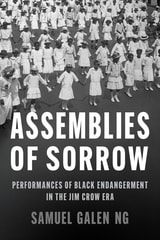
Assemblies of Sorrow
Performances of Black Endangerment in the Jim Crow EraSamuel Galen Ng
University of Illinois Press, 2026
Samuel Galen Ng illuminates this Black consciousness as it emanated from feelings of collective endangerment. The dissemination and intensification of such feelings became a pivotal way of solidifying a national Black consciousness on the eve of the Civil Rights Movement. Ng examines how performances of Black endangerment performed political work that provided Black people with important means of political organizing and insurgency. As Ng shows, the grief and mourning that took place at the performances provided public spaces for individuals and communities to observe specific losses capable of impacting Americans across the country.
Ambitious and interdisciplinary, Assemblies of Sorrow explores an overlooked facet of Black organizing and protest and traces how activists shaped fear and grief into political action.

At Translation's Edge
Edited by Nataša Durovicová, Patrice Petro, and Lorena Terando
Rutgers University Press, 2019

Avala Is Falling
Biljana Jovanovic
Central European University Press, 2020
In Avala Is Falling, Jovanović’s breakout success in 1978, a young woman challenges the expectations that teachers, parents, bus drivers, and doctors have for her. The “Avala” of the title refers to a mountain south of Belgrade which is home to some of Serbia’s most important nationalist monuments and shrines; it is also the site of the main mental hospital for the region, and its “falling” is the unexpected fulfillment of a prophecy from a traditional Serbian folk song. Jovanović’s use of stream of consciousness in her characters’ thinking and speaking, as well as of intertextuality in description and plot advancement heralded the arrival of an innovative new writer who was determined to break with the of traditional concerns of earlier women writers.
This book is now recognized as much more than “jeans prose,” although the fame the book achieved under that characterization eventually pushed it to cult status. Jovanović is now considered a major avant-garde writer, whose stylistic innovations were as challenging as her women-centered themes.