Results by title
21 books match the query 'Feminism and art'
A Decade of Negative Thinking
Essays on Art, Politics, and Daily LifeMira Schor
Duke University Press, 2009
In essays such as “The ism that dare not speak its name,” “Generation 2.5,” “Like a Veneer,” “Modest Painting,” “Blurring Richter,” and “Trite Tropes, Clichés, or the Persistence of Styles,” Schor considers how artists relate to and represent the past and how the art market influences their choices: whether or not to disavow a social movement, to explicitly compare their work to that of a canonical artist, or to take up an exhausted style. She places her writings in the rich transitory space between the near past and the “nextmodern.” Witty, brave, rigorous, and heartfelt, Schor’s essays are impassioned reflections on art, politics, and criticism.
A Mieke Bal Reader
Mieke Bal
University of Chicago Press, 2006
This Reader is organized into four parts, reflecting the fields that Bal has most profoundly influenced: literary study, interdisciplinary methodology, visual analysis, and postmodern theology. The essays include some of Bal’s most characteristic and provocative work, capturing her at the top of her form. “Narration and Focalization,” for example, provides the groundwork for Bal’s ideas on narrative, while “Reading Art?” clearly outlines her concept of reading images. “Religious Canon and Literary Identity” reenvisions Bal’s own work at the intersection of theology and cultural analysis, while “Enfolding Feminism” argues for a new feminist rallying cry that is not a position but a metaphor. More than a dozen other essays round out the four sections, each of which is interdisciplinary in its own right: the section devoted to literature, for instance, ranges widely over psychoanalysis, theology, photography, and even autobiography.
A Mieke Bal Reader is the product of a capacious intellect and a sustained commitment to critical thinking. It will prove to be instructive, maddening, and groundbreaking—in short, all the hallmarks of intellectual inquiry at its best.
A Time of One's Own
Histories of Feminism in Contemporary ArtCatherine Grant
Duke University Press, 2022
Dragging Away
Queer Abstraction in Contemporary ArtLex Morgan Lancaster
Duke University Press, 2022
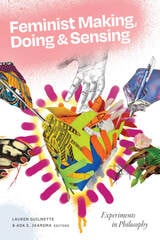
Feminist Making, Doing, and Sensing
Experiments in PhilosophyLauren Guilmette and Ada S. Jaarsma, editors
Duke University Press, 2026
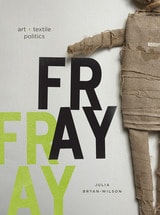
Fray
Art and Textile PoliticsJulia Bryan-Wilson
University of Chicago Press, 2017
Closely examining how amateurs and fine artists in the United States and Chile turned to sewing, braiding, knotting, and quilting amid the rise of global manufacturing, Julia Bryan-Wilson argues that textiles unravel the high/low divide and urges us to think flexibly about what the politics of textiles might be. Her case studies from the 1970s through the 1990s—including the improvised costumes of the theater troupe the Cockettes, the braided rag rugs of US artist Harmony Hammond, the thread-based sculptures of Chilean artist Cecilia Vicuña, the small hand-sewn tapestries depicting Pinochet’s torture, and the NAMES Project AIDS Memorial Quilt—are often taken as evidence of the inherently progressive nature of handcrafted textiles. Fray, however, shows that such methods are recruited to often ambivalent ends, leaving textiles very much “in the fray” of debates about feminized labor, protest cultures, and queer identities; the malleability of cloth and fiber means that textiles can be activated, or stretched, in many ideological directions.
The first contemporary art history book to discuss both fine art and amateur registers of handmaking at such an expansive scale, Fray unveils crucial insights into how textiles inhabit the broad space between artistic and political poles—high and low, untrained and highly skilled, conformist and disobedient, craft and art.
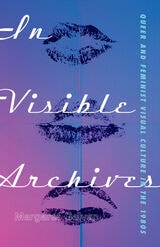
In Visible Archives
Queer and Feminist Visual Culture in the 1980sMargaret Galvan
University of Minnesota Press, 2023
Analyzing how 1980s visual culture provided a vital space for women artists to theorize and visualize their own bodies and sexualities
In 1982, the protests of antiporn feminists sparked the censorship of the Diary of a Conference on Sexuality, a radical and sexually evocative image-text volume whose silencing became a symbol for the irresolvable feminist sex wars. In Visible Archives documents the community networks that produced this resonant artifact and others, analyzing how visual culture provided a vital space for women artists to theorize and visualize their own bodies and sexualities.
Margaret Galvan explores a number of feminist and cultural touchstones—the feminist sex wars, the HIV/AIDS crisis, the women in print movement, and countercultural grassroots periodical networks—and examines how visual culture interacts with these pivotal moments. She goes deep into the records to bring together a decade’s worth of research in grassroots and university archives that include comics, collages, photographs, drawings, and other image-text media produced by women, including Hannah Alderfer, Beth Jaker, Marybeth Nelson, Roberta Gregory, Lee Marrs, Alison Bechdel, Gloria Anzaldúa, and Nan Goldin.
The art highlighted in In Visible Archives demonstrates how women represented their bodies and sexualities on their own terms and created visibility for new, diverse identities, thus serving as blueprints for future activism and advocacy—work that is urgent now more than ever as LGBTQ+ and women’s rights face challenges and restrictions across the nation.
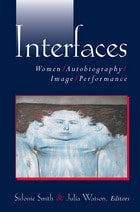
Interfaces
Women, Autobiography, Image, PerformanceSidonie Smith and Julia Watson, Editors
University of Michigan Press, 2002
Editors Sidonie Smith and Julia Watson have been at the vanguard of the study of women's self-representation, and here have collected leading critics' and scholars' thoughts on artistic fusions of the visual and autobiographical. Marianne Hirsch, Linda Hutcheon, Linda Kauffman, Nellie McKay, Marjorie Perloff, Lee Quinby, and the other contributors offer new insights into the work of such artists as Laurie Anderson, Judy Chicago, Frida Kahlo, Orlan, and Cindy Sherman. From a painter's diary to a performance artist's ritualized enactments of kitchen domesticity, the many narratives of the self arising from these artists' negotiations of the visual and textual prove to be goldmines for analysis.
Art historians, artists, critics, literary scholars in women's studies, and anyone interested in the forms and implications of depicting the self will enjoy this richly illustrated collection.
Sidonie Smith is Professor of English, University of Michigan. Julia Watson is Associate Professor of Comparative Studies, The Ohio State University. They also edited Reading Autobiography: A Guide for Interpreting Life Narratives and Women, Autobiography, Theory: A Reader.
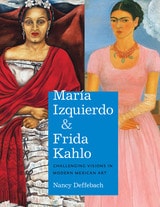
María Izquierdo and Frida Kahlo
Challenging Visions in Modern Mexican ArtBy Nancy Deffebach
University of Texas Press, 2015
María Izquierdo (1902–1955) and Frida Kahlo (1907–1954) were the first two Mexican women artists to achieve international recognition. During the height of the Mexican muralist movement, they established successful careers as easel painters and created work that has become an integral part of Mexican modernism. Although the iconic Kahlo is now more famous, the two artists had comparable reputations during their lives. Both were regularly included in major exhibitions of Mexican art, and they were invariably the only women chosen for the most important professional activities and honors.
In a deeply informed study that prioritizes critical analysis over biographical interpretation, Nancy Deffebach places Kahlo’s and Izquierdo’s oeuvres in their cultural context, examining the ways in which the artists participated in the national and artistic discourses of postrevolutionary Mexico. Through iconographic analysis of paintings and themes within each artist’s oeuvre, Deffebach discusses how the artists engaged intellectually with the issues and ideas of their era, especially Mexican national identity and the role of women in society. In a time when Mexican artistic and national discourses associated the nation with masculinity, Izquierdo and Kahlo created images of women that deconstructed gender roles, critiqued the status quo, and presented more empowering alternatives for women. Deffebach demonstrates that, paradoxically, Kahlo and Izquierdo became the most successful Mexican women artists of the modernist period while most directly challenging the prevailing ideas about gender and what constitutes important art.
Not-Forgetting
Contemporary Art and the Interrogation of MasteryRosalyn Deutsche
University of Chicago Press, 2022
Amid times of emboldened cruelty and perpetual war, Rosalyn Deutsche links contemporary art to three practices that counter the prevailing destructiveness: psychoanalytic feminism, radical democracy, and war resistance. Deutsche considers how art joins these radical practices to challenge desires for mastery and dominion, which are encapsulated in the Eurocentric conception of the human that goes under the name “Man” and is driven by deadly inclinations that Deutsche calls masculinist. The masculinist subject—as an individual or a group—universalizes itself, claims to speak on behalf of humanity, and meets differences with conquest.
Analyzing artworks by Christopher D’Arcangelo, Robert Filliou, Hans Haacke, Mary Kelly, Silvia Kolbowski, Barbara Kruger, Louise Lawler, Martha Rosler, James Welling, and Krzysztof Wodiczko, Deutsche illuminates the diverse ways in which they expose, question, and trouble the visual fantasies that express masculinist desire. Undermining the mastering subject, these artworks invite viewers to question the positions they assume in relation to others. Together, the essays in Not-Forgetting, written between 1999 and 2020, argue that this art offers a unique contribution to building a less cruel and violent society.
Photography after Photography
Gender, Genre, HistoryAbigail Solomon-Godeau
Duke University Press, 2017

Pin-Up Grrrls
Feminism, Sexuality, Popular CultureMaria Elena Buszek
Duke University Press, 2006
Beginning with the pin-up’s origins in mid-nineteenth-century carte-de-visite photographs of burlesque performers, Buszek explores how female sex symbols, including Adah Isaacs Menken and Lydia Thompson, fought to exert control over their own images. Buszek analyzes the evolution of the pin-up through the advent of the New Woman, the suffrage movement, fanzine photographs of early film stars, the Varga Girl illustrations that appeared in Esquire during World War II, the early years of Playboy magazine, and the recent revival of the genre in appropriations by third-wave feminist artists. A fascinating combination of art history and cultural history, Pin-Up Grrrls is the story of how women have publicly defined and represented their sexuality since the 1860s.
Sadistic Cholas
Transfeminist Provocations in Contemporary PeruOlga Rodriguez-Ulloa
University of Texas Press, 2026
Analyzing how Peruvian feminist art and activism subverts and reclaims the chola stereotype to confront colonial and patriarchal institutions.
Indigenous Andean women have long been derided in Peru, spurned by colonial and then national elites as depraved cholas. Olga Rodriguez-Ulloa shows how contemporary artists and activists not only reclaim this term of abuse but also mobilize the stereotype of the angry and perverted chola to confront the cruelties of patriarchy, capitalism, and white supremacy.
Sadistic Cholas examines music, visual arts, literature, and grassroots organizing by self-identified cholas—in particular, Black women and trans and queer feminists. Under colonial domination, cholas were destined for sexual coercion, labor extraction, and reproductive exploitation. While exhuming historical traces of chola resistance, Rodriguez-Ulloa argues that this condition of oppression persisted through the internal war of the 1980s, when Marxist women at the forefront of the armed campaign were condemned as hypersexual deviants. Inspired by their leftist forebears, today’s artists experiment with an aesthetic of sadistic vengeance, configured as rightful self-defense. Yet, in spite of their violent imagery, activist cholas pursue nonviolent goals, promoting a commons of care incorporating people, animals, and the environment.

Still Dangerous!
The Harmony Hammond ReaderHarmony Hammond. Edited by Tirza True Latimer.
Duke University Press, 2026
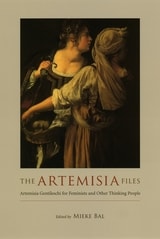
The Artemisia Files
Artemisia Gentileschi for Feminists and Other Thinking PeopleEdited by Mieke Bal
University of Chicago Press, 2005
In The Artemisia Files, Mieke Bal and her coauthors look squarely at this early icon of feminist art history and the question of her status as an artist. Considering the events that shaped her life and reputation—her relationship to her father and her role as the victim in a highly publicized rape case during which she was tortured into giving evidence—the authors make the case that Artemisia's importance is due to more than her role as a poster child in the feminist attack on traditional art history; here, Artemisia emerges more fully as a highly original artist whose work is greater than the sum of the events that have traditionally defined her.
The fresh, engaging discourse in The Artemisia Files will help to both renew the reputation of this artist on the merit of her work and establish her rightful place in the history of art.

The Matrixial Borderspace
Bracha Ettinger
University of Minnesota Press, 2006
Concerned with collective trauma and memory, Ettinger’s own experience as an Israeli living with the memory of the Holocaust is a deep source of inspiration for her paintings, several of which are reproduced in the book. The paintings, like the essays, replay the relation between the visible and invisible, the sayable and ineffable; the gaze, the subject, and the other.
Bracha Ettinger is a painter and a senior clinical psychologist. She is professor of psychoanalysis and aesthetics at the University of Leeds, England, and Bezalel Academy, Jerusalem.
Judith Butler is professor of rhetoric and comparative literature at the University of California, Berkeley. Griselda Pollock is professor of fine arts at the University of Leeds. Brian Massumi is professor of communication at the University of Montreal.
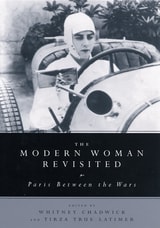
The Modern Woman Revisited
Paris Between the WarsChadwick, Whitney
Rutgers University Press, 2003
The contributions of female artists to the development of literary and artistic modernism in early twentieth century France remain poorly understood. It was during this period that a so-called “modern woman” began occupying urban spaces associated with the development of modern art and modernism’s struggles to define subjectivities and sexualities. Whereas most studies of modernism’s formal innovations and its encouragement of artistic autonomy neglect or omit necessary discussions of gender, race, class, and sexual orientation, the contributors of The Modern Woman Revisited inject these perspectives into the discussion.
Between the two World Wars, Paris served as the setting for unparalleled freedom for expatriate as well as native-born French women, who enjoyed unprecedented access to education and opportunities to participate in public artistic and intellectual life. Many of these women made lasting contributions in art and literature. Some of the artists discussed include Colette, Tamara de Lempicka, Sonia Delaunay, Djuna Barnes, Augusta Savage, and Lee Miller.
Inthis book, an internationally recognized roster of art historians, literary critics, and other scholars offers a nuanced portrait of what it meant to be a modern woman during this decisive period of modernism’s development. Individual essays explore the challenges faced by women in the early decades of the twentieth century, as well as the strategies these women deployed to create their art and to build meaningful lives and careers. The introduction underscores the importance of the contributors’ efforts to engender larger questions about modernity, sexuality, race, and class.
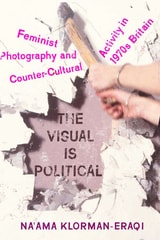
The Visual Is Political
Feminist Photography and Countercultural Activity in 1970s BritainNa'ama Klorman-Eraqi
Rutgers University Press, 2019
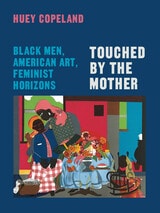
Touched by the Mother
Black Men, American Art, Feminist HorizonsHuey Copeland
University of Chicago Press, 2026
Collecting twenty years of incisive essays, articles, and interviews—including four published here for the first time—by art historian Huey Copeland, this book affirms the extraordinary depth of black men’s cultural production and the diversity of artistic practices that explore visual black masculinity in the United States. Part history, part memoir, part critical manifesto, Touched by the Mother offers a multi-faceted look at American art and discourse of the past fifty years, a personal meditation on navigating the world as a black gay man, and a feminist perspective on the ways transatlantic slavery continues to mark African and African diasporic men. Focusing on how the black maternal shapes black masculinity, Copeland confronts the dynamics that position African-American men—after their mothers—as sites of violence, creativity, and contestation in the cultural imagination.
Richly illustrated throughout, Touched by the Mother considers an exciting range of assemblage, painting, performance, photography, sculpture, and video works by more than twenty renowned practitioners, along with interviews featuring Hilton Als, Thelma Golden, Frank B. Wilderson, III, and other influential figures in contemporary art, culture, and criticism. Works by artists including Mark Bradford, Theaster Gates, David Hammons, Barkley L. Hendricks, Arthur Jafa, Glenn Ligon, Kerry James Marshall, Howardena Pindell, Sun Ra, and Lorna Simpson represent modes of making and thinking that are uniquely “touched by the mother,” Copeland argues, moving us toward the promise of black feminist futures.
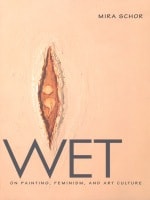
Wet
On Painting, Feminism, and Art CultureMira Schor
Duke University Press, 1997
Bridging the gap between art practice, artwork, and critical theory, Wet includes some of Schor’s most influential essays that have made a significant contribution to debates over essentialism. Articles range from discussions of contemporary women artists Ida Applebroog, Mary Kelly, and the Guerrilla Girls, to "Figure/Ground," an examination of utopian modernism’s fear of the "goo" of painting and femininity. From the provocative "Representations of the Penis," which suggests novel readings of familiar images of masculinity and introduces new ones, to "Appropriated Sexuality," a trenchant analysis of David Salle’s depiction of women, Wet is a fascinating and informative collection.
Complemented by over twenty illustrations, the essays in Wet reveal Schor’s remarkable ability to see and to make others see art in a radically new light.
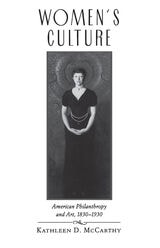
Women's Culture
American Philanthropy and Art, 1830-1930Kathleen D. McCarthy
University of Chicago Press, 1991